In July 2016, a flash flood tore through Ellicott City, Maryland, and devastated All Time Toys. Owner Jason Barnes had bought the business with his family’s savings the month before. Merchandise and premises could be replaced. The harder thing to reconstruct would have been the shop’s memory: inventory, suppliers, employees, customers and the history of what had sold.
His computer survived. According to Retail Pro’s account, local partner Complete Data Systems backed up the surviving database and restored it onto replacement hardware. The shop reopened in January 2017. Software had not stopped the flood. A recoverable record of the business made starting again less like starting from nothing.
- The product: POS software that also manages stock, promotions, purchasing and customer records.
- The advantage: configurable workflows, integrations and partners who understand local retail requirements.
- The question: can the people, systems and data behind your stores work together?

A store is a thousand little agreements
That is a useful way into Retail Pro International. The company makes retail management software for specialty stores, from independents to international chains. Its flagship platform, Prism, connects checkout with the less photogenic work of retail: receiving goods, moving stock, setting promotions, recording customer purchases and deciding what to replenish.
A sale creates obligations elsewhere. An item has left inventory. A promotion has changed its price. A customer may have earned a reward. An online listing may need updating. Retail Pro’s proposition is that these facts should travel together. The register becomes one entrance to a larger operational record.
Prism was unveiled at NRF in 2012 and reached general availability in September 2014. Its customizable interface and cross-platform approach let retailers adapt the working screen to the business. Mobile and desktop access support different store formats; configuration determines how the installation behaves.
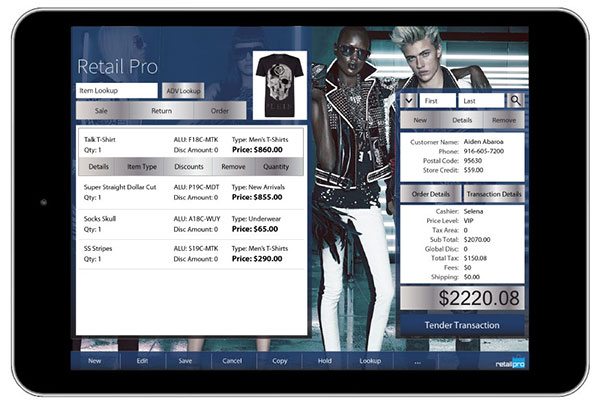
Consider a customer returning one item while buying another. Retail Pro’s subscription page lists sales, orders and returns in one transaction, alongside purchasing, receiving and transfers. It also advertises offline access to features. These are practical promises for a shop floor where an employee has a queue to serve and cannot postpone every awkward transaction until the back office is free.
The surrounding products extend that record. Retail Pro Planning combines forecasting, inventory planning and open-to-buy tools with consulting. Reporting, powered by Krunch, supplies dashboards, queries and alerts. SAP Link connects store activity with enterprise systems. The App Market offers partner integrations rather than requiring every specialized task to live inside the core application.
The hard part of global is local
International expansion makes the problem more interesting. A familiar brand can arrive in a new country and immediately encounter unfamiliar tax rules, receipt requirements, currencies and working languages. A translated button is only the beginning.
Retail Pro combines localization capabilities with certified business partners who implement and support the software locally. Aesop’s Troy Smith described the practical benefit of having someone to contact when the brand entered a new market. A reachable person with regional knowledge is part of the product’s usefulness.
“When we enter a new market, we have a Retail Pro partner we can call.”
Troy Smith, Aesop
That partner model also shapes the company’s stated culture: collaboration between retailers, developers and local specialists. It is a network built around differences between stores. For a buyer, the implication is concrete. Evaluate the partner’s work and support arrangements alongside the software demonstration.
The birthday card problem
At Alapage, a women’s boutique in New Hampshire, the difficulty was smaller and more familiar. Staff maintained denim and birthday loyalty records manually. Retail Pro’s case study describes work that consumed time, invited errors and took attention away from shoppers.
Partner J.D. Associates recommended connecting AppCard. Purchase records could update rewards, while cashiers could enroll customers and inspect past purchases at the POS. The change put loyalty into the transaction already happening, reducing the need for a separate administrative ritual.
The case study reports 2.5 items per transaction among reward members, compared with 1.49 among nonmembers. Those figures deserve a careful reading. Members may already have been more enthusiastic customers. The comparison illustrates different shopping behavior; it does not establish that installing software caused the difference.
A register becomes a route to market
In November 2023, Nayax completed its acquisition of Retail Pro. The announced enterprise value was $36.5 million, including roughly $20 million initially in cash and contingent consideration. The announcement specified a $2 million deferred-revenue reduction. This was acquisition consideration, rather than a venture funding round.
Nayax wanted a larger presence in attended retail and access to Retail Pro’s distribution network. Combining POS software with payments and loyalty created opportunities to sell more services through existing relationships. In January 2025, its “Retail Your Way” presentation emphasized flexible deployment, mobility and integrated customer tools.
For retailers, the economics start with the installation. Retail Pro advertises a subscription offer with updates and online learning. Its separate RIOT RFID offer starts at $100 a month; that is an RFID package, not an all-in Prism price. Buyers should obtain a scoped quote covering software, hardware, migration, integrations, training and support.
Retail Pro sits in the market for specialty retail POS and connected store operations, alongside alternatives such as Cegid, Oracle Retail and Teamwork Commerce. Its attraction is the room to adapt. That room also requires decisions. A straightforward shop with few integrations may gain little from extensive configuration; an international operator may consider it essential.
A useful trial should therefore include ordinary mistakes. Enter a discount incorrectly. Move an item between locations. Interrupt connectivity, then check what happens when it returns. Have a new employee find a customer’s previous purchase. These are suggested buyer tests, rather than claims about observed failures. They reveal whether the proposed configuration fits the work people actually perform.
The useful lesson is to begin with the handoff that hurts: stock that fails to reach the website, rewards kept separately, a return nobody can trace. Map it, connect it and test it with the staff doing the work. In the toy shop, the surviving database mattered because it remembered the business. Every ordinary trading day asks a quieter version of the same question.
Take it to the counter
Explore the platform, watch it work, or follow the company’s updates.