Changing a cash register sounds like a small job until the register belongs to a cannabis dispensary. Then the job includes purchase limits, product batches, loyalty balances, online orders, and employees who have customers waiting. Multiply that problem by 85 stores. Give it less than six weeks. That was the additional Curaleaf rollout Sweed reported in June 2026.
- Sweed connects dispensary sales, stock, online shopping, and marketing.
- Its bet is that shared records make useful automation possible.
- Its migration story suggests preparation matters as much as software.
The distinction matters: 85 stores were the new migration, bringing Curaleaf’s deployment to 165 stores across 14 states. Sweed says the transition preserved day-to-day operations. The interesting detail is what preceded it. Curaleaf had already worked with Sweed in two markets for more than a year. A rapid expansion had a long rehearsal.
The connection broke first
Co-founder Rocco Del Priore arrived at Sweed through an earlier cannabis eCommerce business, Cultivate. In a 2025 interview, he described difficulty connecting it to existing point-of-sale systems. Some lacked APIs, the interfaces that let programs exchange information. Cooperation between vendors was another obstacle. The online shop could only be as useful as its connections allowed.
That experience changed the scope of the problem. Building a better storefront would still leave the retailer negotiating the gaps between tools. Del Priore also expected larger operators to enter cannabis sooner than other software suppliers anticipated. Sweed’s response was to put point of sale, commerce, and marketing into a shared system built for multiple locations.
Consider the ordinary work this joins together. A customer buys in a store, earns points, later orders online, and receives a promotion. With separate records, staff must reconcile the journey. With a common record, the software can recognize the relationship. That is Sweed’s proposition, expressed through something more practical than the phrase “all-in-one.”

One customer, fewer arguments
Sweed sells business software to licensed cannabis retailers. Its tools cover checkout, inventory, branded websites and apps, delivery, loyalty, marketing, and business intelligence. Operators can manage catalogs and transfers, count stock with mobile devices, build reports, and segment customers by purchasing behavior. Metrc and BioTrack integrations connect retail workflows to state traceability systems.
customer history→Relevant
offer
The integration claim needs precision. Sweed builds the central retail modules together, but still connects to outside services. It advertises integrations with Leafly and Weedmaps, for example. The distinction is that the retailer’s core sales and customer functions share a foundation. It competes in the cannabis retail software market alongside Dutchie, Flowhub, Treez, and other specialist platforms. Those rivals also offer connected retail products. Buyers need to compare actual workflows, data access, and implementation support rather than assume that a shared feature name means the same experience.
A smaller example makes the argument tangible. Sweed’s Illinois inventory case describes employees exporting spreadsheets, printing lists, counting by hand, and typing results back in. Mobile scanning removed those handoffs. The company reports cycle counts falling from about 60 minutes to 15-20 minutes. Much of the gain came from giving people less clerical work.
The bill for remembering
Integration also has a price argument. In a November 2025 case study, Sweed described an anonymous five-store group that had switched in 2021. Its monthly marketing spend fell from $4,000 to $1,500 while adding connected loyalty, segmentation, and coordinated email and messaging campaigns. That is $2,500 a month, or $30,000 over twelve months at the same run rate.
Vendor-published example; not platform pricing.
This is a customer-specific marketing comparison. Sweed’s contracts put service fees in individual order forms. Buyers should compare the whole replacement bill, including equipment, implementation work, messaging, and any retained tools. An anonymous case gives a useful question to ask during a demo; it gives no assurance that another retailer will save the same amount.
The commercial model follows familiar enterprise software practice: a retailer buys services under a negotiated agreement, with support and ongoing operation included in the contractual framework. The work continues after installation, as staff learn the system and managers decide which reports and automations deserve attention.
There is evidence beyond chains. CloudHaven, a single-store Illinois dispensary, appears in a separate Sweed case reporting a 35% sales increase after consolidating its systems. That remains a vendor-published outcome, with several operational changes happening together. It illustrates the intended customer fit without establishing that the software alone caused the increase.
The screen gets a second job
In August 2025, Sweed introduced an AI-powered customer-facing display that lets shoppers and budtenders work on a cart together. Recommendations and relevant promotions appear during checkout. “Most platforms treat checkout as the finish line,” Del Priore said in the announcement. Sweed sees an opportunity to help shape the purchase while it is happening.
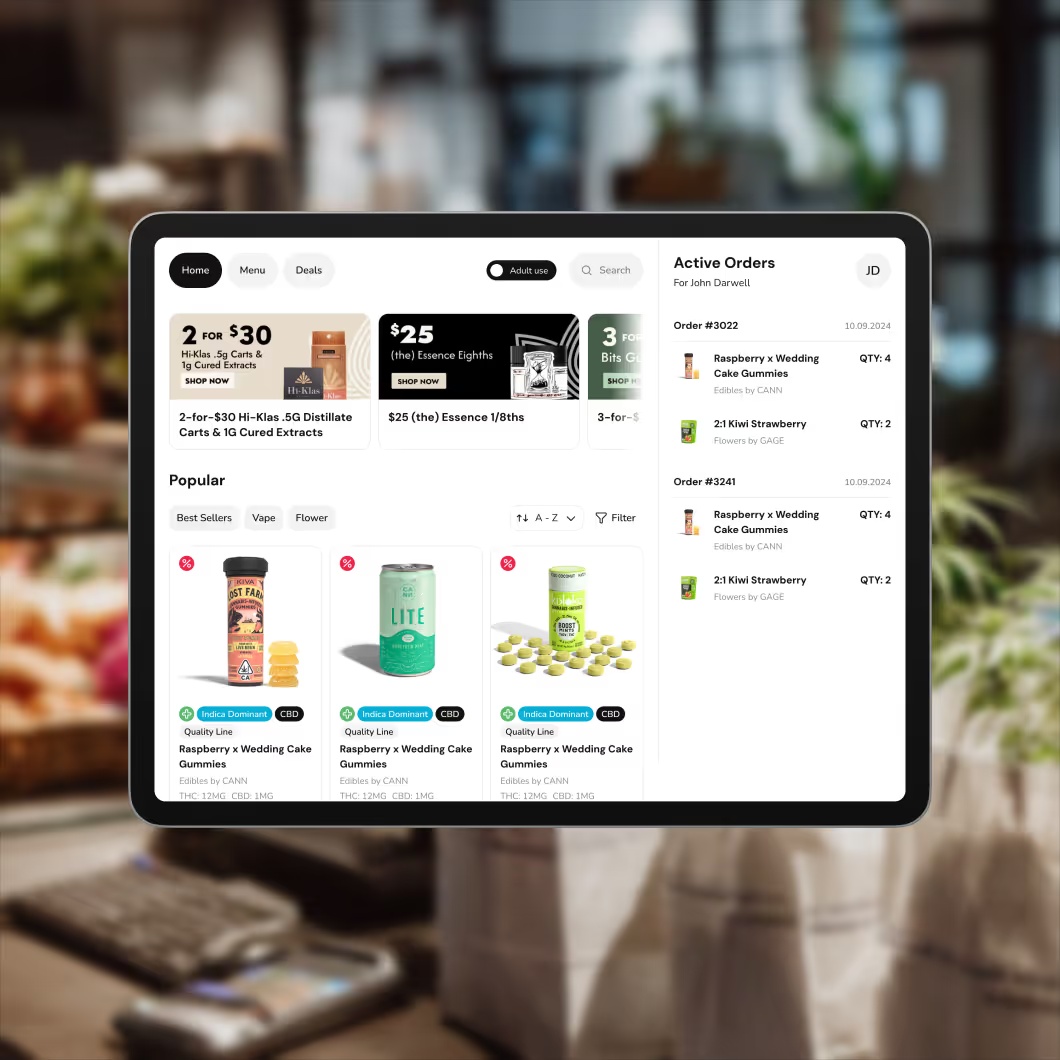
The company kept extending that shared foundation in 2026. August brought Smart Surveys for customer feedback and Google review invitations, followed by a public eCommerce API for custom storefronts. Retailers can build their own front end while retaining Sweed’s commerce backend. The API’s full headless UI and several embeddable components remain marked as coming soon.
Its corporate history needs a careful reading, too. Sweed merged with wholesale marketplace Leaf Trade in March 2023. When LeafLink acquired Leaf Trade in November 2024, the announcement explicitly said Sweed would remain independent. The wholesale relationship helps explain its place in the market, but does not make Sweed a LeafLink-owned retail product.
Borrow the rehearsal
“The template did most of the work”
Rocco Del Priore / on the Curaleaf migration
For a buyer, the lesson is to rehearse the work before scaling the change. Test a representative store. Have employees practice real transactions. Check that promotions, loyalty balances, and online orders survive the transition. Sweed’s migration account emphasizes training and timing; those are management responsibilities that a feature list cannot discharge.
The proposition fits retailers willing to bring several workflows together. A business deeply committed to specialist tools needs to test what consolidation would sacrifice. Poor records and an untrained team can still frustrate customers. Sweed’s useful wager is that fewer handoffs give a retailer more room to get the details right, from the stockroom to the next visit.