Crypto has an enviable talent for counting the wrong thing beautifully. Followers rise. Impressions swell. A community channel acquires the frantic pulse of a casino carpet. Then someone asks the vulgar little question that ruins lunch: did any of this produce a customer, a useful wallet, durable liquidity or a person who stayed?
Catie Romero-Finger has made that question central to her work. She is the founder and CEO of BABs, a New York-based, women-led agency working across Web3 strategy, growth, public relations and community. Her argument is not that storytelling has become obsolete. She has spent roughly two decades doing it. Her argument is that a story should eventually survive an encounter with evidence.
“Gone are the days of vanity metrics,” she said while describing the firm's direction in 2026. The line lands with the satisfying finality of someone closing a bar tab. BABs now talks about joining off-chain campaign data to on-chain behavior: who heard the message, which wallets acted, what kind of activity followed and whether the community being assembled has substance beyond its head count.
“Gone are the days of vanity metrics; it is all data to prove spend and growth impact.”Catie Romero-Finger
The funny part is that her route to this idea did not begin with tokens. It began with the older, less memeable business of explaining difficult systems to people who could not afford to misunderstand them.
Before the chain, there was water
Romero-Finger's early career moved through Chicago, Seville and London, across multicultural marketing, technology consulting, sustainability and water infrastructure. At Abengoa Water, she managed international marketing and communications in a world of desalination plants, public contracts and engineering language. One of her projects involved communications around the Accra desalination plant in Ghana. Another put her in the public conversation around the Vista Ridge water pipeline in Texas.
Infrastructure teaches a useful severity. A campaign may shape public understanding, but the thing being described must still carry water. Her professional record from that period includes global launches, government outreach, corporate films, major events and communications for high-value projects. A former colleague remembered her handling a department budget, multiple campaigns, event work and a team of four or five at once. It is an operator's portrait: many moving pieces, very little romance about the moving.
The translation stayed; the technology changed
She studied Spanish and philosophy at Mount Mary University, later earning an MBA at IE Business School in Madrid. The pairing looks almost suspiciously tailored to her eventual work: language, argument, markets. She works in English and Spanish and has described Spain as her adopted home of almost twenty years. Moving among countries has given her a recurring problem to solve. What travels? What needs translation? Which assumption looks universal only because everyone in the room shares it?
In 2019, she began helping a project that used blockchain technology to improve node speed. She read her way deeper into the subject and found more work helping projects with messaging and public relations. In 2021, an APAC-focused crypto agency asked her to help lead its expansion into Western markets. The setting was new. The old skill, making technical ideas legible across borders, fit neatly.
An NFT idea grows up
Romero-Finger worked closely with operations leader Nastya Adamova. The two decided to build something of their own. BABs was first imagined as an NFT project. Then the market kept sprouting new categories: wallets, exchanges, real-world assets, gaming, venture funds, artificial intelligence projects and other creatures that arrived before the vocabulary around them had settled. The project became a full-service agency.
This is a useful founding story because it contains no ceremonial lightning bolt. It is a story of scope changing under competent people. Romero-Finger describes her role with similar plainness: she is the face of the company, develops strategic client relationships, manages trouble with clients or partners and keeps people clear on what BABs is. “Essentially, I keep the engine running,” she said, “both internally and externally.” A founder's day, translated from the heroic into the mechanical.
The firm's development has followed the same practical instinct. It began with the familiar Web3 agency repertoire of brand, community and campaigns. It has since moved toward data tools and engines that attempt to connect engagement with token activity and other on-chain signals. Romero-Finger wants BABs' proprietary performance product to become a standard used by creators and agencies. That is an ambitious destination, but the underlying grievance is ordinary enough: clients should know what their money did.
Crypto marketing is particularly vulnerable to decorative success. A creator can have a large audience whose wallets never move. A busy channel can conceal mercenary participation. A launch can spike, then evaporate. Matching on-chain and off-chain signals does not eliminate judgment, but it gives judgment more furniture. Attention becomes the start of the inquiry rather than its flattering conclusion.
Change who gets the microphone
Measurement is only half of Romero-Finger's public thesis. The other half concerns access. Her Medium biography begins, “I refuse to be the only woman in the room.” It is not coy. Elsewhere, she has argued that technology needs more than symbolic diversity because the people building and funding systems determine which lives, markets and problems those systems can see.
In 2022, she and her colleagues noticed that only about 30 percent of the announced speakers at NFT.NYC were women. With roughly three weeks remaining, they put together a full-day event called websh3 and brought Consensys in as a partner. The sharpest choice was about content. They did not want a day in which women were invited mainly to discuss being women in Web3. The speakers would talk about what they did well: building, creating, strategy, capital.
It is a small but important editorial distinction. Representation can become another vanity metric if the invited person is used as proof of virtue rather than treated as an authority. Romero-Finger's answer was to change the composition of the stage and then let expertise supply the subject.
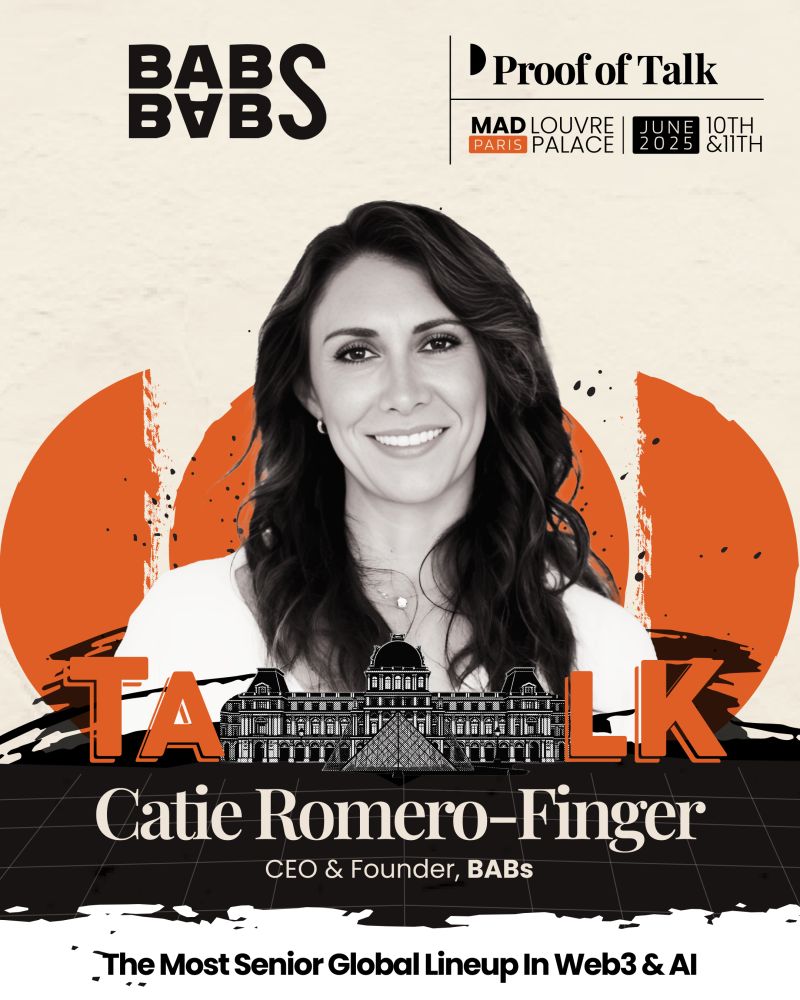
websh3 continued with events and partnerships, including a sold-out Brooklyn gathering during NFT.NYC in 2023. The agenda covered fundraising in a bear market, intellectual-property rights and creativity. Romero-Finger also appeared on the NFT.NYC Brands Track and, in 2025, on the Proof of Talk lineup in Paris. Her network now crosses agency operators, founders, investors, event organizers and technology communities. She has also been listed as a mentor with Outlier Ventures and an advisor to Cheeze.
“If my first fifteen years in the field were defined by innovation, I want my next fifteen years to focus on impact.”Catie Romero-Finger
The word “impact” is notoriously happy to attend a meeting without bringing identification. Romero-Finger gives it two tests. Who gained access? What happened after the message traveled? The first makes the room broader. The second makes the work answerable.
The better scoreboard
Her recent public commentary shows where this logic leads. When she writes about tokenized assets, stablecoins or blockchain networks, she repeatedly returns to distribution, active users, fees, liquidity and what people can actually do with the product. Technical capacity is interesting; use is decisive. Issuance alone does not make a market. Speed alone does not make adoption. A token launch with separate teams working on incentives, legal structure and growth can look polished piece by piece and still come apart at listing.
This is the worldview of a communications professional who has become suspicious of communication without consequence. It is also the worldview of someone who has watched successive technology industries invent a fresh dialect for an old human temptation: mistaking visible activity for progress.
BABs itself remains a private company, and the sweeping claims common to agency case studies deserve the same scrutiny Romero-Finger wants applied to marketing. The compelling part of her position is not any single metric or tool. It is the demand for a chain of reasoning that a client can inspect. Here was the audience. Here was the action. Here was the business result. Here are the limits of what we know.
There is a pleasing continuity to the career. Water systems, global consulting and blockchains have little in common at first glance. Look again and each is a complicated network that most people encounter through consequences rather than schematics. Romero-Finger's work has been to stand between the system and its public, find language that travels, and then ask whether understanding produced movement.
Crypto will continue counting everything it can. Some numbers will glow beautifully on dashboards. Romero-Finger's wager is that the useful number lives one question later: yes, they looked, but what did they do?
Continue exploring