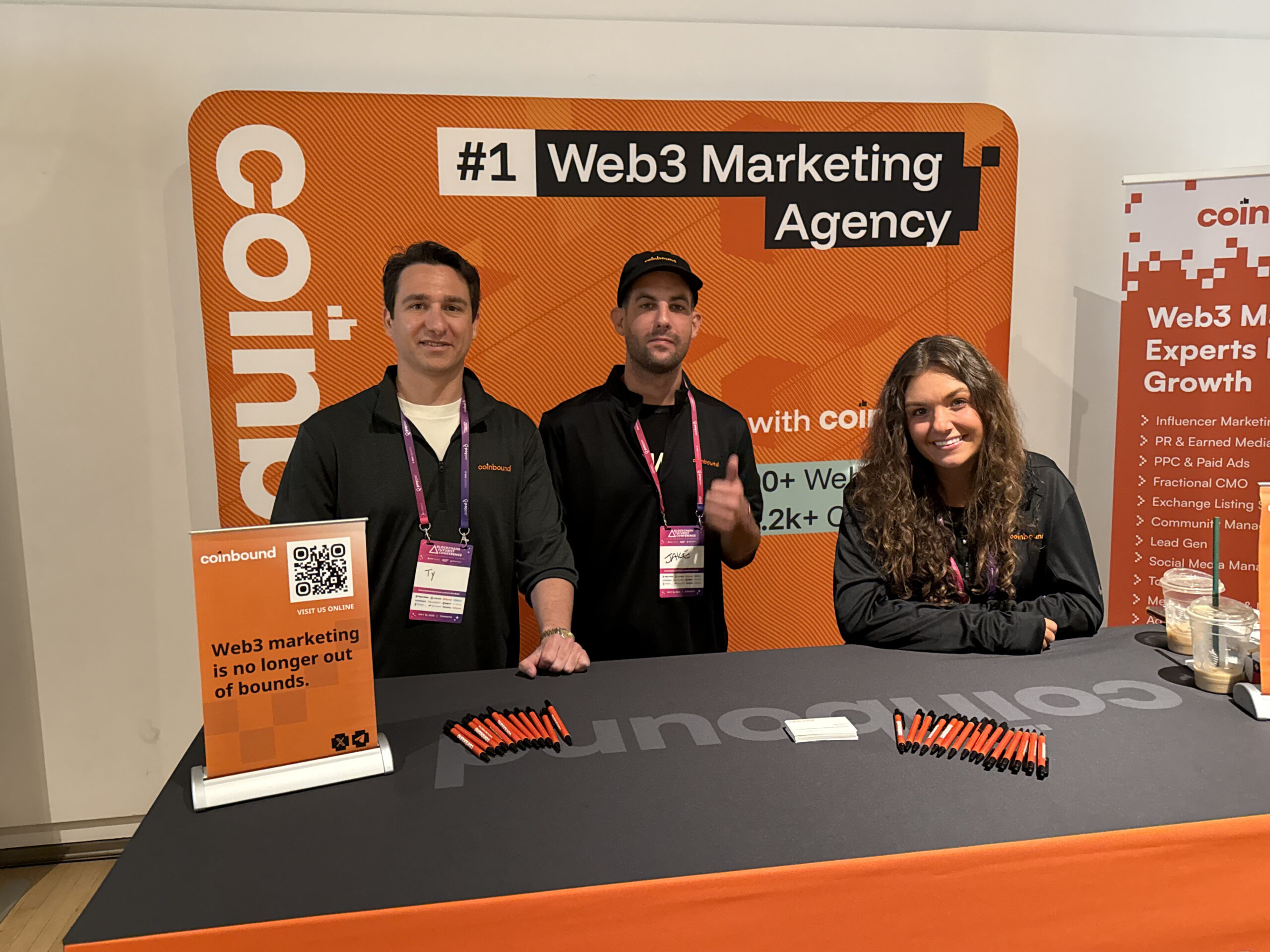
At a crypto conference, the Coinbound booth looks like a cheerful dare. Three staffers stand behind a table covered in orange pens. The wall announces “#1 Web3 Marketing Agency.” A smaller sign says that Web3 marketing is no longer out of bounds. The setting is almost too perfect: in an industry built from invisible ledgers and pseudonymous wallets, credibility still has to put on a lanyard and stand next to the coffee.
This is Coinbound’s business. The agency helps crypto companies become legible, discussable and, ideally, trusted. It hires creators, pitches reporters, runs X accounts and Discord servers, buys ads, shapes brands, advises founders and helps tokens approach exchanges. Its clients have included MetaMask, eToro, Nexo, Sui, Gala, Immutable, Cosmos, Tron and Litecoin. The company says more than 900 Web3 teams have hired it across more than 1,400 campaigns.
The category nobody knew how to sell
Ty Smith’s founding observation was simple. He had entered crypto in 2017 and watched technically ambitious teams struggle to explain what they had built. Conventional agencies arrived with conventional playbooks and, in his telling, missed the culture entirely. So in 2018 he created an agency that would live inside the category rather than visit it.

That distinction matters more than it sounds. A supermarket campaign can buy broad reach and wait for shoppers. A DeFi protocol must find people who understand wallets, tolerate volatility, care about a particular chain and can distinguish a product from a scam. The addressable audience is smaller, more skeptical and unusually good at talking back in public.
“They all created some incredible tech, platforms, and currencies, but they all had one thing in common. They had no idea how to market themselves.”Ty Smith, founder and CEO
Coinbound’s answer is specialization. Its remote-first team works across influencer marketing, public relations, community, social, paid acquisition, content, branding and fractional marketing leadership. The agency is not selling one clever ad. It is selling coordination among people who already know where crypto attention gathers and how quickly it moves.
A 500-person shortcut
The most defensible part of the operation may be its roster of more than 500 crypto creators across X, YouTube, TikTok and podcasts. A general agency can discover those names. Coinbound claims something harder to reproduce: a performance history. It checks audience authenticity, topical fit, engagement and posting behavior, then tracks each creator so weak performers can be replaced.
This is borrowed attention, but it is also borrowed judgment. A creator is useful because followers have already decided to listen. A publication is useful because readers have already decided it belongs in the information diet. A Discord moderator is useful because trust is often created one reply at a time. Coinbound packages those pre-existing relationships and sells the package to companies that cannot wait years to build their own.
The unusually useful $4,100
Agency portfolios prefer enormous numbers. One of Coinbound’s more revealing figures is modest: $4,100. That was the stated crypto-network ad spend in a three-week campaign for BMIC, a quantum-resistant blockchain project. Coinbound paired the ads with five paid-media placements and nine creator actions. Its case study attributes $192,000 in presale volume to the program, spread across 74 participating wallets.
The cost is useful because it makes the machinery inspectable. The ads supplied consistent high-intent traffic. Media coverage made an unfamiliar technical claim easier to digest. Creators produced bursts of conversion. No single channel carried the campaign. The company’s public pricing is less exact: proposals are custom, while Clutch lists a $10,000 minimum engagement and a $150 to $199 hourly range. Media budgets can sit on top of agency fees.
Another campaign shows what happens earlier in the funnel. Before POPOLOGY’s product was live, Coinbound ran four Zealy community sprints, founder-led media and eight creator activations. The program produced 1,157 waitlist signups, 3,040 Zealy participants, 553 pieces of user-generated content, 5,420 net new X followers and 2,456 net Discord members.
Coinbound explicitly says those POPOLOGY results measure pre-launch attention and participation, not active product use. A crowded waiting room is evidence of a crowded waiting room. The product still has to open the door.
After the click, a wallet
That gap between attention and behavior explains Coinbound’s more interesting second act. Its press-release product, Coinscribble, became Mintfunnel in 2025 and expanded into native advertising. In 2026, Mintfunnel added Web3 Analytics, designed to connect traffic sources with sessions, wallet connections, mints, swaps and purchases. Later came an interface that lets AI clients prepare campaign and PR orders with previews and spending caps.
For an agency, measurement software is more than a side product. It answers the uncomfortable client question: what did all that attention do? Google Analytics can report a visit, but crypto teams care about the wallet at the end of it. If Mintfunnel can reliably join those events, Coinbound moves from being a seller of activity to a recorder of outcomes.
Four winters and a smaller guest list
The first crypto bear market frightened Smith. Inbound inquiries dried up, and he wondered whether he had built a company or merely caught a wave. Coinbound now says it has survived four bear markets. The lesson Smith draws is not that retainers are safe. In a recent podcast episode he argues the opposite: agency retainers are less stable than they look, and the best clients tend to arrive through reputation rather than cold outreach.
The company’s response is selectivity. Smith says Coinbound declines more than 95 percent of inbound prospects when it lacks the right team, connections or strategy. Turning down revenue is a curious boast, but the logic is sound in a small industry. A disappointing campaign travels through the same network as a successful one.
Internally, Coinbound describes a remote, asynchronous and people-first culture organized around measurable goals, client outcomes, learning and candid relationships. Those values suit a market that runs continuously but cycles violently. They are also a reminder that expertise here is perishable. Yesterday’s dominant chain, platform or creator can become tomorrow’s abandoned tab.
The bit worth stealing
Most readers cannot copy Coinbound’s creator list or media relationships. They can copy the sequence. Pick one meaningful action before the campaign begins. Make the story easy for another person to carry. Create participation before purchasing scale. Coordinate creators, community and paid media around the same claim. Instrument conversion before the traffic arrives. Report the difference between attention and adoption.
The method is less convincing when the product cannot retain the users it attracts, when legal restrictions narrow what can be promised, or when the audience does not gather in crypto-native channels. It also asks for enough budget and organizational patience to coordinate several channels. A $10,000-plus agency engagement is not a sensible experiment for every early project, and a creator can lend attention without lending credibility.
Coinbound occupies a specific place in the market: more integrated than a PR boutique, more culturally specialized than a general performance shop, and more service-heavy than an ad platform. Rivals such as MarketAcross, Lunar Strategy, NinjaPromo, Blockwiz, FINPR and Outset PR compete for pieces of the same budget. Coinbound’s wager is that the whole stack works better together - and that, after years of selling borrowed attention, owning the measurement layer makes the borrowing easier to defend.