Caralynn Nowinski Collens likes a goal that requires some preparation. In a July 2021 interview, she recalled summiting Kilimanjaro with her husband the previous summer. Next on their itinerary was Mount Baker in Washington. A tough hike or a long run, she said, offered the satisfaction of working toward something substantial. Her leisure calendar evidently has a rather elastic definition of leisure.
The mountains are an appealing place to begin her story, though the summit photograph would leave out much of what matters. There is the training, the arrangement of the trip, the person beside you, the decision about what to carry. Her career has involved a similar attention to everything that makes an ambitious undertaking possible. She builds the organization around the idea.
Today she is co-founder and CEO of Chicago-based Dimension Bio. Earlier chapters took her through university research, her own startup, venture capital, investment banking and a manufacturing collaborative. The sequence can look restless on a résumé. Look at the work itself, and a recurring question emerges: how do people with different kinds of expertise get something difficult done together?
Her answer has become increasingly practical. Gather the people who understand different pieces of the problem. Give their work a direction. Make choices when time and money run short. Accept that leadership involves asking questions whose answers belong to someone else. It is an approach with room for ambition and very little room for the fantasy of the all-knowing founder.
A business course changes the route
Collens graduated from Northwestern University in 1999. She studied communication sciences and went on to earn an MD and MBA at the University of Illinois Chicago. During that period, she took a year to pursue the business degree. A course on commercializing technology caught her attention. She began her first company while still a student.
That company, SanoGene Therapeutics, came out of the University of Illinois. She helped lead its spinout and secure a strategic equity investment. The experience put a different kind of problem in front of her: an invention needed an organization, money and a way into the world beyond the university. Her education was acquiring an extracurricular curriculum in company building.
After graduation she chose venture capital. She worked as a principal at ARCH Development Partners and Midwest Venture Partners, and later as a senior vice president at Sikich Investment Banking. Much of her early work involved technology companies emerging from universities. She could see those ventures from both sides of the funding conversation, as someone who had built a company and someone evaluating companies.
University research and corporate finance appear in separate boxes on a biography. In practice, moving between them requires an interest in translation. A researcher may have spent years refining a question. An investor needs to understand what can follow from the answer. Collens made that territory between invention and organization a recurring workplace. The next move brought her back to the university, this time as an administrator.
Seventy organizations, one shared problem
As associate vice president for innovation and economic development at the University of Illinois, she worked on relationships beyond the campus: commercialization, talent development and economic impact. UI LABS extended that work into a larger collaboration among industry, academia and government. She helped build it from an idea in late 2011 through its 2014 launch, eventually serving as CEO until 2019.
In February 2014, UI LABS received a five-year, $70 million Pentagon grant to establish the Digital Manufacturing and Design Innovation Institute. A Northwestern account that winter described a consortium of 70 organizations, companies and universities. Digital tools would help manufacturers tackle costs, inefficiencies and the coordination of supply chains. The organizational challenge was substantial before anyone switched on a machine.
A consortium asks people to cooperate across institutions that have their own priorities, vocabulary and reporting lines. The attraction is access to knowledge and capabilities beyond a single institution. The difficulty is arranging useful work around all those separate interests. For Collens, that arrangement became the assignment. Chicago’s Goose Island provided a physical home for the collaboration.
The 2015 annual report described a team that had doubled, equipment installed and projects moving toward results. The new facility gave partners somewhere to work together. In a photograph from that year’s New York Times Cities for Tomorrow conference, Collens shared a panel with Chicago deputy mayor Steve Koch and Microsoft executive Dan’l Lewin. Her work had expanded from individual ventures to the machinery of civic and industrial cooperation.
The factory needs people, too
The work at UI LABS could be refreshingly concrete. Its 2016 report described augmented reality used to translate work instructions, software intended to simplify work with advanced composite materials, and efforts to reduce the waste and time involved in setting up machining processes. These were questions about how a working day changes when new tools arrive.
It is easy to discuss digital manufacturing as a procession of equipment. Collens also addressed the people expected to use it. In 2017, UI LABS and ManpowerGroup released a workforce analysis identifying 165 data-centric jobs associated with the future of American manufacturing. The report mapped educational requirements across a range of roles. A factory could become more connected while its workforce needed new routes into the work.
She carried the collaboration argument beyond manufacturing. Her November 2017 TEDxChicago talk, “How to see what’s below our feet and save millions,” addressed technology and the operation of cities. Even the title redirected attention toward the infrastructure under ordinary life. Factories and cities both gave her a setting in which expertise was distributed across many organizations.
By 2017, the UI LABS manufacturing floor had been overhauled, new staff had arrived and the organization was working to bring resident input into smart-city projects. The mix is revealing: equipment, people, participation. Each belongs to the same effort to make technology useful. The project needed a place to be tested and people willing to learn from what happened there.
- 1999Northwestern graduate
- 2011-14UI LABS takes shape
- 2019Joins Dimension as CEO
- 2025Dimension Bio name introduced
A founder who makes room for other founders
Collens joined Dimension Inx as CEO in late 2019. The company’s platform had been invented by Ramille Shah and Adam Jakus. Her manufacturing work had helped bring her into their orbit; the next chapter gave her an opportunity to apply that experience inside a company. She arrived to lead an existing technical effort, a distinction that helps explain the partnership.
Shah described choosing a partner who could build teams, negotiate agreements and establish partnerships. She recognized the limits of what she could do alone. Collens likewise argued that academic achievement and running a company involve different demands. Recognizing the gaps in one’s abilities is part of finding the right people. Their account of the partnership gives both expertise and humility a job.
“I love making sense of the chaos,” Collens said in 2022. The pleasure, for her, lay in the creativity and strategy of bringing different perspectives together. A startup still requires discipline: there may be fewer people and less money than the plan demands. Someone must decide which work can proceed and which must wait. Her description of leadership includes the enjoyment and the constraint.
Around the same period, she and her husband described coordinating their household as two CEOs raising a son. They set rules around travel and made weekends time with him. There is something fitting about a builder of collaborations being explicit about the arrangements at home. Even a shared calendar can expose the gap between an appealing intention and a workable plan.
“I love making sense of the chaos.”Caralynn Nowinski Collens, 2022
The question behind the next decision
Dimension raised a $12 million Series A in February 2023, led by Prime Movers Lab. That spring, Collens discussed a new Chicago facility with more room for research, production and the growing team. She had initially expected full production to go to a contract manufacturer. The company instead developed capabilities internally, discovering additional intellectual property and ways to retain economic value.
The choice brought manufacturing closer to the business she was building. It also supplied another example of a plan changing once conditions changed. A company’s production arrangement affects what it can learn, what it controls and how it spends. Collens’s years around advanced manufacturing had become part of the decisions she was making as an executive.
In May 2025, Dimension Inx introduced the Dimension Bio name. The company continues to list Collens as co-founder and CEO, Shah as co-founder and chief scientific officer, and Jakus as a co-founder. The current leadership roster also includes executives responsible for manufacturing and quality operations and corporate development. The division of work is visible in the titles.
Her advice to founders emphasizes choosing a team, setting direction and knowing which questions to ask. She warns about the pull of urgent tasks and the need to look across the organization. An executive can always find something immediate to do. Leaving enough attention for decisions that shape the next year takes a different kind of discipline.
The mountains remain on the itinerary
Outside work, Collens has described hiking, skiing, climbing and camping with her husband Steven and their son Asher. Mountains appear regularly in her account of family time. “It’s very hard for me to sit still,” she said in 2023. One suspects a reclining chair would have to make a persuasive case for itself.
There are quieter influences, too. She has spoken about being moved by accounts of perseverance, including Jonathan Kozol’s book Fire in the Ashes. She admires people who live with purpose and continue through difficult circumstances. That interest adds texture to a career otherwise told through titles, institutions and financing rounds. The people who keep going hold her attention.
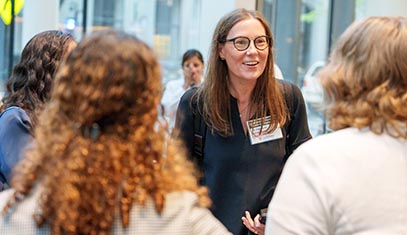
In April 2025, she was photographed talking with attendees at the launch of Northwestern’s Querrey Simpson Institute for Regenerative Engineering. The picture offers a modest, useful view of her working world: a conversation, several people gathered, the university and commercial spheres in the same space. It fits a career spent moving between those spheres.
Her route has required repeated changes of setting, from a classroom to an investment firm, from a university office to a manufacturing floor, from a consortium to a startup. The connecting work has been assembling people and resources around a problem. Somewhere beyond those rooms, there is also the next family outing to arrange. A substantial goal, in her telling, begins well before the climb.