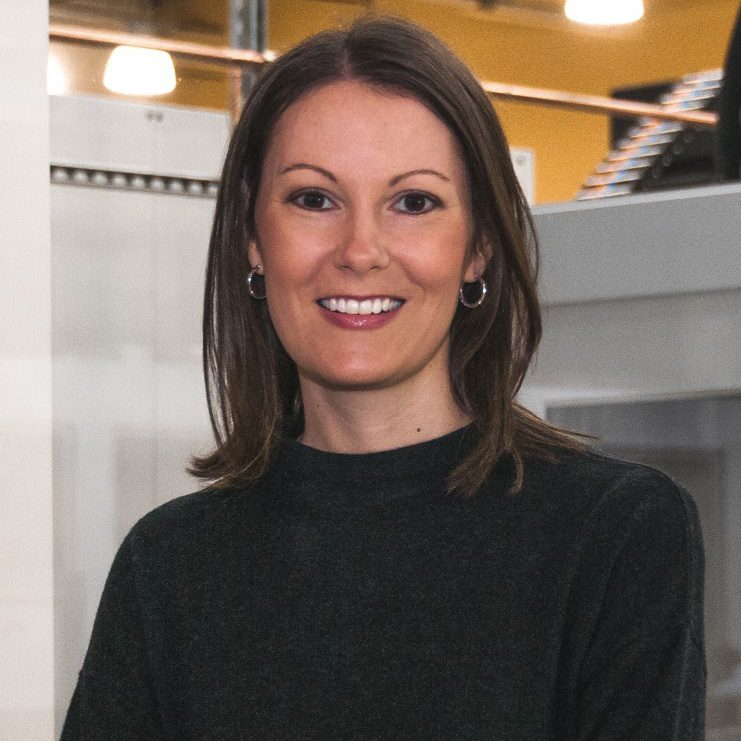
She built the country's hub for smart factories. Then she pointed all that machinery at the one thing it had never touched - the inside of a human body.
Most biotech promises a molecule. Caralynn Nowinski Collens is offering something stranger - a place for cells to live. Her company, Dimension Bio, prints three-dimensional microenvironments out of engineered materials, then lets the body do what it has always known how to do. The tagline is a quiet manifesto: because cells alone are not enough.
Cells, delivered into a wound or a failing organ, tend to wander off and die. They need scaffolding, blood supply, architecture, a signal that says stay here and build. Dimension Bio's BioNidum platform fuses materials science, 3D-printing, and digital manufacturing to give them exactly that - an implantable, tissue-like therapy that promotes vascularization, cell infiltration, and integration. The goal is not to replace biology. It is to hand biology a set of instructions and get out of the way.
That framing - engineering as a service to biology, not a substitute for it - is the through-line of a career that has refused to sit still. Collens trained as a physician. She never really practiced. Instead she has spent two decades building organizations that turn hard science into things people can actually use, and the body was simply the last frontier she circled back to.
The tidy version of a medical career - residency, attending, clinic - never happened. During her joint M.D./M.B.A. at the University of Illinois at Chicago, Collens co-founded a startup chasing gene therapy for brain cancer. She stepped away from residency to do it. She calls the decision transformative, and reports no regrets.
What followed reads like a scavenger hunt across the machinery of innovation: neuropsychiatric research, seed-stage venture investing, M&A advisory at firms including ARCH Development Partners, Midwest Venture Partners, and Sikich. The common thread was never a single field. It was the act of moving an idea from a lab bench to something real.
Her test for strategy: not whether a deal pays, but whether it moves you closer to the result you actually need. Everything else is a distraction wearing a nice suit.
In late 2011 Collens co-founded UI LABS as little more than a concept. By 2014 it had launched - and with it, MxD, the U.S. national hub for digital manufacturing, formerly known as DMDII.
As CEO she grew a network of more than 350 partner organizations, deployed $100 million across 75-plus solution-development projects, and stood up the City Tech Collaborative alongside it. In 2019 she spun both MxD and City Tech out as independent entities. It was, on paper, a full career. She treated it as research.
Because here is what those eight years taught her: advanced manufacturing had quietly transformed nearly every industrial sector, and medicine had barely noticed. She started calling biofabrication "the next frontier in manufacturing medical treatments." Then she went to go build it.
Independent control over material composition, architecture, and microstructure. In plain terms: they can tune the recipe, the shape, and the texture separately, then print a scaffold that invites the body in rather than fighting it off.
Pipeline reaches from sports medicine, orthopedics, and reconstructive surgery to cell delivery for liver failure and Type 1 diabetes. The first product out the door: CMFlex, an FDA-cleared 3D-printed regenerative bone graft.
Co-founds a gene-therapy startup for brain cancer while an M.D./MBA student at UIC. Leaves residency to chase it.
Venture capital, corporate finance, and M&A - all pointed at university spin-outs and getting science to market.
Co-founds UI LABS from concept, launches it, and stands up MxD - the U.S. digital manufacturing hub.
As CEO, builds a 350+ partner network and deploys $100M across 75+ projects. Spins out MxD and City Tech in 2019.
Joins Dimension Inx as CEO - after months aligning on vision with co-founders Ramille Shah and Adam Jakus.
Leads a $12M Series A. FDA clears CMFlex. Named Female Founder of the Year and Dealmaker of the Year.
Featured on the Prime Movers Lab Podcast as the company rebrands around its BioNidum platform: Dimension Bio.
A board member made the introduction long before there was anything to introduce her to - flagging Ramille Shah as a rising star in 3D-printing and tissue engineering. When Shah and Adam Jakus later spun Dimension Inx out of Northwestern University, Collens didn't parachute in. She spent months aligning on vision before agreeing to run it.
It fits the pattern. This is a founder who treats the word "yes" as expensive - to a deal, to a distraction, to a partnership. The saying-no muscle she built in finance became the saying-yes-carefully instinct that decides which company is worth a decade of her life.
Caralynn Nowinski Collens - CEO, the builder. Ramille Shah, Ph.D. - CSO, the materials scientist. Adam Jakus, Ph.D. - the technologist who helped invent the printing chemistry at Northwestern.
"Transparency and trust are must-haves."
"You know you have a focused strategy when you say no to money."
"Biofabrication is the next frontier in manufacturing medical treatments."
Ask her what biofabrication is for and she doesn't reach for a market-size slide. She reaches for a face reconstructed after a gunshot wound, and for the chance to offer fertility to a child who survived cancer. The engineering is only ever in service of that.
She summited Mount Kilimanjaro with her husband, Steven - and plans more mountains. The appetite for a hard climb is not a metaphor she chose; it's just how she's wired.
Hiking, skiing, climbing, camping. Home is Chicago, with Steven and their son, Asher.
Two degrees, one program: an M.D. and an M.B.A. earned jointly at UIC - the physician and the dealmaker built at the same desk.
She chairs the board of Imerman Angels, a one-on-one cancer support organization, and has served as an independent director at Fathom Digital Manufacturing.
The honors list runs long: Crain's Forty Under Forty, Tech 50, Notable Women in STEM, and SME's 30 Leaders Transforming Manufacturing.
Her north-star phrasing for a CEO's job - leading, not merely running - is the sentence she keeps returning to, in interview after interview.
There is no shortage of organs and tissues in the abstract. There is a brutal shortage of them where and when a specific person needs one. Dimension Bio's wager is that the answer isn't only more donors or better drugs. It's manufacturing - the same discipline that made cars, phones, and jet engines reliable - finally applied to the business of regrowing us.
Collens has spent a career refusing to specialize in a field and specializing instead in a verb: to build. First companies, then a national institute, now a body's own repair kit. The through-line was never the industry. It was the conviction that hard problems are worth a decade, and that you get further by saying no to almost everything else.