A good idea can travel light. A laboratory cannot. That small inconvenience runs through John Flavin’s career, from building companies in Chicago to building the arrangements that help someone else begin. There are investors to find, people to recruit, rooms to equip. The discovery may be elegant. The shopping list rarely is.
Flavin founded Portal Innovations in 2020 with a practical proposition: put early capital, equipped workspace, and experienced company builders within reach of scientific entrepreneurs. He had already spent years on different sides of the same problem. He had been an operator inside companies, a convener of mentors, and a leader inside a university. Each job brought him closer to the question of what happens after somebody decides an idea ought to become a business.
His story is especially concerned with the location of that business. Chicago had research institutions and ambitious people. Flavin wanted the next stage of their work to be possible nearby. A city could help produce an idea, then watch the company built around it depart. He began making a career out of assembling reasons to stay.
The expense of starting from scratch
In the early 1990s, Flavin helped build MediChem Life Sciences in Chicago. Years later, writing with his brother Patrick, he recalled the range of jobs that came with starting: constructing laboratories, raising money, and recruiting scientists and professionals. The environment around them offered little of the ready-made support that founders might hope to find.
It is a useful beginning for a career often described through organizations and financing. Before he could help other people find infrastructure, he had experienced the task of supplying it himself. A founder’s time had to stretch across the company and the conditions required to run it. The idea needed attention. So did the premises.
His early roles were grounded in finance and operations. He served as MediChem’s chief operating officer and was a co-founder, president, and chief financial officer of Advanced Life Sciences. By 2013, his career included two Nasdaq initial public offerings. Those jobs placed him among the people who turn a technical ambition into budgets, teams, and an organization that can answer questions from investors.
That experience matters to the shape of his later work. His approach to entrepreneurship is unusually attentive to the parts that must be arranged around a founder. The useful question becomes quite concrete: what could this person accomplish if fewer hours went into finding a room, a piece of equipment, or somebody who knew the next step?
First, find the people
Before Portal had a laboratory model, Flavin had a mentor network to build. He led Chicago Innovation Mentors from its early launch in October 2011 until September 2013. The consortium connected entrepreneurs emerging from Illinois universities and research institutions with experienced corporate mentors.
By the time he left, it had grown to more than 180 mentors and 66 ventures. The numbers describe a particular kind of work: bringing people with experience into contact with people trying to do something unfamiliar. A network is easy to draw on a slide. Getting busy executives and entrepreneurs into it takes considerably more effort.
At the University of Chicago, technology-development director Alan Thomas credited Flavin with personally recruiting most of the entrepreneurial and executive talent in that mentor corps. This is one of the more revealing details in his career. The connections were assembled through individual effort. The resulting organization gave founders access to knowledge that no single adviser could be expected to possess.
His work also included co-founding MATTER in Chicago. Across these efforts, the recurring task was to create a setting where people could find help beyond their own immediate circle. Experience inside a company was becoming a resource that could be shared among companies.
A network he helped expand between 2011 and 2013.
A university opens its doors
In September 2013, Flavin moved to the University of Chicago to lead the newly formed Chicago Innovation Exchange. The assignment brought company-building experience into an institution with researchers, students, national laboratory connections, and a surrounding community of potential entrepreneurs.
The Exchange opened in October 2014. Its work sat alongside existing university entrepreneurship and technology-commercialization programs. For Flavin, the setting widened the circle of people whose ideas might need a business around them. It also made coordination a substantial part of the job.
In 2016, a $50 million total commitment from Michael Polsky supported an expanded, unified Polsky Center for Entrepreneurship and Innovation. The arrangement brought the Chicago Innovation Exchange and UChicagoTech’s activities under the same umbrella as established entrepreneurship programs. Flavin was chosen to lead it.
The distinction matters. He was helping join and expand work already underway, with colleagues who had built its different parts. The ambition was to make the route through those parts easier for faculty, students, alumni, and community entrepreneurs. A university can contain a great deal of help while still asking a newcomer to discover where it lives.
That chapter connects directly to Portal. Education, commercialization, incubation, and capital were being considered together. Flavin’s career had moved from running individual companies to organizing the support through which more companies could emerge. The unit of attention had become larger, though it still began with a person trying to start.
A cheque needs somewhere to land
Flavin returned to a company finance role as Endotronix’s chief financial officer between April 2018 and February 2020. In March 2020, he announced Portal Innovations. Its launch paired a venture-development platform with a partnership with real estate developer Trammell Crow Company to create wet and dry laboratory space at Fulton Labs in Chicago’s Fulton Market.
The proposition joined several kinds of work that a young company might otherwise have to organize separately. Portal would provide investment, management expertise, help assembling teams, and startup resources alongside specialized space. Capital would arrive in a setting where it could be put to work.
Portal calls that combination Crafted Capital. The phrase refers to human, financial, and physical resources. Its appeal is fairly plain: a company needs people who can make decisions, money to carry out the work, and a suitable place to do it. Coordinating them gives the founder a more usable starting point.
Three resources. One coordinated starting point.
The model also gives Flavin a continuing role in individual companies. He co-founded Pyxis Oncology and served as its founding chairman; his work includes board involvement at Grove Biopharma and an executive chair role at ClostraBio. Company building remains part of his career alongside the business of helping other founders begin.
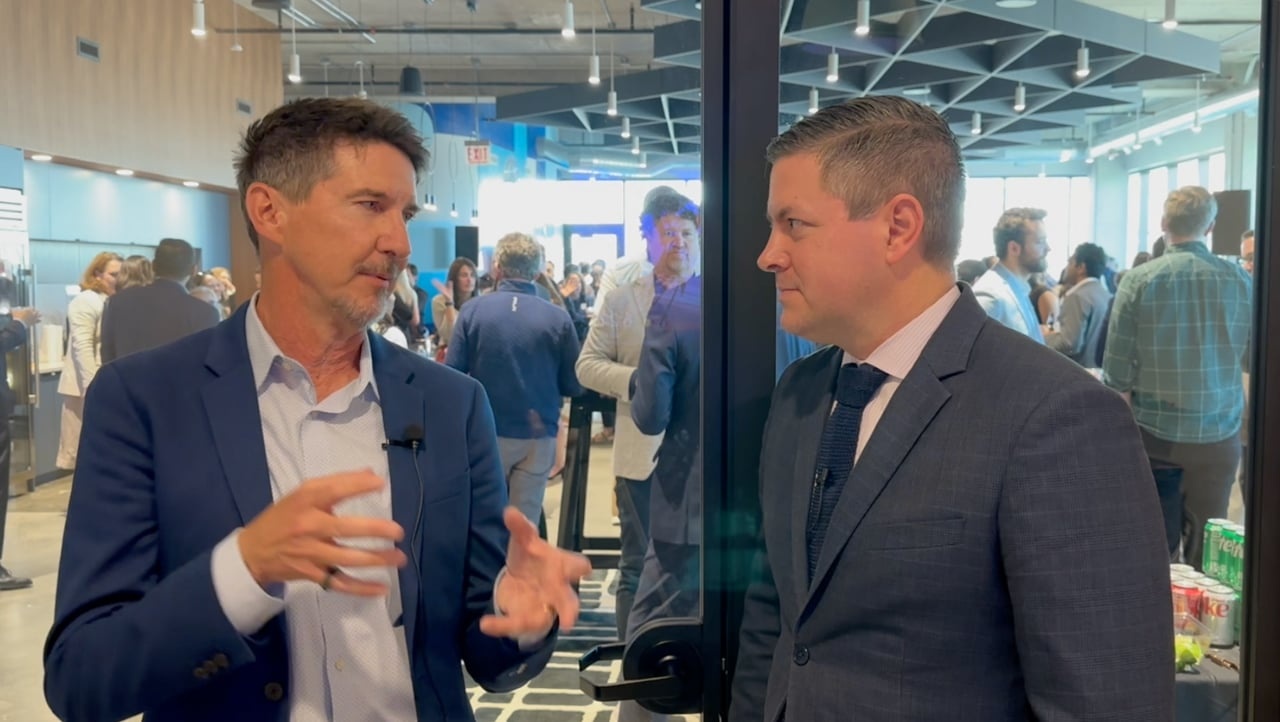
In a 2024 interview filmed in Chicago, he returned to his own experience of building both companies and their infrastructure. Portal was intended to make that process easier in places that had fewer ready-made resources. The explanation had the practical specificity of an operator who remembered the extra jobs.
Chicago, with room on the map
Flavin’s interest in geography extends beyond his home city. Portal’s expansion has taken the company-building approach into other regions, with different institutions and partners. In Houston, for example, he joined Texas Medical Center president and CEO Bill McKeon for a December 2023 conversation about the resources early companies need.
His ambition can be heard in a short sentence: “I want to build the next Boston.” It describes a wish for more places to develop the connections that make starting and growing a company possible. The work involves discovering a region’s existing strengths and linking them with the support a founder needs.
“I want to build the next Boston.”
John Flavin, 2023
New Jersey offers a recent example. In April 2026, Flavin appeared in New Brunswick with Chris Picariello, president of Johnson & Johnson Innovation - JJDC, for a conversation about the state’s startup environment. He spoke about the way its organizations and resources fitted together, from grants to economic-development support and industry connections.
“New Jersey is the easy button,” he said. The line is amusing partly because nothing about building a company is likely to feel easy for long. But the point is practical: an entrepreneur should be able to find the available help and use it as the business develops.
The New Jersey Innovation Hub opened in July with 16 founding member companies. In August, NJEDA announced an up-to-$5-million commitment to a Portal-managed investment fund, matched by an up-to-$5-million commitment from RWJBarnabas Health. Workspace and financing were being brought into the same regional effort.
For Flavin, this is another version of the problem he began addressing in Chicago. The partners and place change. The question remains whether an entrepreneur can move from an idea into a working company with useful resources close at hand.
Then, let the founders talk
There is also a microphone in Flavin’s working life. He created and hosts Lab Rats to Unicorns, which began publishing in 2021. Its title puts the world of discovery beside the venture world’s favorite mythical creature. A laboratory rat gets a rather ambitious career plan.
The show explores the people and process behind company creation. Its scope includes science commercialization, clean technology, and quantum computing and AI. In an August 2026 episode, Flavin spoke with MemQ co-founders Manish Singh and Sean Sullivan about quantum networking, infrastructure, and entrepreneurship.
The podcast gives another form to his interest in the route from research to business. In mentoring, experience is passed directly between people. On the show, those conversations can reach someone who is still deciding whether to begin. The company’s origin becomes a story with choices and participants, rather than a finished result.
There is a consistent concern across these chapters. Flavin keeps returning to what surrounds the founder: the advisers, the equipment, the money, the next person to call. His own work has taken him through companies, a mentor consortium, a university, and now a venture development platform. Each setting offers a different way to make the beginning more manageable.
Chicago remains the starting point of that story. What follows is an effort to give more entrepreneurs a workable address for their ambition. A good idea may travel light. Flavin’s career has been spent arranging some of the heavier things it needs when it arrives.
Keep the conversation going
Interviews, ideas, and the places behind the story.