Canon U.S.A. Sells You a Camera. It Also Prints Your Office, Scans Your Chest, and Etches the Chips in Your Phone.
Everyone knows the red logo from the camera strap. Almost nobody knows Canon also builds hospital scanners, factory-floor optics, and chip-making machines - and files more U.S. patents than almost anyone. Here is the whole company behind the shutter.
Pick up almost anyone's Canon and you are holding a decision the company made about you: that you are a photographer. It is a good camera and a good story, and it is also a decoy. The red wordmark on the strap belongs to Canon U.S.A., Inc., the Americas arm of a Tokyo optics company whose largest single business is not cameras at all - it is printing. Behind the shutter sits a manufacturer that also builds the CT scanner in your hospital, the copier down your office hallway, the network cameras watching a parking lot, and the lithography machines that help pattern the silicon inside your phone. The camera is what you see. The company is what you don't.
Canon U.S.A. runs all of this from Melville, New York, on a 52-acre Long Island campus it has occupied - in one form or another - since 1971. The current headquarters, One Canon Park, opened in 2013: roughly 700,000 square feet, LEED-Gold certified, and voted "Best Office Building" on Long Island more than once. About 1,600 people work there; roughly 9,700 work for Canon U.S.A. across the Americas. It is one of the quieter corporate anchors in New York, which suits a company that would rather you noticed its pictures than its buildings.
01 / THE MISDIRECTIONWhat Canon actually does
The cleanest way to understand Canon is to stop thinking "camera company" and start thinking "optics and imaging company that sells to everyone who needs to see clearly." The parent, Canon Inc., organizes itself into five segments: imaging, printing, medical, industrial, and a catch-all "others." Canon U.S.A. is the group that markets, sells, and services those products across the Americas. The through-line is glass and sensors. Whether the job is a wedding, a wide-format art print, a chest scan, or a semiconductor wafer, the underlying competence is the same - capture light, move it, and turn it into information.
This is why the "camera company makes CT scanners" fact feels like a plot twist but isn't one. It is the same business wearing different clothes.
02 / THE MONEYPrinting pays for the cameras
Here is the detail that reorganizes everything: at the parent level, printing is the largest business, at roughly 56% of sales. Medical is around 13%, industrial around 8%, with imaging and the rest filling in. The camera you associate with the brand is a prestige product riding on top of a much larger machine-and-consumables operation. Office multifunction devices, laser and inkjet printers, production presses, and the ink and toner that feed them - that is the engine room.
Shares are approximate and vary year to year.
The business model underneath is older than the mirrorless wars: sell the machine, then sell what the machine keeps needing. Printers pull ink and toner. Copiers pull service contracts. Cameras pull lenses - and once a photographer owns three or four RF or L-series lenses, switching brands means rebuying a decade of glass. Canon has spent that loyalty carefully. The lens mount is the moat.
03 / THE RANGEFrom your desk to the operating room
The catalog is genuinely sprawling. It helps to see it grouped by who is buying.
Imaging
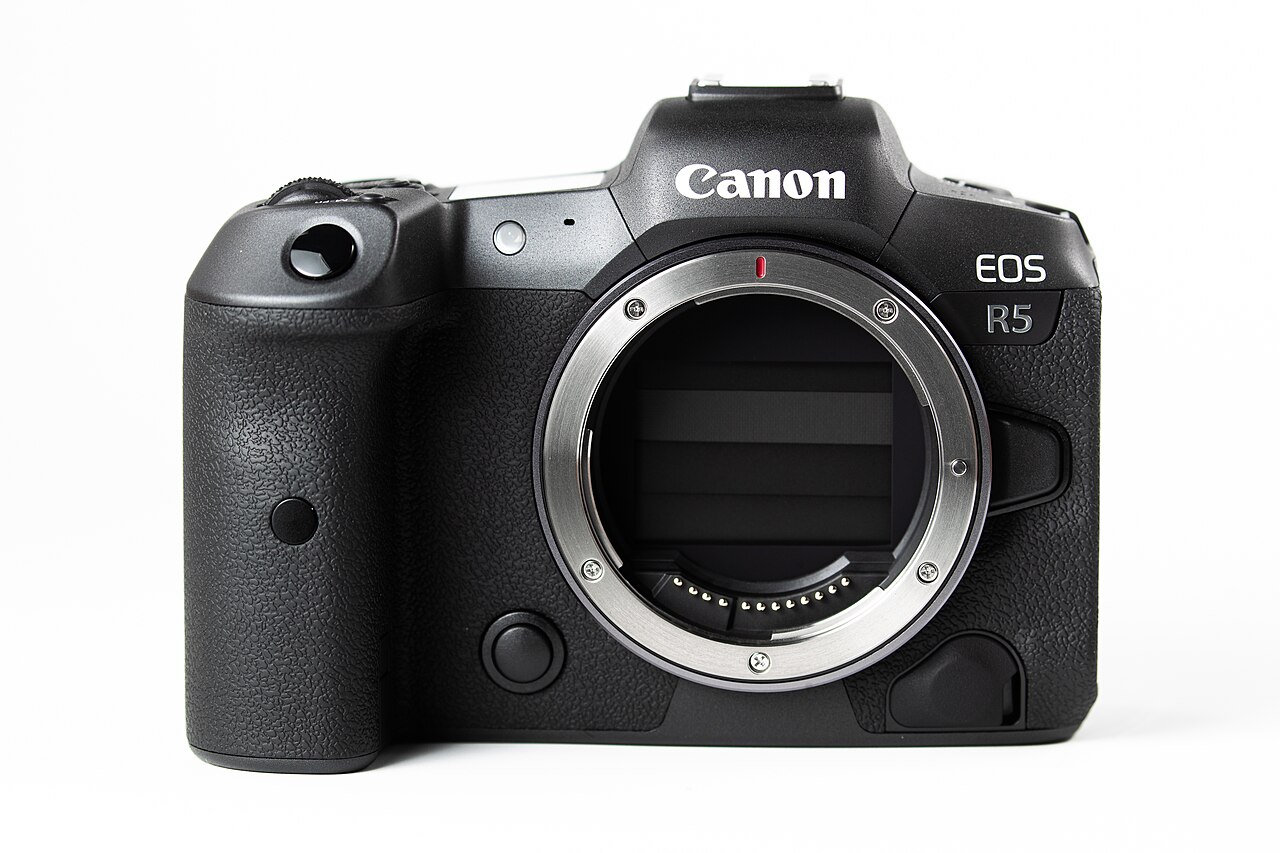
EOS R mirrorless bodies - including the flagship EOS R1 and EOS R5 Mark II - plus RF and cinema lenses, broadcast optics, and PowerShot compacts.
Printing
PIXMA and imageCLASS for homes and small offices; imageRUNNER copiers; imagePROGRAF wide-format; production presses for commercial print shops.
Medical
CT, MRI, ultrasound and X-ray systems and healthcare IT through Canon Medical Systems, formerly Toshiba Medical.
Industrial
Semiconductor lithography, nanoimprint lithography, flat-panel equipment, and precision measurement and inspection systems.
Network Video
Network and security cameras for business, public safety, and broadcast - the optics DNA pointed at surveillance.
Services
Managed print, document workflow, maintenance and support contracts that turn one-time sales into ongoing relationships.
04 / THE FLAGSHIPThe EOS R1 is a computer with a shutter
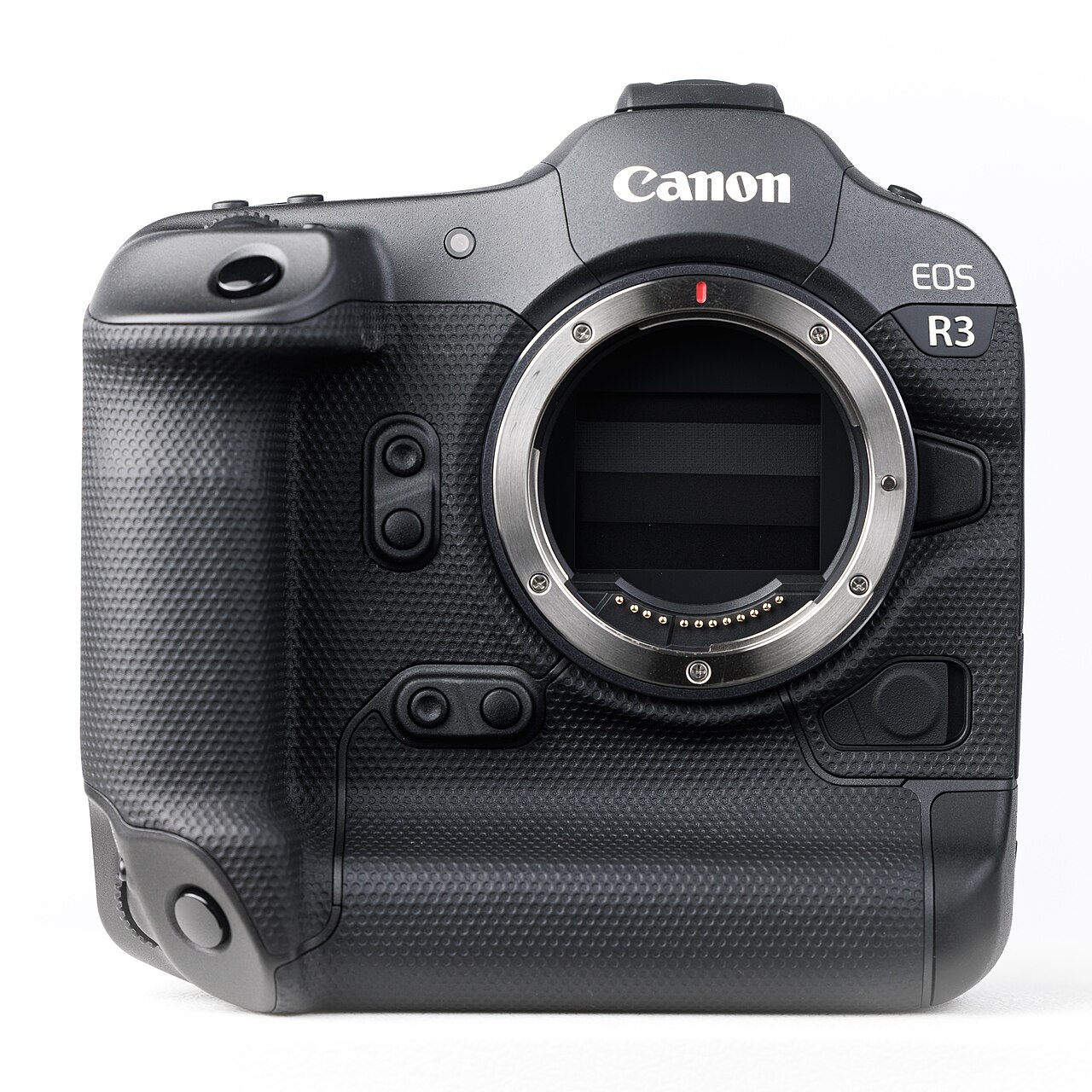
In 2024 Canon launched the EOS R1, the first camera it has been willing to call the flagship of the EOS R system, alongside the more accessible EOS R5 Mark II. The R1 pairs a back-illuminated stacked 24.2-megapixel full-frame sensor with two processors, records 6K RAW internally at up to 60 frames per second, and shoots stills and video at the same time. It launched around $6,299. That price tells you the customer: sports, news, and high-end video professionals for whom a missed frame is a missed paycheck. It is less a camera in the phone-camera sense than a purpose-built imaging computer.
05 / THE PROOFAn invention machine that hides its work
If you want a single number that captures how much engineering sits behind the brand, use this one: Canon has finished in the top 10 for U.S. patents granted for 41 consecutive years, and first among Japanese companies for 20 years running. In some years it out-files companies you would assume dwarf it. Very little of that invention ever appears on a camera box. It goes into sensor design, lens coatings, print heads, medical detectors, and the industrial optics almost no consumer will ever touch.
06 / THE ORIGINFrom a Leica knockoff to the chip fab
The lineage is worth knowing because it explains the ambition. In 1933 a small Tokyo lab - the Precision Optical Instruments Laboratory - set out to build a world-class camera in a market owned by German brands like Leica and Contax. In 1934 it produced a prototype called the Kwanon, named after Kannon, the Buddhist goddess of mercy; the modern name "Canon" grew out of it. The company was formally established in 1937. Canon U.S.A. opened a New York branch in 1955 and was incorporated in 1965. Ninety years after copying a Leica, the same organization makes hospital scanners and semiconductor equipment. It is one of the more underrated corporate arcs in technology.
07 / THE COMPETITIONWho it is really fighting
Because Canon lives in five markets, it has five sets of rivals. In cameras it trades blows with Sony, Nikon, Fujifilm, and Panasonic - Sony being the pace-setter on sensors and Nikon the historical rival. In printing and office it faces HP, Epson, Brother, Xerox, Ricoh, and Konica Minolta. In medical imaging the field is Siemens Healthineers, GE HealthCare, and Philips. In semiconductor lithography, the giant in the room is ASML. Few competitors meet Canon across more than one of these fronts, which is precisely the point: a slump in cameras can be cushioned by printers, a remote-work dip in office print offset by medical. Breadth is the strategy.
08 / THE BETStamping chips instead of projecting them
The most interesting long shot in the portfolio is nanoimprint lithography. Conventional advanced-chip manufacturing projects circuit patterns onto wafers using extraordinarily expensive light-based systems. Canon's approach effectively stamps the pattern instead, aiming for finer features at lower cost and energy. If it works at scale, it gives the camera company a seat at the semiconductor table that its optics heritage arguably earned. If it doesn't, it is a reminder that Canon still places long, patient, R&D-heavy bets - the same instinct that turned a Leica clone into a five-market manufacturer.
That philosophy, Kyosei, is not marketing garnish so much as an operating logic. It is the frame Canon uses to justify spending on things that do not obviously pay off next quarter - long research horizons, environmental programs, community work on Long Island. For a company answerable to a Tokyo parent and public markets, it functions as permission to think in decades.
09 / THE TAKEAWAYWhat you can steal from it
If you are building anything, Canon offers three cheap lessons. First: lead with the product people love and let it subsidize the products that actually pay - the camera is the billboard, printing is the business. Second: build a switching cost that compounds - lenses lock in photographers the way ink locks in printer owners. Third: sell the same core competence to more than one customer instead of chasing unrelated diversification - Canon didn't leave optics to enter medicine, it pointed its optics at medicine. The camera on your strap is a very good ambassador for a company that would rather you didn't count how many other machines carry the same red logo.
Explore Canon U.S.A.
Frequently asked
Is Canon U.S.A. the same as Canon Inc.?
No. Canon U.S.A., Inc. is the Americas sales, marketing, and service subsidiary of Canon Inc., the parent company in Tokyo. It is based in Melville, New York.
Does Canon only make cameras?
No. Canon operates across imaging, printing, medical, and industrial businesses. Printing is actually the parent's largest segment, and Canon also makes medical scanners and semiconductor equipment.
Where is Canon U.S.A. headquartered?
At One Canon Park in Melville, New York, on a 52-acre Long Island campus. Canon has been on Long Island since 1971.
Who runs Canon U.S.A.?
Isao "Sammy" Kobayashi became President and CEO effective January 1, 2024, succeeding Kazuto "Kevin" Ogawa.
What is Kyosei?
Kyosei is Canon's corporate philosophy - "living and working together for the common good" - guiding its approach to R&D, sustainability, and community.