The mistake was on a certificate. A customer had sent Graphics360 an employee milestone certificate with an error, then needed it corrected. In a testimonial published by the printer, Gregory H. says the replacement was ready within an hour. The paper had done nothing wrong. The machine had done nothing wrong. The problem had entered the process before either of them had a chance.
That little account offers a useful way into this Santa Ana company. Printing appears to be a business of objects: cards, brochures, banners, signs. But the object is also the final resting place of somebody’s decisions. A wrong name becomes a wrong name in ink. A late approval becomes a shorter production window. By the time a visitor sees the sign, all those small decisions have become public.
Graphics360 puts its intervention near the beginning. Its website tells people working in Canva, Adobe Express, and other design tools that a person will help get their file ready before production. The promise is direct: someone will look, ask questions, and hold the job until the artwork is ready.
“We won’t produce your job until it’s ready to print”
Graphics360’s promise to customers uploading designs
A second pair of eyes has a business model
Founded in 2001, according to its LinkedIn profile, Graphics360 occupies the practical middle of the print market. It serves the person ordering cards and the organization assembling a roomful of branded materials. The Newport Beach Chamber of Commerce describes a family-owned operation with production on the premises, handling small and large digital formats along with binding.
The business earns its money through printed products and project services. Customers can request quotes and submit work online. The catalog reaches from brochures and proposal components to fabric displays and vehicle graphics. Design help and installation extend the relationship on either side of the press. For a buyer coordinating several pieces, that breadth can mean fewer separate production conversations.
Its competitive argument is personal review. On its About page, Graphics360 contrasts direct guidance with large online print shops. That is the company’s positioning, rather than proof that another printer will mishandle a file. Still, the distinction gives a prospective customer something concrete to ask: who checks the artwork, who calls if it needs fixing, and who follows it through?
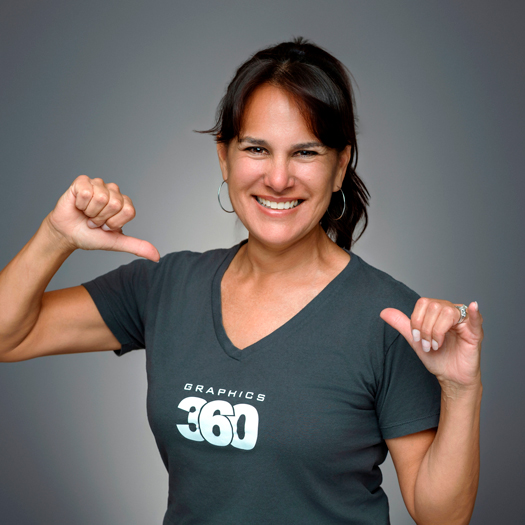
The public-facing team includes president Sonya Roeser, Christopher Roeser in operations, and production manager Sergio Cendejas. There is also Maximus the Mastiff, assigned to customer relations. The joke makes sense in a business whose pitch depends on being approachable. A nervous customer should feel able to ask a small question before it becomes a large print run.
The $65 order with a $50 hurry attached
Start with something ordinary. Graphics360 lists 500 standard business cards for $65: 16pt opaque cover, full color on both sides. Fifty cost $35; a thousand cost $95. These are posted product prices, not a quote for every possible finish or delivery arrangement.
The premium choices explain why “business card” is an incomplete specification. MultiLoft stock can add thickness or a colored layer visible at the edge. White toner opens up dark paper; clear toner adds a varnish-like effect. The buyer is choosing a physical object as well as a layout. Those decisions belong in the brief.
Before any applicable extras. Eligible jobs only; production availability and file approval required. Published prices checked September 12, 2026.
Now add urgency. The published schedule assigns a $50 same-day rush fee to eligible orders worth up to $100. Applied to the $65 cards, that produces a $115 subtotal before any other applicable charges. The arithmetic is simple. The scheduling condition matters more: turnaround begins after file approval.
Ordinary cards and banners generally get three business days. Fabric displays and canopy tents get six to seven, without rush availability. Flags and table throws also exclude rush service. A mixed event order therefore needs a calendar built around its slower pieces. Money cannot buy an expedited option the schedule does not offer.
The ocean does not install itself
Consider the elevator lobby in Graphics360’s October 2025 project post. The wall becomes an aerial view of ocean waves. In the installation photograph, a worker faces the surf while standing behind a work platform. The image is atmospheric; the task is wonderfully literal. Someone has to make the ocean fit the wall.
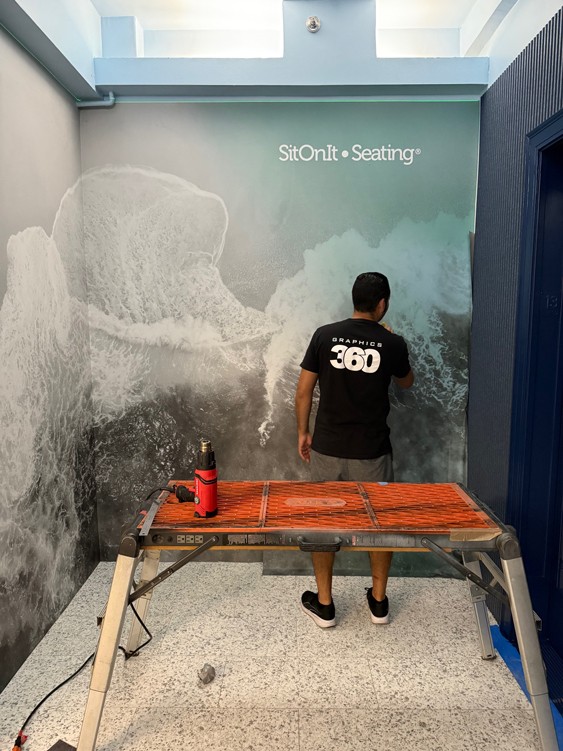
The installation service includes site surveys, surface preparation, and scheduling, followed by fitting graphics to materials such as glass, drywall, and metal. It also covers removals and seasonal changes. These are separate kinds of work. Printing produces the image; installation has to account for the place where that image will live.
This is where a company’s range becomes useful. An office wall, a shop window, and a floor graphic might carry related artwork, yet each creates a different set of physical decisions. The practical question is how the material meets the surface, and how the work fits around people using the space. Graphics360 explicitly includes those steps in its service description.
- 01ArtworkReview the file
- 02MaterialMatch the use
- 03ProductionPrint and finish
- 04InstallationFit the surface
An editorial map of the company’s described services, not a measured production timeline.
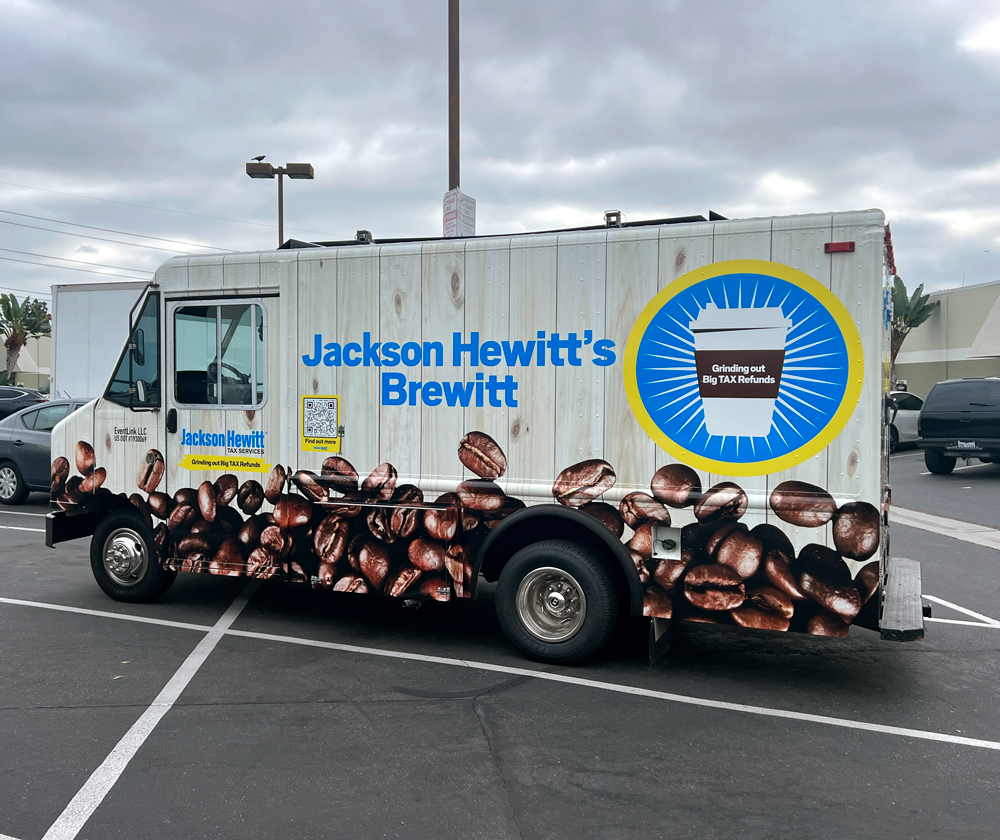
Vehicle graphics add another variation. The company offers full wraps, partial wraps, and smaller spot graphics, specifying 3M or Avery vinyl on its product page. A customer can brand a single vehicle or a fleet. The brief has to identify the vehicle and the intended coverage before the printer can turn a logo into something that fits.
The customer is often organizing something bigger
Graphics360’s project archive includes Beautycon 2024 in Los Angeles, a recruiting-vehicle design and wrap for the Orange County Sheriff’s Department posted in January 2025, and work for the department’s Medal of Valor ceremony that May. These examples locate the business in events, workplaces, and public-facing organizations, where printed materials are components of a larger undertaking.
The smaller jobs matter too. Company-hosted testimonials describe small-business printing, nonprofit event materials, and corporate projects. In one account, Sheraya S. says her company tried several printers before finding the quality it wanted at Graphics360. That is a customer’s explanation for switching, not a controlled comparison. It nevertheless points to a buying criterion that a price-per-sheet calculation misses: confidence in the next job.
There is a telling qualification in the company’s listed weekday hours: “or until the work is complete.” Weekend rush work can be discussed in advance. The invitation is to coordinate. For the person responsible for an event, that conversation may be as useful as the online upload form.
Borrow the approval habit
The most portable lesson here is a modest one. Give the printer the actual use, the actual deadline, and the artwork early enough for questions. Agree on what has to be approved. Put that approval date into the project plan. An upload receipt and a production-ready file are two different milestones.
Graphics360’s FAQ provides a particularly useful example: when exact brand color matters, ask ahead for a printed proof. It recommends 300 DPI at full size for close-viewed small-format pieces and explains the extra artwork beyond a trim line that prevents white edges. These are decisions to resolve before multiplying a design into hundreds of copies.
A buyer with a routine, already-prepared file may put more weight on price or shipping convenience. A buyer who needs the printer to help resolve a layout, coordinate several formats, or fit graphics to a real surface has more reason to consider this kind of shop. The next useful step is a specific brief and a quote. Start with what needs to be ready, and when. Leave enough room for somebody to notice the certificate contains an error.
See the work. Plan the job.
Graphics360 website · Project portfolio · Business-card options · Turnaround and rush fees · Request a quote
LinkedIn · Twitter/X · Instagram · Facebook
WATCH THE PROCESS