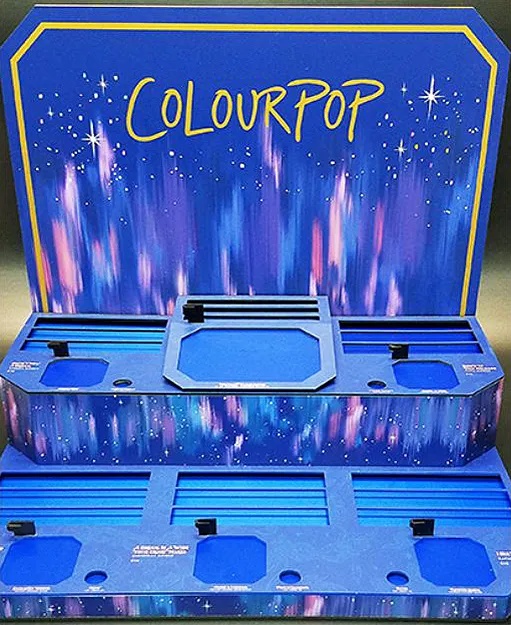
A cosmetics display is a surprisingly demanding object. The colors have to tempt a shopper, the openings have to fit the products, and the whole thing has to behave itself on a counter. Look at the ColourPop fixture in P5 Graphics & Displays’ portfolio: blue compartments, a tall decorative back, a small stage for merchandise. The graphic is only part of the job. Somebody also has to make the stage.
That is the territory occupied by P5, a California commercial printer whose work extends into custom retail fixtures, signs and fabrication. It takes on the physical apparatus of selling: the counter that organizes a range, the sign that identifies a business, the printed surface that turns a structure into an advertisement. Its offering brings together people who think about images and people who think about how things get made.
For a buyer, the attraction is practical. A project can begin before every material, dimension and production method has been settled. P5 describes working with customers who arrive with an idea and develop it alongside designers, engineers and coordinators. That makes the company relevant at the awkward moment when a persuasive presentation must become something that can occupy actual space.
The interesting part happens after the ink
The word “printing” can make this business sound flatter than it is. P5 offers graphics on rigid and flexible materials, but also cutting, engraving and construction. Its services cover custom displays for shops, exhibitions and promotional events; indoor and outdoor signage; and CNC fabrication in materials including acrylic, wood and metal. Those activities meet at the edges, joints and curves of the finished object.
A printed sheet can carry the right message and still be only an intermediate part. A shaped sign needs its outline cut. A merchandise fixture needs somewhere to put the merchandise. A display with integrated lighting introduces another set of decisions. P5 explicitly includes lighting and audiovisual capabilities in its description of point-of-purchase work, putting electrical considerations alongside graphic ones.
The commercial logic is fewer separate conversations about the same object. An art department can propose a shape; fabrication can address how to produce it; project coordination can keep the decisions connected. That is the promise implied by P5’s service mix. Its value to any particular buyer will depend on how much of that mix the job actually requires.
- 01BriefPurpose + setting
- 02DesignArtwork + engineering
- 03MakePrint + cut + fabricate
- 04PlaceInstallation
Service map / conceptual sequence, not a production timetable.
A surfboard walks into a print shop
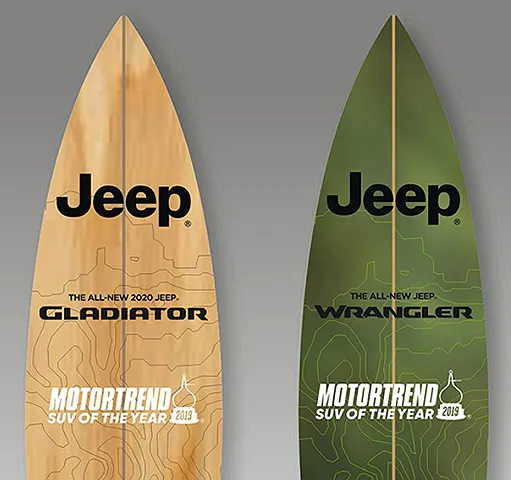
Then there are the surfboards. P5’s CNC portfolio shows two surfboard-shaped pieces with Jeep and MotorTrend branding, one in a natural wood tone and the other green. Their shape gives the graphics a character that a rectangle would not. They are a useful illustration of the company’s range: brand communication can be a silhouette as much as a printed sentence.
Elsewhere in the portfolio, a Dogeared-branded fixture arranges jewelry cards on a compact tiered structure. Cosmetics displays use slots, shelves and background panels to give small products a visible address. These photographs are evidence of what P5 chooses to show as its work. They also make its category easier to understand than an inventory of printing terms could.
The common thread is the relationship between product and presentation. A fixture has to accommodate the things it displays, while leaving room for the brand to speak. Looking at these objects, the buyer can ask concrete questions: Will a card hang cleanly? Can a shopper reach the item? Does the shape help explain the product? Those are useful questions to bring to a fabricator.
The machine list has a second act
P5’s published equipment list makes the connection between graphic and object visible. It names a Canon Arizona 2380 XTF flatbed printer, an EFI VUTEk 5r+ roll-to-roll printer, an EFI VUTEk h5+ hybrid printer and an Epson SureColor S8060. The list then moves into a Zünd digital cutter and an Advanced Automation laser cutter. Printing and shaping are both part of the advertised production toolkit.
For readers who do not collect printer model numbers, the distinction is straightforward. The company describes equipment for printing directly onto rigid surfaces, equipment for material supplied on rolls, and equipment that handles both. Its applications include banners, wraps and backlit graphics. The cutting equipment adds shaped outlines and fabricated components to that menu.
Machine ownership alone does not tell a buyer whether a particular project is a good fit. The useful question is which process suits the intended object. A flexible graphic and a rigid display panel present different requirements. P5’s mix gives a project team several routes to discuss, making the conversation about the application more informative than simply asking for the biggest printer.
P5 lists a five-meter EFI VUTEk 5r+ for roll-to-roll graphics. Scale is one capability; choosing the right material is another.
Small batches, then more of them
The most revealing customer account on P5’s website comes from Ariel at Mozi Ventures. The testimonial describes “starting off custom manufacturing products for us in small batches” before production moved to larger quantities. It is a modest, specific account of how a fabrication relationship can develop: start with a smaller requirement, then ask the supplier to make more.
That progression matters because custom production has to accommodate decisions as well as volume. A buyer may first need to establish what the object should be. Once that is settled, the same relationship may support repeated manufacture. The Mozi account illustrates that possibility without turning one customer’s experience into a promised result for everyone.
Other company-hosted testimonials describe related needs. A customer identified with Zevn Lifestyle Essentials discusses concepts and revisions for point-of-purchase displays. Another, identified with Grenwood Holdings, describes fleet-wrap design. Printech and AMG also appear. Together they suggest a customer base buying different combinations of visual design and production, rather than one standardized item.
“starting off custom manufacturing products for us in small batches”
Ariel, Mozi Ventures / testimonial published by P5
These are selected testimonials, and their proper use is to understand the work customers say they bought. The accounts are particularly interesting for their emphasis on the process: developing ideas, revising designs and getting a physical product made. That is where an involved supplier can earn its place in a purchasing decision.
A $3,155.85 glimpse of the business
A public purchasing record supplies a different view of P5’s customers. In materials for its December 16, 2020 board meeting, Capistrano Unified School District included a consolidated check register listing P5 Graphics and Displays Inc. Two accounting lines dated November 5, 2020 carry amounts of $620.95 and $2,534.90 under the same check number, adding up to $3,155.85.
That is a documented historical transaction, not a price list for a display. The register establishes a school-district purchasing relationship and the recorded amounts; it does not itemize the products beside those entries. Its interest is the additional customer context. Alongside the retail fixtures and promotional work in P5’s portfolio sits the ordinary institutional business of buying from a print and fabrication supplier.
A team built around the handoffs
P5 dates its start to 2015 and describes the original ambition as a “one-stop-shop” printing business. Its current team page gives that ambition a human outline. Amit Patel is listed as president and Jimmy Patel as chief financial officer. Alongside management, the roster includes project management, graphic design and prepress, display design, printing, cutting and fabrication.
One role is especially telling: electrical and mechanical engineering. It fits the company’s stated work on displays with lighting and audiovisual features. Such a fixture asks the design to accommodate more than ink and surface. The people needed to resolve those questions belong in the project early, while the form is still being decided.
The business serves firms locally and nationwide, according to its website. Its published service description extends from engineering and manufacturing to installation. That breadth places it between commercial print production and custom fixture manufacturing, with signage running through both. A customer can approach it with an image, an object or a problem that involves the two.
Buy the finished job, starting with the brief
P5’s sales process is organized around a request for a quote, with a separate artwork-upload page. That points to a project business: the scope must be understood before the work can be priced. For the buyer, a useful comparison begins with what the quote covers. Design revisions, material selection, fabrication and installation belong in that discussion wherever they apply.
The practical lesson to copy is to describe the intended use before prescribing the solution. Bring the dimensions, the products being displayed, the quantity, the setting and the required date. If a fixture must include lighting, say so at the beginning. If the artwork is ready but the construction is undecided, make that distinction clear. These are editorial suggestions for a stronger brief, not a claim about P5’s formal intake requirements.
A straightforward repeat print order may need little engineering input. A custom fixture holding several products may need considerably more. P5’s combination makes the most sense when the buyer can use its overlapping capabilities. The portfolio’s small stages, shelves and shaped signs make the point neatly: a sales pitch becomes more interesting when someone has worked out where it will stand.