There is a category of business whose value becomes obvious only after the owner walks out the door. The equipment remains. The phone still rings. There are invoices, customers, shelves of paper and machines built to put color on almost anything. Yet something essential has gone missing. Pete's Print, a commercial print shop in Hoover, Alabama, discovered this in the most expensive way possible - and then put an unexpectedly small price on the lesson.
Pete Petroff started the company in the 1990s; the Better Business Bureau dates the opening to January 1, 1995. His proposition was almost aggressively plain: make a quality product, charge an economical price, and treat customers well. This was not a pitch designed for venture capital. It was designed for the person standing at a counter with a deadline, an imperfect file, and 500 copies of something that had to look right.
Years later, Petroff was diagnosed with a rare disease. Treatment would require multiple surgeries. He sold the business so that recovery could become his full-time job. His recovery, the company says, went better than expected. The business did not. Two years after the sale, he bought Pete's Print back for $3,500 and began again.
The invisible machine
What failed first? The public account does not identify a broken press or a vanished product line. It says something more personal: without Pete, Pete's Print was not the same. That is the polite language of a service business losing its operating rhythm. A customer does not merely buy ink on paper. The customer buys the phone call in which somebody catches the low-resolution logo, the suggestion to use a sturdier stock, the judgment that a finish will make a card feel expensive, and the willingness to bring the completed job to the door.
The machines made the print. The founder had been making the promises believable.
The shop's own testimonials keep returning to verbs that do not appear on an equipment specification: recommend, suggest, hurry, deliver. A marketing consultant described Pete as someone who would improve the final product, not simply produce what arrived. Another customer praised the staff for learning precisely what a business-card job needed. These are small interventions. Collectively, they are the invisible machine.
One counter, fewer handoffs
Today the company presents itself as a full-service shop. That phrase often means “we own a large menu.” Here it describes a useful sequence. Pete's Print can create or repair the design, produce business cards or postcards, print a banner or corrugated sign, cut vinyl for a storefront or vehicle, add coating and finishing, personalize pieces with variable data, insert them into envelopes, and handle mailing or distribution. A customer can start with an idea and leave with the physical campaign.
A local job, compressed
That compression matters most when the job is really several jobs. Real-estate agents are a named specialty: business cards, for-sale signs, banners, postcards, decals. The agent is not buying isolated objects. She is launching the same identity across a front yard, a mailbox, an open house, and a handshake. The practical advantage is not that Pete's Print invented any of those formats. It is that one shop can keep the color, timing, and message aligned.
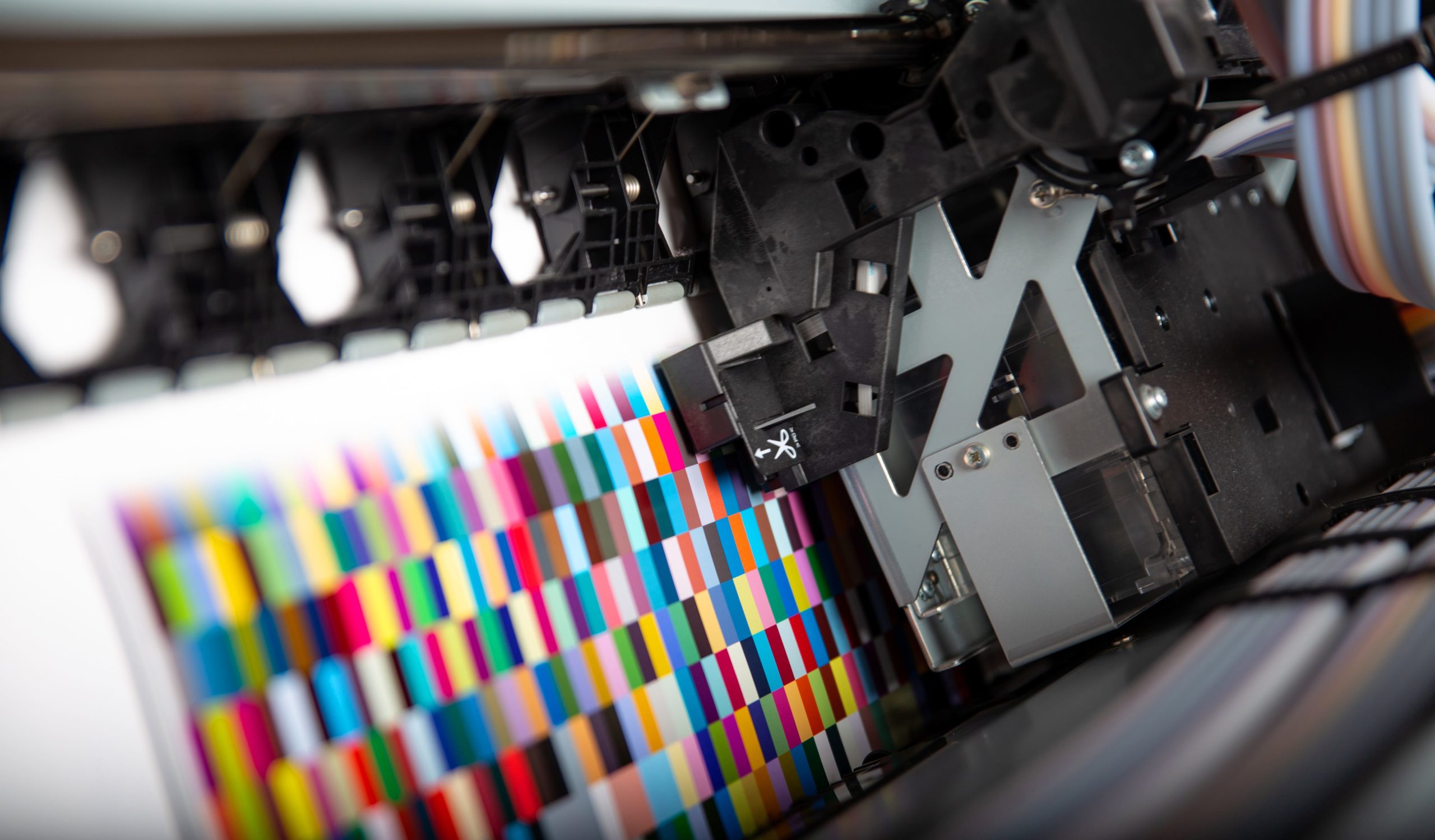
The production floor supports the claim. The company's published equipment list includes an HP Scitex flatbed printer for rigid surfaces, a Roland wide-format printer and cutter, a Canon digital color press, a Colex flatbed cutter, a UV coater, a high-volume duplicator, and a Pitney Bowes inserting system. This is not a museum of industrial nouns. It is a map of jobs that can stay in the building.
The useful middle of the market
Pete's Print sits between two familiar alternatives. At one end is the national online printer, optimized for standardized orders, self-service files, and low unit prices. At the other is the office-store counter, convenient for copies and familiar formats. Pete's Print occupies the advice-heavy middle: local enough to rescue a deadline, equipped enough to keep multiple stages together, and small enough for the founder's judgment to reach the job.
Where the shop earns its keep
Public reviews make the distinction concrete. Customers mention professional and on-time work, fair prices, personal help from Pete and Jodi, and a rapid fix when wedding-invitation envelopes came back unprinted. The shop's Chamber of Commerce listing carried a 4.8 rating across 67 reviews when indexed. Local government records also show Pete's Print & Copy Center as a City of Hoover vendor - modest line items that place the company exactly where it claims to be: inside the ordinary machinery of its community.
The business model is correspondingly direct. Customers request quotes rather than selecting a universal price from a grid. Revenue comes from project work: design and setup, production, materials, finishing, mailing, and fulfillment. There is no public evidence of institutional funding, a national footprint, or software-like scale. The economics depend on keeping the presses busy while attaching human attention to jobs that warrant it.
The part worth copying
The tempting lesson is “never sell your company.” That is too easy, and useless to anyone who must sell. The better lesson is to identify the work hiding inside the owner's name. If customers come back because one person catches errors, recommends materials, negotiates timing, and delivers the result, those actions need to become a process before ownership changes. Write down the preflight checklist. Record the questions asked at intake. Give another employee authority to improve a job, not merely route it. Measure successful saves, not only finished orders.
Copy this
- Own the handoffs customers hate.
- Turn expert advice into an intake checklist.
- Specialize around a customer's whole campaign.
- Make rescue work part of the service promise.
Know the trade
- Hands-on advice adds labor and limits volume.
- Specialized equipment needs steady local demand.
- Commodity buyers may choose the lowest online price.
- Founder magic becomes risk if it stays undocumented.
This approach is less persuasive for a buyer with flawless files, flexible deadlines, huge standardized quantities, and price as the only criterion. A national printer can pool volume and ship cheaply. Nor does the local model travel automatically: expensive equipment without enough regional demand becomes idle steel, while lavish consultation on every tiny order consumes the margin. Pete's Print works when the cost of a mistake, delay, or fragmented campaign is greater than the savings from a faceless transaction.
What changed Petroff's mind was a rare combination: his health improved, and the company deteriorated. He returned to a business bearing his name and discovered that its central asset had never appeared on the equipment list. Three decades after the opening, the shop is still selling signs, cards, mailers, graphics, and copies. But the $3,500 story suggests its real product is continuity - the quiet assurance that somebody nearby will notice, decide, and get the thing out the door.
Put something on paper
See the work, request a quote, send a file, or follow the shop where it actually posts.