At Columbia Grain, the problem could fit inside a notebook. Sergio Hernandez, the company’s business execution manager, had customer knowledge written down. His question was what would happen when the person holding it moved on. Crop plans, preferences, conversations: a grain business could keep its buildings and lose part of its memory. In a customer account published by Bushel in May 2026, Columbia Grain described choosing software to make that knowledge available to the next person.
- Bushel connects farmers with the grain buyers and retailers they already use.
- Its software joins account records, grain offers, customer conversations, and payments.
- The hard part is making those connections useful enough to become a habit.
Follow the receipt
The company behind that CRM began in 2011 as Myriad Mobile, a Fargo custom software shop founded by Jake Joraanstad and Ryan Raguse. Building applications for different clients supplied experience. Agricultural work supplied a repeatable problem. A sugar beet application gave growers access to scale tickets, the receipts recording deliveries. The team extended that idea to grain businesses, including The Arthur Companies and Minn-Kota Ag Products.
A delivery receipt sounds small until you consider its dependencies. Someone needs to match the load to the right account and contract. Someone needs an accurate balance. Eventually, someone needs to get paid. Digitizing that first record opened a route through the transaction.
Bushel launched its agricultural platform in 2017. In June 2019, Myriad Mobile adopted the Bushel name. The announcement described more than 1,000 live grain receiving locations already connected. A product had become the company’s organizing idea.
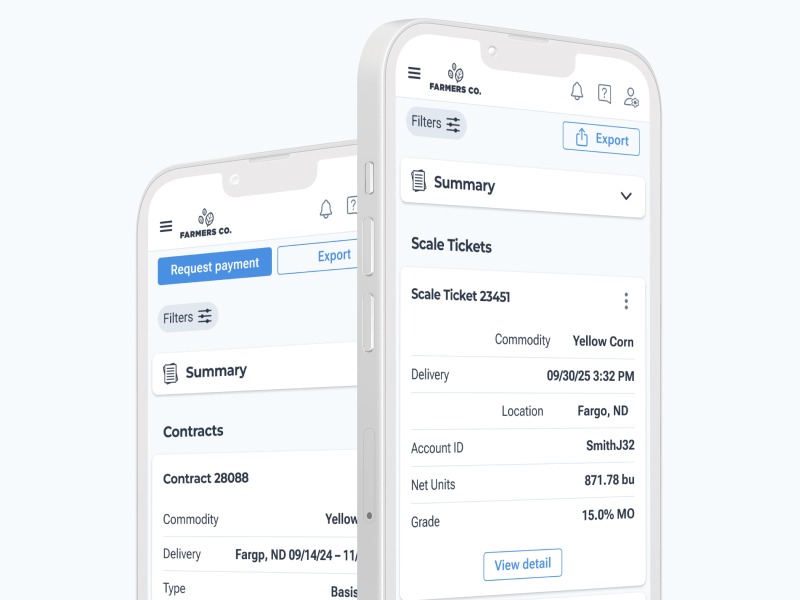
The app wears the elevator’s name
A farmer may encounter Bushel through an app bearing a local grain buyer’s identity. The portal connects to the business’s accounting system and puts tickets, balances, bids, and contracts within reach. That arrangement explains Bushel’s position: it supplies infrastructure inside an existing commercial relationship.
Its customers include elevators, cooperatives, processors, agricultural retailers, and lenders. Bushel says its network connects more than 3,500 grain and ag retail locations across the United States and Canada. Those are connected locations; the figure does not mean Bushel owns the facilities or buys their grain.
Schematic of supported workflows; availability depends on the tools and integrations in use.
The suite follows adjacent jobs. Trade manages cash bids and grain offers. CRM gives staff shared customer history. Pay handles financial workflows. Bushel Farm, acquired as FarmLogs in 2021 and renamed in 2023, tracks field activity, costs, and marketing positions. Connections with John Deere Operations Center and Climate FieldView can import field activities; participating Bushel grain buyers can supply contract data.
Alternatives overlap by task. AgriDigital provides grain management software; Barchart supplies agricultural market data and trading tools. Bushel’s distinctive proposition is the connection between the buyer’s workflow and the farmer’s records. Its expertise sits in the joins between systems, where retyping otherwise becomes somebody’s afternoon.
What the connection costs
For farmers, the public annual price ladder starts with Rainfall at $75, then Lite at $199 and Essentials at $599. Essentials adds profitability and operational tools. Machine data connections carry a separate $999 annual add-on. The standard tiers cover farms up to 20,000 acres; larger operations go through sales. Rainfall tracking is limited to mapped fields in the continental United States.
Machine data connections: +$999/year. Agribusiness software is sold separately.
The enterprise side sells subscription software through sales conversations. Farmers receiving an elevator’s account-access app occupy a different role from farmers buying a farm management subscription. Confusing the two makes the business look simpler than it is.
Building those connections has attracted outside capital. Bushel disclosed a $19.5 million Series B in 2019, a $47 million Series C in 2021, and a $26 million round in August 2023. The last was led by The Banc Funds Company, alongside investors including Cargill, The Andersons, and Scoular. These are financing amounts, not implementation budgets.
The check has company
A payment can have complications that an attractive interface cannot wish away. If a lender has a lien on crop proceeds, the grain buyer must account for that claim. Bushel’s July 2026 announcement described businesses falling back on two-party checks, manual searches, mailed documents, and coordination with lienholders.
Its Lien Protection Program takes on lien review, electronic documentation, and distribution to the appropriate recipients. The program includes indemnification against missed liens under its terms. The important product decision is addressing the reason a paper process persists.
Another connection reaches upstream. In February 2026, Bushel and Gevo subsidiary Verity announced an integration linking permissioned farm records with sustainability modeling and traceability. Gevo North Dakota was the first pilot customer. Participation is a farmer’s choice; the data connection supports documentation rather than guaranteeing a premium.
Software needs a weekly habit
“I’ve got a notebook with a bunch of notes.”Sergio Hernandez, Columbia Grain
Back at Columbia Grain, leadership support mattered. The team discussed CRM during weekly calls and encouraged feedback. Its account describes a skeptical colleague reconsidering after a walkthrough. The persuasive moment was seeing how the work could get easier.
Bushel has practiced its own version of learning the job. Its tenth anniversary gathering included a visit to an Arthur grain elevator. Curiosity, empathy, and camaraderie were the values it named. Watching grain unload gives a software team something a requirements document cannot.

The useful lesson is practical: start with a task that must happen, connect the records behind it, and give the people doing it a reason to return. The limits are practical too. Unsupported integrations leave gaps; unused CRM leaves knowledge in notebooks. Bushel’s bet depends on both sides of the transaction joining in. A receipt gets the story started. People still have to carry it forward.