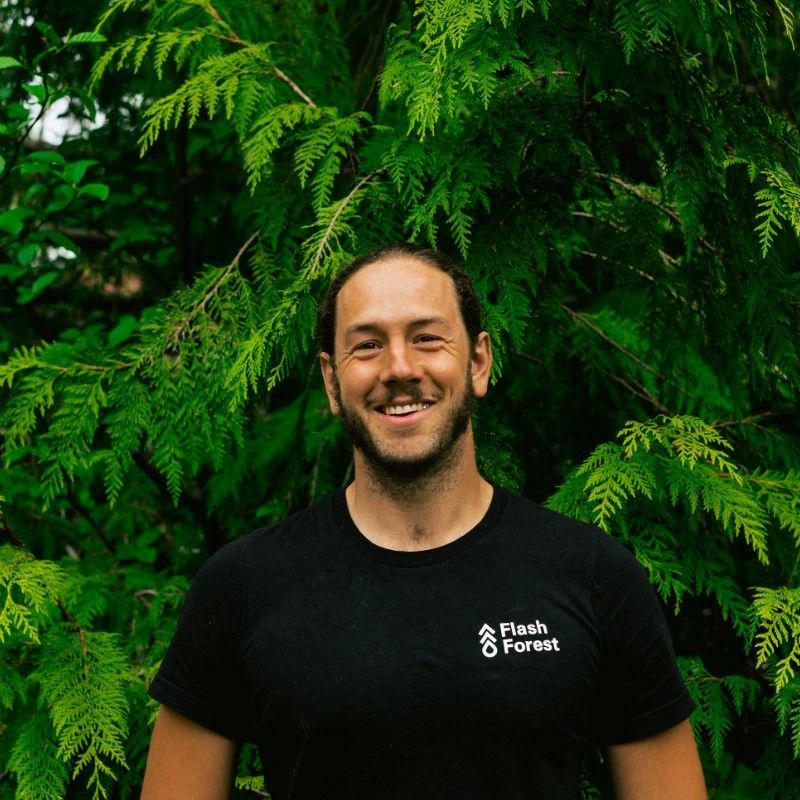
The tree planter who sent in the drones
Bryce Jones learned reforestation the way most Canadians who try it learn it: on his knees, in the dirt, one seedling at a time. In 2013 he spent a planting season working across British Columbia and northern Alberta, and by the time the season ended he had put roughly 76,000 pine, spruce and fir trees into the ground. That number is a badge of honour among planters. It is also a physical toll, and it left Jones with a question that would not go away.
The logging industry he was replanting behind had spent decades getting faster. Feller-bunchers, processors, forwarders - the machinery that clears a forest keeps improving. The machinery that puts one back? A person, a shovel, and a bag of seedlings. That mismatch, more than any single statistic, is what pushed Jones toward Flash Forest.
Technology revolutionized how we cut forests down, but the way we replant them barely changed.
Bryce Jones, TEDxJones is not a stereotypical Silicon Valley founder. He grew up in Kelowna, in British Columbia's interior, and took a winding route to the problem. He earned a Bachelor of Science in biology from the University of Victoria, finishing in 2016. Before that he had co-founded a windshield chip-repair business as a teenager. After graduation he started Jones Solar Consulting. Forestry, biology, a bit of hardware, a bit of entrepreneurship - the pieces that would later define Flash Forest were scattered across a resume that did not obviously point anywhere.
From Kickstarter to a fleet
Flash Forest launched in 2019, first as a crowdfunding campaign. The pitch was direct: use drones, artificial intelligence and geographic information systems to automate the slowest parts of reforestation, and aim the technology at land that human crews either cannot reach safely or cannot plant economically. Post-wildfire terrain sits at the top of that list. After a burn, the ground can be unstable, remote and dangerous, which is exactly where replanting matters most and where sending in people is hardest.
Jones co-founded the company alongside his brother Cameron Jones, who serves as chief operating officer, and Angelique Ahlstrom. Keeping a founder team that includes a sibling is its own kind of pressure test, and the Jones brothers built the early company around a single mechanical idea: retrofit an industrial drone with an autonomously controlled firing device that shoots a biodegradable seed pod into the soil at high velocity.
We're on track to be 10 times faster than human tree planters.
Bryce JonesThe seed pod is the quiet piece of engineering at the centre of it all. Each pod is biodegradable and packed with native species chosen for the specific site, along with nutrients meant to give the seed a head start. The drone maps a plot, decides where each pod should go, and fires. A human planter carries a bag and walks a line. A Flash Forest drone works from the air, and it does not get tired.
Eight species, one province at a time
Early Flash Forest plantings in southern Ontario put down eight native species, including white pine, white spruce, blue spruce, red maple, sugar maple and white birch. That detail matters more than it might seem. Reforestation done badly means blanketing land with a single fast-growing species and calling it a forest. Doing it well means matching a mix of native species to the ground they are going into. The technology story tends to grab headlines - drones, AI, seed pods - but the biology degree in Jones's background shows up in the species list.
The company's ambition is deliberately large. The public goal is one billion trees by 2028, and Jones has said the longer horizon runs well past that.
Our goal is one billion trees this decade. Then eventually, we're pushing to bring our technology worldwide, planting tens to hundreds of billions of trees.
Bryce JonesMoney, mentors and a measuring stick
Ambition on that scale needs capital, and in 2023 Flash Forest closed an $11.4 million CAD Series A round. The company incubated at ICUBE, the startup accelerator at the University of Toronto Mississauga, and secured federal funding along the way. Jones has been recognized by MaRS Discovery District as one of a handful of cleantech entrepreneurs worth watching, and the University of Victoria has counted him among its notable alumni. He took the story to a wider audience with a 2021 TEDx talk on drone reforestation.
None of this settles the hardest question, which Jones would likely be the first to acknowledge: planting a tree is not the same as growing a forest. Seeds have to survive, seedlings have to take, and a billion pods fired from the air only count if a meaningful share of them become standing trees years later. That is the measuring stick the whole sector is judged by, and it is a slow one. Jones's bet is that speed and scale, applied to the land nobody else wants to plant, tilt the odds in the forest's favour.
What comes through in his story is less the gadgetry than the through-line. A biology student who became a tree planter, a tree planter who became a solar consultant, a consultant who became a founder - and at each step the thread was the same problem, seen from a slightly different angle. Jones did not stumble into reforestation. He kept circling back to it until he found a version of the work that could scale beyond his own two hands.