Breaking | FlexAI CEO Brijesh Tripathi raises $30M seed to democratize AI compute From Aurora Supercomputer to AI Startup | 50,000+ GPUs managed at Intel Career: NVIDIA → Apple → Tesla → Intel → Founder | FlexAI now serving 60+ customers in 25+ countries "Infrastructure should never slow down innovation" | Brijesh Tripathi, FlexAI FlexAI backed by Alpha Intelligence Capital, Elaia Partners, Heartcore Capital | Paris + San Francisco Breaking | FlexAI CEO Brijesh Tripathi raises $30M seed to democratize AI compute From Aurora Supercomputer to AI Startup | 50,000+ GPUs managed at Intel Career: NVIDIA → Apple → Tesla → Intel → Founder | FlexAI now serving 60+ customers in 25+ countries "Infrastructure should never slow down innovation" | Brijesh Tripathi, FlexAI FlexAI backed by Alpha Intelligence Capital, Elaia Partners, Heartcore Capital | Paris + San Francisco
CEO & Co-Founder • FlexAI

Brijesh
Tripathi

The man who built supercomputers is now building the platform that runs yours

He managed 50,000 GPUs at Intel. Deployed one of the world's largest supercomputers. Joined Apple when its chip team had 25 people. Now he's making AI compute available to everyone who doesn't have an Intel-sized budget.

San Francisco AI Infrastructure FlexAI $30M Seed Workload-as-a-Service
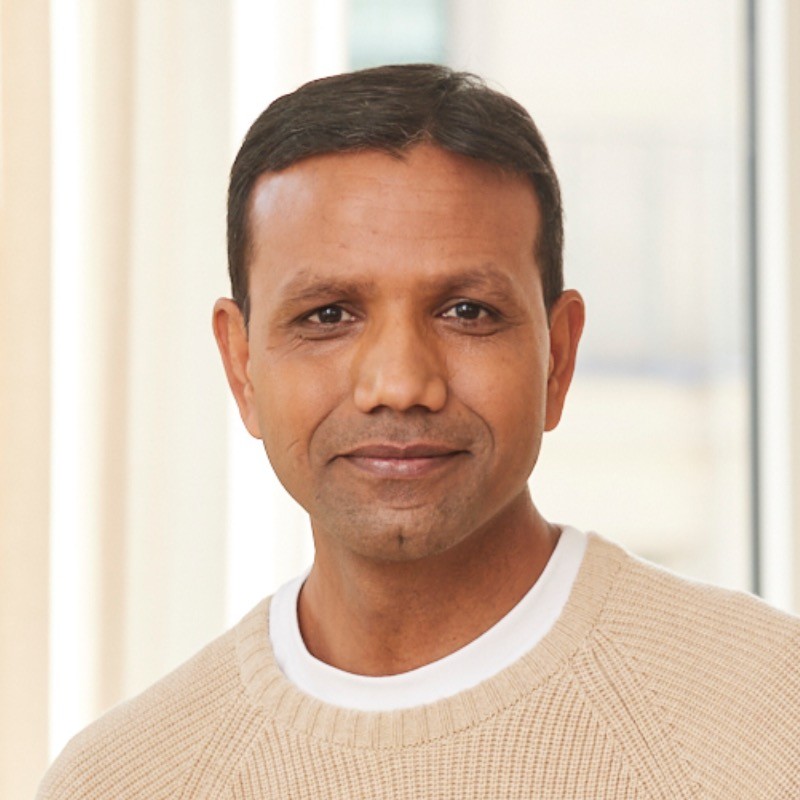
Brijesh Tripathi and Dali Kilani, FlexAI co-founders
Brijesh Tripathi (right) • CEO, FlexAI
50K+ GPUs managed at Intel
$30M Seed funding raised
60+ FlexAI customers
25+ Countries served

The Kid Who Played with Transformers

At age ten, Brijesh Tripathi was already taking step-down transformers apart. Not the Michael Bay kind - the electrical kind. The kind that converts high-voltage current into something manageable. It was the earliest version of what he would spend the next four decades doing: taking complex, powerful, inaccessible systems and making them work for people who couldn't otherwise touch them.

That impulse carried him from India to NVIDIA's Silicon Valley offices - one of the company's earliest hires via its IIT recruitment program, back when recruiting in India was still a novel idea for US tech giants. From there, a path that reads less like a career plan and more like a guided tour of every major compute platform of the last quarter century.

"Don't over-plan, take life as it comes to you, have an open mind to what's coming to you and be receptive. Don't be too rigid on plans."

- Brijesh Tripathi, EE Times interview

He joined Apple's chip design team in 2010, when the group numbered 25 people working in the immediate aftermath of the iPhone launch. The team now has 17,000 engineers. He was there at the foundation. Then Tesla - working hardware engineering directly under Elon Musk - where the dominant philosophy was that the only real constraints were science and physics, not organizational inertia or conventional wisdom. He describes that stint as his best professional experience.

Intel came next, in the role that would prove most directly relevant to what he's building today. As Vice President of the Accelerated Computing Systems and Graphics (AXG) division, Tripathi oversaw the deployment of Aurora - one of the world's largest supercomputers - and managed over 50,000 GPUs. He understood, at industrial scale, exactly what it takes to provision, orchestrate, and sustain AI compute. He also understood exactly who couldn't do it at that scale: nearly everyone.

FlexAI
Workload-as-a-Service
Founded 2023
HQ Paris, France
Funding $30M seed (April 2024)
Investors Alpha Intelligence Capital, Elaia Partners, Heartcore Capital, Bpifrance, Partech
Partners AMD, AWS, Google Cloud, Intel, NVIDIA
Customers 60+ across 25+ countries
Co-founder Dali Kilani (CTO)
Visit flex.ai →
Quick Facts
Location San Francisco, CA
Role CEO & Co-Founder
Background Hardware + AI
Supercomputer Aurora (Intel, Top-5)

AI for Everyone, Everywhere

The problem Brijesh Tripathi set out to solve at FlexAI is one he watched up close for two decades: AI compute is extraordinarily powerful and extraordinarily inaccessible. The hardware is expensive, the configurations are brittle, the expertise required to run it reliably is rare, and the entire system locks you into a single vendor's ecosystem the moment you commit.

FlexAI's answer is Workload-as-a-Service - a software orchestration layer that routes AI workloads (training, fine-tuning, inference) to the best available hardware automatically, whether that's NVIDIA, AMD, Intel Gaudi, cloud, or on-premises. The platform's intelligence lives in the routing layer: matching workload requirements to compute characteristics, dynamically adjusting as conditions change, and handling the operational complexity so developers don't have to.

"We believe in AI's transformative power to solve some of humanity's biggest problems, but it will require a 1000x magnitude more compute to be able to realise this vision. The availability of AI compute today is limited to a select few. Our vision is to unlock access to compute for the many."

- Brijesh Tripathi, FlexAI launch statement

FlexAI operates as an aggregator of AI compute demand - sourcing hardware from Intel, AMD, and others at preferential rates (leveraging Tripathi's deep relationships from his Intel days), and distributing those economics across its customer base. It's not primarily an NVIDIA play, which is a meaningful strategic differentiator in a market where most AI infrastructure startups live and die by CUDA availability.

"Using any infrastructure in the AI space is complex; it's not for the faint of heart," Tripathi told TechCrunch at launch. The long-term vision is simpler to state than to build: bring AI compute infrastructure to the same level of simplicity that general-purpose cloud has achieved over the past decade.
Domain Expertise
GPU ArchitectureExpert
AI InfrastructureExpert
Hardware EngineeringExpert
Workload OrchestrationExpert
Cloud + On-Prem SystemsExpert
"

Infrastructure should never slow down innovation.


Every Stop, a Bigger Machine

2000 - 2007
Sr. Design Engineer
2010 - 2015
Platform Architect
2016 - 2018
HW Engineering Lead
2018 - 2019
VP Hardware Eng.
2021 - 2023
VP, AXG
2023 - Now
CEO & Co-Founder
2000 - 2007
Joined NVIDIA as one of the company's earliest hires from India, recruited directly via its IIT program. Spent seven years as a Senior Design Engineer building foundational GPU expertise.
2010 - 2015
Joined Apple as a Platform Architect when the chip design team had just 25 members - shortly after the original iPhone. The team grew to 17,000. He was there at the beginning of Apple Silicon's origin story.
2016 - 2018
Led hardware engineering at Tesla, reporting directly to Elon Musk. Adopted the philosophy that the only real constraints are science and physics. Calls it his best professional experience.
2018 - 2019
Joined Zoox as VP of Hardware Engineering before Amazon acquired the autonomous driving startup.
2021 - 2023
Became VP at Intel's AXG division. Oversaw deployment of Aurora - one of the world's largest supercomputers. Managed over 50,000 GPUs. Saw firsthand who couldn't access that kind of compute: nearly everyone.
2023 - Present
Co-founded FlexAI with Dali Kilani. Raised $30M seed in April 2024. Now building the Workload-as-a-Service platform that reroutes AI compute from the few to the many.
Anecdote

When Brijesh joined Apple's chip design team, there were 25 people on it. He was part of a small group building what would become one of the most dominant silicon programs in history. That team now has 17,000 engineers. He was present at a moment that most people only read about in retrospectives.

On Tesla

"There are no constraints other than science and physics." The philosophy Elon Musk ran Tesla with is the one Brijesh Tripathi carried directly into FlexAI. Ask why something can't be done before accepting that it can't.


1000x More Compute for the World

🚀
The Problem
AI compute is inaccessible to most organizations. Hardware is expensive, brittle, expertise-intensive, and locked into proprietary ecosystems. The current infrastructure runs on 30-year-old architectural assumptions.
The Solution
FlexAI's orchestration layer routes AI workloads to the best available hardware automatically - NVIDIA, AMD, Intel Gaudi, cloud or on-prem - without code changes. Infrastructure becomes invisible. Innovation doesn't wait.
🌎
The Goal
AI's full potential requires 1000x more compute than exists today. Tripathi's goal: make that compute available to any developer, any company, anywhere in the world - not just the ones with Intel-scale budgets.

"Bankers now know how to use GPUs as collateral."

- Brijesh Tripathi on the new economics of AI infrastructure financing

Quotable

"

Infrastructure should never slow down innovation.

"

The availability of AI compute today is limited to a select few. Our vision is to unlock access to compute for the many.

"

We want to bring AI compute infrastructure to the same level of simplicity that general purpose cloud has.

"

There are no constraints other than science and physics.

"

Using any infrastructure in the AI space is complex; it's not for the faint of heart.

"

Don't over-plan, take life as it comes to you, have an open mind and be receptive.


The Details Worth Knowing

10
Age when he started playing with step-down transformers. The obsession with converting powerful, inaccessible systems into something usable started early.
25
People on Apple's chip design team when Brijesh joined. It now has 17,000 engineers. He was present at the very beginning of Apple Silicon's rise.
50K+
GPUs managed during his time at Intel's AXG division, giving him rare operational insight into what large-scale AI compute actually requires.
1000x
The magnitude of additional compute Tripathi believes AI needs to realize its full potential - the ambition that drives every product decision at FlexAI.
#1
NVIDIA's early India IIT hire program gave Tripathi his first US opportunity - one of the earliest cross-border talent pipelines in Silicon Valley semiconductor history.
Aurora
The Intel supercomputer Tripathi helped deploy - one of the world's largest and most powerful - now powering research at Argonne National Laboratory.

What He's Built

🏆
Aurora Supercomputer
Led deployment of Aurora at Intel AXG - one of the world's largest supercomputers, housed at Argonne National Laboratory, capable of exascale computing.
📈
FlexAI $30M Raise
Co-founded FlexAI and secured $30M in seed funding from Alpha Intelligence Capital, Elaia Partners, Heartcore Capital, Bpifrance, and Partech in April 2024.
📋
Apple Silicon Foundation
Was part of Apple's chip design team from its early days, contributing to the architectural foundations that became the A-series and M-series SoC programs.
Tesla Hardware Lead
Led hardware engineering at Tesla under Elon Musk, working on next-generation vehicle compute platforms during a pivotal period in EV development.
🌐
Global AI Platform
FlexAI now serves 60+ customers across 25+ countries, with hardware-agnostic infrastructure supporting AMD, AWS, Google Cloud, Intel, and NVIDIA.
🔐
Multi-Architecture Support
Built FlexAI to support CUDA (NVIDIA), ROCm (AMD), and Intel Gaudi - ending the lock-in that forces most AI teams to bet everything on a single chip vendor.

In Conversation

In this EE Times interview, Brijesh Tripathi traces his path from a 10-year-old tinkering with transformers in India to deploying some of the world's most powerful compute infrastructure. The title captures his philosophy precisely.

The throughline of his career - NVIDIA, Apple, Tesla, Zoox, Intel, FlexAI - is not a plan. It's a series of open doors, each one taken because it offered a deeper understanding of the machine underneath the machine. The willingness to follow the compute is what made him, eventually, the person building the platform that routes it.

Watch on YouTube →

Links