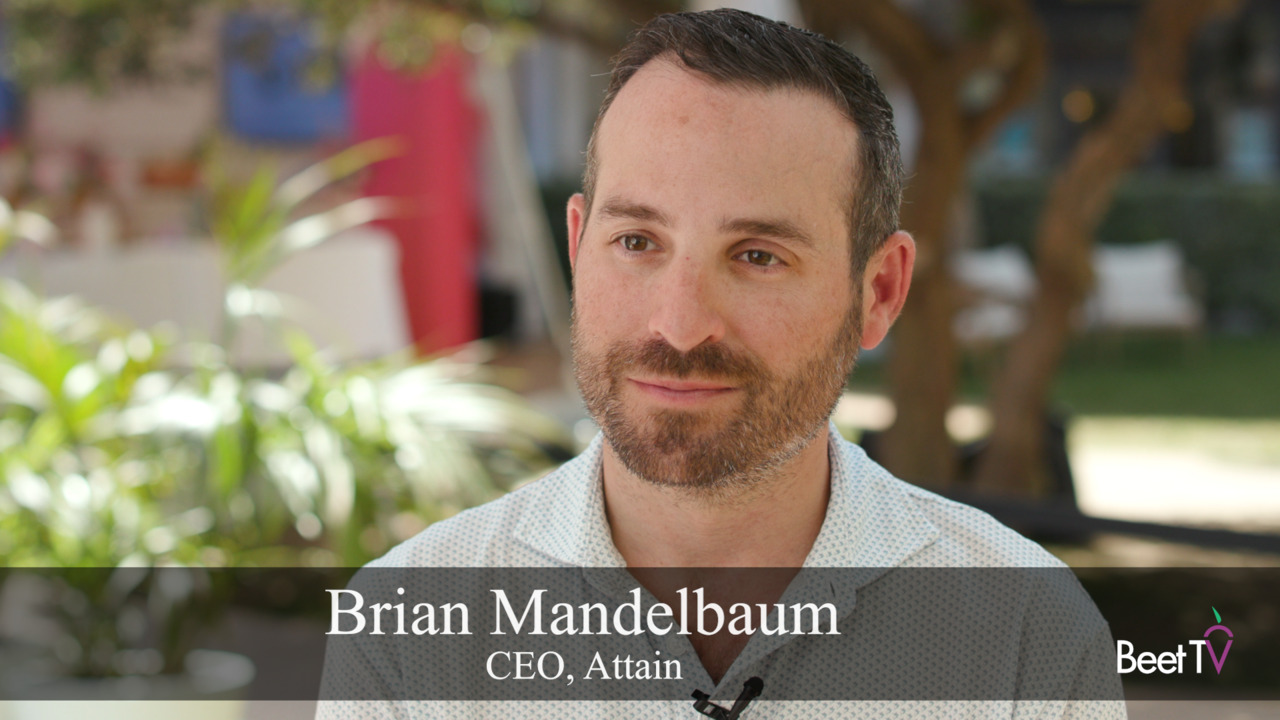
A young planner once walked into Brian Mandelbaum’s office and announced that she wanted his job. He welcomed the ambition. There was room for both of them to move up. It is a small story, but a useful introduction to a founder whose public language revolves around outcomes. Sometimes the outcome is a purchase. Sometimes it is a colleague becoming ready for the next job.
Mandelbaum is the Chicago-based cofounder and CEO of Attain, a company built around permissioned purchase data. His subject can sound forbiddingly technical: audience activation, media optimization, measurement. His underlying question is pleasantly ordinary. After all the money spent on an advertisement, did anyone buy anything?
Advertising has invented many ways to look busy. A dashboard can resemble a cockpit while leaving its occupant unsure whether the aircraft has moved. Mandelbaum’s career follows a persistent attempt to connect the instruments to something happening outside the window.
The education before the company
Before building advertising technology, he worked inside the agencies that bought and planned digital media. At Saatchi & Saatchi in New York, he was director of interactive, overseeing digital strategy, media and integrations for brands including Wendy’s, Cold Stone Creamery, Reynolds and Miller High Life. In 2008, Cramer-Krasselt named him vice president and interactive group media director.
That work put him close to an awkward boundary. Brands wanted an effect in the world: a customer, a sale, another visit. Digital systems supplied a growing inventory of things to count. The relationship between the two was the interesting part. For someone responsible for translating a brand’s ambitions into media decisions, the numbers needed to earn their place in the conversation.
His later ventures would address different pieces of that problem. The continuity matters more than the vocabulary. He had worked with the people spending advertising budgets before he began selling them new ways to evaluate the spending.
First, make sure somebody saw it
In 2011, he founded Clearstream TV, a video advertising business. By October 2014, Clearstream was tackling a remarkably basic defect in digital video: an advertisement could continue playing after its viewer had scrolled away or switched tabs. The advertiser had bought an opportunity to be seen. The browser had supplied an opportunity to be elsewhere.
Clearstream’s Play-In-View technology paused the advertisement when it moved out of view. It resumed when the viewer returned. This was a practical, occasionally uncomfortable expression of the bargain behind free online content. Attention had a price, and Clearstream wanted the transaction to involve actual attention.
The distinction was already central to Mandelbaum’s work. Counting a video’s delivery could produce a tidy report without establishing whether a person had watched it. A better measure required looking more closely at the person’s behavior. Clearstream was acquired by Engine Group in 2015. Mandelbaum had taken a concern familiar from agency life and built a company around it.
The customer gets a seat at the table
Attain began in 2019 with Mandelbaum and technology cofounder Dominic Bennett. The business was originally called Klover. Its premise brought a different participant into the advertising bargain: the consumer whose purchases made the data valuable in the first place.
Consumers would receive benefits through financial tools and rewards while giving permission for their data to be used. For marketers, the resulting purchase information could help explain what people bought, where they bought it and how their behavior changed. The company’s opportunity depended on keeping both sides interested.
In November 2022, the parent company adopted the Attain name and announced a $25 million Series B led by Mercato Partners. The consumer app retained the Klover name. The separation made the two audiences easier to understand: a person using an app for everyday benefits, and a business using commerce data to make marketing decisions.
The consumer side kept developing. Attain launched shopping rewards app Frisbee in 2023 and acquired Merryfield in September 2024. Each added another way for consumers to participate. The company described Merryfield as a means of broadening the composition and depth of its purchase panel. For a business interpreting shopping behavior, who participates is part of the product.
The long distance between an ad and a sale
By 2023, Mandelbaum was arguing for a wider understanding of performance. Consider connected television. Someone sees an advertisement while watching a program and buys later, somewhere else. There may be no convenient click connecting the two events. That does not make the advertising irrelevant.
His answer included media mix modeling, which examines statistical relationships between sales and the different influences on them. The point was to consider the full range of a brand’s marketing investments. An advertisement should not lose its claim to usefulness merely because the checkout happens on another screen, or at a physical counter.
Partnerships turned the argument into infrastructure. In May 2023, Attain announced a relationship with The Trade Desk intended to give advertisers faster feedback on purchases and campaign performance. In October, it announced a joint solution with DoubleVerify connecting attention measures to purchase outcomes. One relationship addressed the buying workflow; the other addressed the gap between being noticed and being acted upon.
These are related questions, but they require different evidence. An ad can be visible without being persuasive. A purchase can follow an ad without proving the ad caused it. Connecting the records makes the question more tractable; careful analysis still has a job. Mandelbaum’s commercial wager is that marketers will pay for a better view of that distance.
The shoppers who spoiled the stereotype
Purchase data can also puncture a comfortable assumption. In January 2024, Mandelbaum appeared on Bloomberg Technology with Ed Ludlow to discuss Temu. The shopping app’s reputation suggested a young audience. Attain’s analysis pointed toward older customers as especially loyal shoppers.
In the company’s account of Temu’s first full year in the United States, Baby Boomers aged 59 and older placed roughly six orders over twelve months, about twice the frequency of Gen Z shoppers aged 18 to 26. The finding came from Attain’s consumer panel. It described observed activity within that analysis, rather than granting any generation a permanent shopping personality.
For Mandelbaum, it was a useful demonstration of what the company sells. A cultural impression of a retailer and its customers can be vivid, plausible and commercially misleading. The receipt supplies a less fashionable witness. It has the advantage of having been there.
A word follows him down the Croisette
At Cannes Lions in 2025, he noticed the industry catching up with his preferred vocabulary. A year earlier, he had been talking about outcomes. Now the word seemed to follow him along the Croisette, appearing throughout the festival’s marketing scenery. Advertising is rather good at adopting a word. Making the word useful takes longer.
Attain’s involvement in PMG’s Alli Marketplace offered one route. Rather than leaving purchase information in a separate report, the aim was to bring it into planning, buying, activation and measurement. Feedback becomes more useful when it arrives where a decision can still be changed.
Mandelbaum also resisted treating brand advertising and performance advertising as rival camps. Emotional, expansive brand work still mattered in his account. The demand was accountability across the investment. A memorable campaign and a finance director’s questions could occupy the same room without either having to leave.
His April 2025 explanation of Attain’s work with Experian extended that practical emphasis. Purchase-based audiences could be used across television, social and programmatic channels, with live sales signals helping advertisers adjust campaigns while they ran. His interest was in shortening the interval between learning something and being able to act on it.
The currency he uses inside the office
Inside a company, his preferred vocabulary changes. “I actually value loyalty as a currency,” he says. He describes trust as reciprocal and wants employees to exercise judgment without waiting for instructions. Seeing former colleagues advance gives him particular satisfaction. His mentorship goal is that people leave their time working together better equipped than when they arrived.
“I actually value loyalty as a currency.”
Brian Mandelbaum
People who have worked with him describe a similar instinct for making things understandable. Gary Doyle’s public recommendation emphasizes his ability to simplify complex digital strategy and leave colleagues better informed. Jamie Anderson adds a less technical observation about his sharp dressing. Even an advertising technologist, apparently, can be judged on presentation.
A larger question at the checkout
In his December 2025 assessment of the year, Mandelbaum reported nearly 70 percent growth for Attain and more than 100 percent growth in its enterprise business. He also said the company had grown profitably. These were his figures, and his accompanying emphasis was on customers expanding their use of the platform and on disciplined investment.
His newer project broadens the ambition. With Till 1.1, he describes a demand model trained on actual transactions and evaluated against subsequent purchases. The proposed uses extend to retailers deciding what to stock, brands planning products and investors examining demand. Advertising supplied the original reason to assemble the data; he now sees more questions it might help answer.
That remains a proposition to test. Its appeal is easy to understand. People have complicated relationships with the things they intend to buy. Plans change between a conversation and a checkout. Mandelbaum has built a career around examining what survives that journey. The next prediction will still need to meet the next receipt.
Keep following the receipts
Attain - the companyBrian Mandelbaum on LinkedInWatch: the Temu conversationWatch: accountability at CannesListen: the measurement debateListen: mentorship and trustRead: purchase data with ExperianRead: Mandelbaum introduces Till 1.1Profile updated October 23, 2026. Growth figures reflect Mandelbaum’s public account of 2025.