Matt Maloney was working on a question about apartments when dinner intruded. At Apartments.com in Chicago, he and fellow developer Mike Evans dealt with geographic searches: people in one place looking for something in another. After enough late nights and repetitive takeout orders, the missing application became rather obvious. A city could put its rental housing online. Surely it could manage a menu.
The resulting business, founded in 2004, asked a more precise question than where to eat. Which restaurants would deliver to this particular address? A nearby kitchen might sit outside your delivery area. A restaurant you had never heard of might happily come to your door. The boundary mattered as much as the distance. Maloney had found a practical use for his working knowledge of maps.
There is something endearing about a technology company beginning with such an ordinary irritation. Nobody needed to cultivate a new appetite. The appetite was already there, becoming less patient by the minute. Maloney and Evans needed to organize information that existed in scattered menus and make it useful when someone wanted to eat.
By July 2009, Maloney was describing an expansion that had proceeded from a neighborhood guide to Chicago, then San Francisco, Boston, New York, Philadelphia and Washington. Each city brought the same question and a different collection of answers. Dinner was a repeatable need. The restaurant list had to be assembled all over again.
A programmer goes back to school
Maloney came from Spring Lake, Michigan, and graduated from Michigan State University in 1998, having studied natural science. He met his wife, Holly, there. He later earned a computer science master’s degree at the University of Chicago in 2000 and a Booth MBA in 2010. His education traces a change in the problems he wanted to solve: first scientific, then computational, then commercial.
The business degree arrived after the business had begun. That order matters. He had something customers could use, but running a company demanded abilities that writing software had not supplied. The classroom offered a place to ask questions with consequences waiting back at work.
Even admission to Booth’s New Venture Challenge was awkward. His first application failed. After he explained the business to professor Steve Kaplan, the gap between the actual venture and the written plan became apparent. Maloney entered the competition and eventually shared first place in 2006. Explaining a working idea turned out to be a separate job from having one.
The price of a yes
The original restaurant pitch involved paying for prominent placement on the website. Restaurants were reluctant. A listing was another expense, and an audience somewhere on the internet was a difficult thing to put in the till. The founders changed the proposition to a commission on orders. Payment would follow a sale.
“I make a dime when you make a dollar.” Maloney’s compact explanation of that change gets to the appeal. It gave the restaurant owner a way to connect the fee with something concrete. The arithmetic could be discussed across a counter.
Learning to sell was uncomfortable for him. In a later conversation, he described wanting a natural discussion and finding the repetition of a sales pitch awkward. Yet a useful pitch had to survive repetition, revision and another call. He came to see the same activity in fundraising and board meetings. A programmer who became a chief executive still had to persuade another person to act.
New city, same empty stomach
Winning a competition did not immediately produce a cheque. Grubhub’s first institutional financing arrived in 2007, with Origin Ventures leading the Series A. The interval between endorsement and investment is an inconvenient part of the founding story. Applause cannot pay a company’s bills, even when it comes from knowledgeable people.
Geographic growth also placed limits on the romance of an internet business. The service could be reached from anywhere; a useful local restaurant network could not. Chicago’s supply did little for a hungry person in San Francisco. The company had to build local relevance repeatedly.
In 2012, Maloney and Evans visited Zillow for a lunchtime discussion. There was a pleasing circularity to developers from an apartment-search business explaining a food-search business to a property-search company. Their subject remained the everyday friction between wanting something and finding a convenient way to get it.
A bell, a bag, and Monday morning
The 2013 combination with Seamless brought together two businesses solving related problems in different markets. Maloney became CEO of the combined company. It was an exercise in assembling customers, restaurants and people before the next exercise: becoming a public company.
On April 4, 2014, he stood at the New York Stock Exchange for Grubhub’s debut. The photograph has the usual suits and applause, plus people dressed as food and an enormous takeout bag. Financial ceremony occasionally benefits from admitting what the business actually sells. This one did so with considerable enthusiasm.
The IPO raised about $192 million. Maloney’s fond recollection was of the following Monday, when the roadshow and preparations were over and the office could get back to work. His verdict was brief: “Let’s attack.” A public listing had enlarged the resources available to the company, along with the audience watching it.
He liked the practical benefits of public ownership: funds for acquisitions, help recruiting and more confidence from restaurants. The exchange bell made a photograph. The balance sheet made further moves possible. For a founder who stayed in charge after listing, the distinction shaped what the celebration was for.
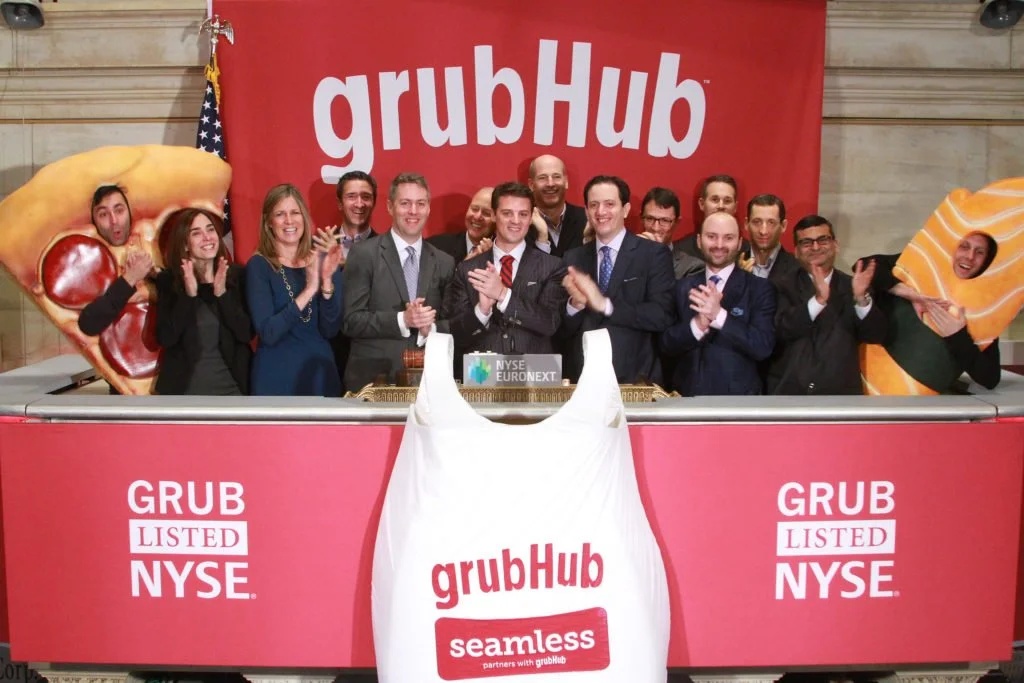
Photo: Ben Hider / NYSE Euronext, via Origin Ventures.
A milestone with Monday’s work still waiting.
The fax machine gets a vote
An ordering website could look wonderfully simple from a sofa while remaining complicated in the kitchen. Early orders went to restaurants by fax. Machines jammed or ran out of ink. Grubhub developed tablet software so restaurants could confirm orders and manage information. A diner’s elegant few taps still depended on somebody receiving the request at the other end.
That detail is a useful corrective to a frictionless account of Maloney’s career. Food requires preparation, confirmation and a trip through actual streets. Software can arrange the work; the work remains. A company selling convenience inherits a surprising number of ways for an evening to go wrong.
By 2019, the business faced a harder public argument about who benefited from its convenience. Restaurant websites created by Grubhub attracted criticism over control and commissions. Maloney defended the practice, saying restaurants had given permission; reporting also included an owner who disputed that account. The relationship between a platform and its merchants had become contentious.
In interviews, he challenged competitors over fees while defending the volume of orders Grubhub could bring restaurants. The same business that had won an early yes by linking payment to sales now had to defend the terms of a much larger relationship. Growth brought scrutiny of the bargain itself.
Seventeen years, then a handover
On June 15, 2021, the acquisition by Just Eat Takeaway.com closed. Adam DeWitt, previously Grubhub’s president and chief financial officer, became CEO. Maloney moved to the parent company’s management board, with responsibilities including North America and integration. His time as Grubhub CEO had lasted roughly seventeen years.
In October, Just Eat Takeaway announced that he would leave its management board effective December 1. The stated purpose was to pursue other opportunities. These were two distinct transitions: handing over day-to-day leadership of Grubhub in June, then leaving the parent’s executive board at the end of the year.
His interests had already extended beyond his own company. He invested in Morsel, a Chicago venture for culinary photographs and stories, and contributed to The Wall Street Journal’s Accelerators blog. He had also served in Chicago’s entrepreneurial institutions. The founder’s experience had become something other people could draw on.
Maloney joins the JET management board.
JET management board takes effect.
Dinner delivery meets the hard shoulder
By 2026, another local-service problem had his attention. Curbside SOS, whose founders include Maloney, Ryan Ruttan and Anthony Ina, sought to connect motorists with roadside providers through a digital marketplace. Prices, provider choice and vehicle tracking took the place of wondering who might eventually turn up.
In April, Frontenac announced its recapitalization of Honk Technologies. The combined roadside business reunited several Grubhub colleagues: DeWitt as CEO, Maloney as chairman and Eric Ferguson as chief operating officer. They had worked together on coordinating a service across many local markets. Now the customer might be beside a stationary car.
“Roadside assistance is a real-time logistics challenge,” Maloney said in July, when Honk announced further leadership additions. Ray Schauer, a longtime Grubhub engineering executive, was named incoming chief technology officer. The reunion extended into the technical team.
The resemblance between the businesses is specific. Both require matching a local request with someone able to fulfill it, then keeping the customer informed. The differences are equally practical. A stranded motorist has different needs from someone ordering dinner. Experience supplies useful questions; the new business still has to answer them.
“Roadside assistance is a real-time logistics challenge.”
Matt Maloney · July 2026
Another seat at the table
On October 14, 2026, HighLevel announced Maloney’s appointment to its board. The software company serves businesses and agencies, putting him alongside founders Shaun Clark, Varun Vairavan and Robin Alex. He connected the opportunity with his earlier work helping independent restaurants turn technology and digital marketing into sales.
The appointment places him in a different role from the one that made his name. A board member contributes judgment while founders and executives run the operation. At Honk he chairs the board; at HighLevel he joins it. Both positions give his experience a use beyond repeating his former job title.
His public stories retain smaller pleasures, too. Maloney and Holly have spoken about visits to Ireland, including family-history travel to the Dingle Peninsula and stops at the Guinness factory in Dublin. An account of somebody’s working life can make room for an itinerary that has nothing to do with raising capital.
The most revealing continuity is his interest in tasks people already need done. Find an apartment. Find dinner. Find someone who can help with the car. There are grander ways to describe a technology career, but these questions explain why a customer might bother opening an app. Maloney’s next chapter returns him to that moment: a person in a particular place, waiting for something useful to arrive.
Keep the conversation going
- Matt Maloney on LinkedIn
- Matt Maloney on X
- Honk Technologies
- Grubhub: the company profile
- Watch: Maloney discusses the Just Eat Takeaway deal on CNBC
- Listen: his New Venture Challenge conversation
- Read: Maloney on Grubhub’s early decisions
- Read: Honk’s 2026 leadership announcement
- Read: HighLevel’s board appointment