Mark Lawrence had accumulated about $5,000 in parking tickets. For someone who loved driving, Chicago was providing an expensive education in what happened afterward. Plenty of people respond to this sort of instruction by complaining about the city. Lawrence helped start a company. The complaint, at least, would have required fewer meetings.
SpotHero’s early proposition was easy to understand: find a place to leave the car before arriving with a car that needed leaving. The difficult part was assembling enough places, persuading people to book them, and making a digital promise survive contact with an actual parking garage.
Over the next fifteen years, Lawrence would move from recruiting individual parking hosts to running a network spanning the United States and Canada. Uber completed its purchase of SpotHero in April 2026. Between the tickets and the transaction lies a less tidy story about knowing when a business is ready for its next address.
A business hiding in the driveway
Lawrence came to entrepreneurship through finance. He studied at Bradley University and worked as a financial analyst at Bank of America. His education included Spanish as well as finance, a detail that gives his résumé a little more range than the usual uninterrupted march through spreadsheets.
In Chicago, Lawrence and Jeremy Smith began working on the parking problem that became SpotHero. Larry Kiss joined the founding team. The service launched in 2011, initially connecting drivers with private spaces, including driveways near Wrigley Field. Baseball offered a particularly clear meeting of people with somewhere to park and people who badly wanted somewhere to park.
The first version depended on recruiting hosts individually. Lawrence recalled trudging through Chicago snow to ask people to list their spots. After a year, he had assembled 50 spaces. A lunch with a parking company in the second year brought access to another 1,000. The weather had supplied a useful critique of the sales process.
Spaces recruited, as Lawrence recalled them. A comparison of two anecdotes, not an annual growth series.
Partnering with garages gave the marketplace access to inventory that already existed at scale. Owners had parking to sell; drivers needed a way to discover and reserve it. The business could concentrate on connecting those interests. A driveway had demonstrated the idea. Garages gave it room to operate.
The map could wait
By December 2012, SpotHero had announced a $2.5 million financing round led by Battery Ventures, following its time in Excelerate Labs. It had eleven employees and operated in Chicago and Milwaukee. Lawrence said the money would support engineering, marketing and expansion. There was already an ambition beyond the neighborhood.
How to expand was the argument. Investors pointed toward competitors adding cities. Lawrence wanted to make the service useful in a concentrated market first. A driver in Philadelphia had little reason to celebrate a company’s impressive selection in Boston. Each arrival was stubbornly local.
He put competing revenue scenarios in front of investors and argued for a more sequential approach. Concentrating bookings could also make SpotHero more consequential to individual garage partners. Strong relationships in one market helped open conversations with operators whose businesses extended much farther.
“I didn’t know I was right.”
Mark Lawrence, on his early expansion decisions
That admission gives the story its tension. Retrospect makes strategy look like a road with the exits conveniently labeled. Lawrence had to choose while other people were proposing different routes. His account includes doubt, calculations and deadlines. Patience still needed a schedule.
The sequence eventually reached Washington, D.C., where SpotHero launched with 100 locations. There is a practical difference between announcing a city and offering enough choice there to become useful. For a marketplace, a map can describe ambition long before it describes a satisfactory customer experience.
Please park your own car
Another argument concerned who should do the parking. App-based valet businesses promised drivers the convenience of handing over their cars and summoning them back. For a customer, the appeal was obvious. For the business, every handover also involved labor, coordination and time.
Lawrence faced pressure to try that model. In his later conversation with Guy Raz, he described testing it and concluding that the economics did not work for SpotHero. The company returned to its core approach: make a reservation and let the customer drive into the space. Convenience still had to pay its way.
In April 2017, SpotHero acquired Parking Panda, a rival that had figured in those earlier expansion debates. The all-stock transaction added twenty cities, including Canadian markets. A company once held up as an example of how quickly Lawrence should expand became part of the business he had built more deliberately.
The acquisition offers a satisfying reversal, although the broader lesson resists a slogan. Different kinds of growth impose different obligations. More garages demand reliable relationships and usable reservations. Valet service adds people moving vehicles through traffic. The same friendly button on a phone can conceal very different businesses.
A customer opening either app might see a price, a location and a way to pay. Behind that screen, the company has to decide what it is promising to deliver. Lawrence’s choice kept the reservation at the center of the transaction. The driver would handle the part that drivers already knew how to do.
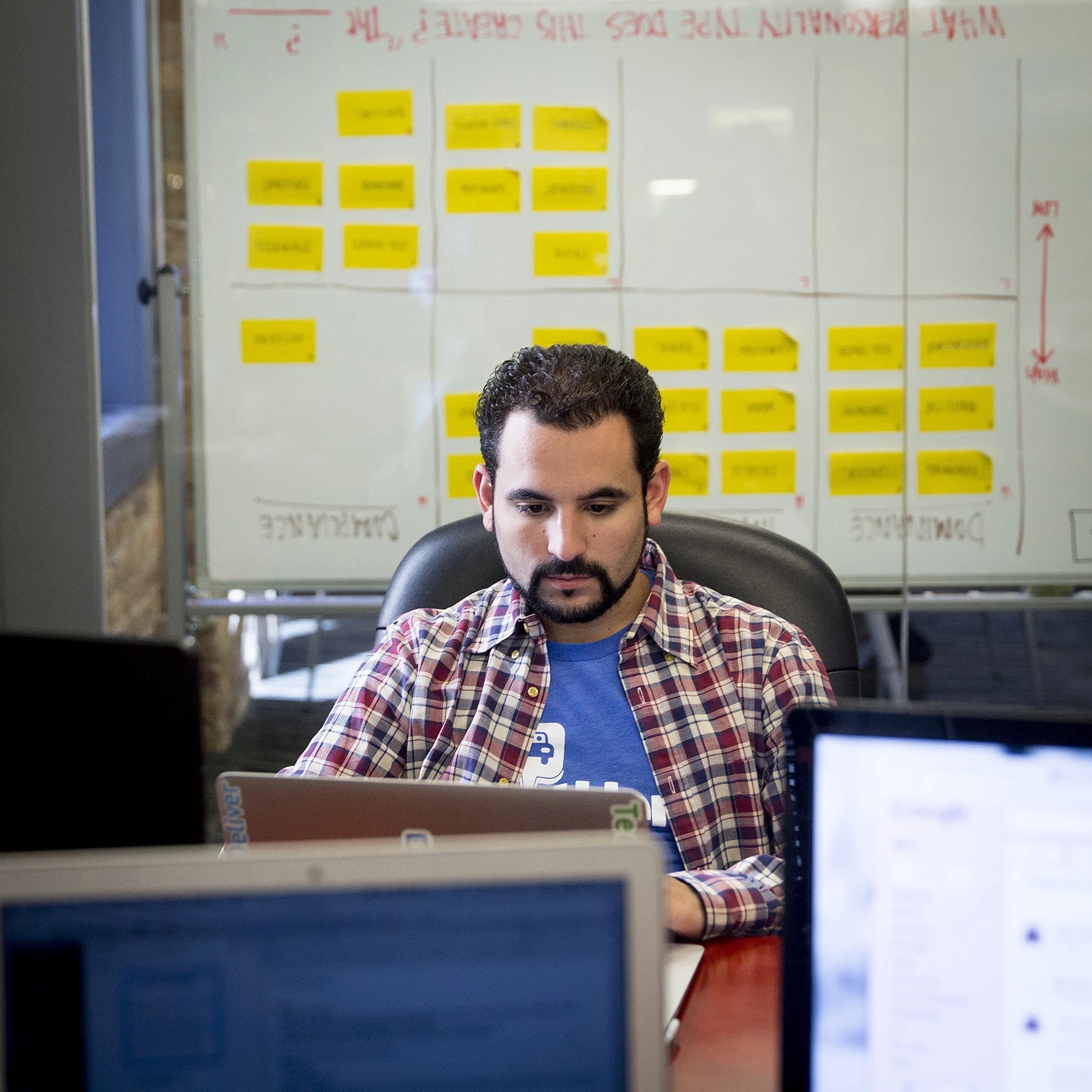
The desk behind the app
By his 2016 Tech in Chicago interview, SpotHero had raised a $20 million Series B, reached fifteen cities and grown to a team of 120. The conversation covered hiring, culture and launching new markets. These are different problems from finding the first host willing to rent a driveway, even when the company name stays the same.
The accompanying reading list has its own interesting parking arrangement. Books about Howard Schultz and Richard Branson sit alongside Liz Wiseman’s Multipliers and James Clavell’s Shogun. Business memoirs share shelf space with a large historical novel. It is a more companionable list than a row of manuals all promising the same seven steps.
Recognition also arrived from the industry he had entered. Lawrence was named to the National Parking Association’s inaugural 40 Under 40 class in 2015. Years later, SpotHero announced his selection as an Outstanding Tech CEO finalist for the 2024 Momentum Awards. The milestones span both parking and Chicago’s technology community.
His work has extended beyond SpotHero. Workstorm lists him on its advisory board. Mode Mobile’s filings document his board service beginning in February 2021. He also participated as an individual investor in Quake Media’s 2021 funding round. The parking founder has been invited into other rooms, with other products to consider.
A reservation needs an entrance
For all the talk of marketplaces, the product has a physical test. Someone must reach the garage. In 2019, SpotHero integrated Waze so a driver could move from a booked space to navigation directed toward that location. The companies had already worked together on navigation beacons for Chicago’s underground roads.
This is the unglamorous territory where a useful app earns its place on a phone. Buying parking and finding the entrance are separate actions. Helping the customer connect them reduces an awkward gap in the journey. Software gets judged on streets that were laid out without consulting the software.
There is a human scale to that problem. A parking reservation belongs to the minutes before something else: work, a game, an evening out. Drivers rarely set off hoping for a memorable garage experience. An uneventful arrival is a respectable product outcome, even if it makes a rather subdued advertising campaign.
Even the future needs somewhere to stop
Lawrence has also argued that autonomous vehicles will need parking infrastructure. Back in 2018, he was discussing garage upgrades that could allow vehicles to enter and leave without a human driver managing the transaction. Changes intended for future vehicles could improve the experience for present customers too.
He returned to the subject in his May 2026 appearance on All Things Parking with Dani & John. The conversation examined the idea that autonomous fleets might make garages obsolete. Lawrence challenged the assumption of vehicles remaining perpetually in motion. His interest remains in the practical arrangements that transportation forecasts sometimes hurry past.
It is an argument about the boundaries of a trip. Mobility companies organize movement; a journey also contains pauses. Nobody needs to settle every prediction about car ownership to recognize that the place where a vehicle waits can affect how the whole system works. Lawrence has made that waiting place his business.
The next passenger is Uber
On February 23, 2026, Uber and SpotHero announced their acquisition agreement. Uber described plans for parking reservations within its app, initially focused on commuters, events, venues and airports. It also outlined future parking benefits for Uber One members. These were plans for the combination, with execution still ahead.
Uber’s cash purchase price for SpotHero. Company transaction value.
The transaction closed on April 16. Uber’s quarterly filing records a $617 million cash purchase price for all outstanding SpotHero equity. Fifteen years after the public launch, the company had become part of a transportation platform with a much larger audience.
SpotHero’s current company page lists more than 14,000 garages, lots and valets in over 400 North American cities. Lawrence is still listed as co-founder and CEO. The scale is far removed from the first neighborhood listings, although the customer’s immediate request remains remarkably familiar.
A driver wants somewhere to put the car. Lawrence’s career has accumulated financing rounds, partnerships, acquisitions and board seats around that modest sentence. It began with the irritation of arriving without an answer. The business he built lets somebody else leave home with one.
Continue the ride
Conversations, company details and further reading.
SpotHero website ↗Mark Lawrence on LinkedIn ↗Watch: All Things Parking, May 2026 ↗Listen: How I Built This with Guy Raz ↗Tech in Chicago interview and reading list ↗The early expansion decisions ↗Lawrence on the first listings and garage partnerships ↗Mode Mobile board biography ↗Workstorm advisory biography ↗The Waze navigation partnership ↗Lawrence on autonomous-ready garages ↗2024 Momentum Awards finalist announcement ↗SpotHero’s founders and current network ↗Quake Media’s 2021 funding round ↗