The carpet came out of a van. Eric Lefkofsky was a first-year student at the University of Michigan when a friend’s father offered a modest proposition: sell remnants to students and keep half the profits. Dorm rooms needed something underfoot. A carpet store had pieces to spare. Between them sat a business, provided somebody was willing to do the selling.
His partner was Noah Siegel. By sophomore year, they had sold $40,000 worth of carpet. A year later, their operation covered five universities and generated $300,000 in annual gross sales. These were useful sums for students. They were also an education in a particular kind of opportunity: something already exists, somebody needs it, and the arrangements between the two could be improved.
Lefkofsky called the business Apex Industries. The extra word gave a small enterprise a pleasingly large silhouette. Even the carpet had a corporate ambition.
The van came first
He used profits from the carpet business to launch Mascot Sportswear, selling children’s clothing with college-team logos. He ran it while studying, continuing into law school. He earned his undergraduate degree at Michigan in 1991 and his J.D. in 1993. The qualification was in law; much of the extracurricular practice involved customers.
Today, Lefkofsky is the founder and CEO of Tempus AI. The better-known shorthand for his earlier career is Groupon. Both descriptions leave a considerable amount of machinery outside the frame. There are printing presses, freight routes, advertising transactions and a partnership with Brad Keywell stretching back to the 1990s. There are also failures, which tend to receive less space in the polished version of a founder’s biography.
Two failures, one surviving partnership
After law school, Lefkofsky and Keywell bought Brandon Apparel Group, a Wisconsin clothing business. Sales grew, but debt grew with them. When the market turned, the obligations became too heavy. Their next attempt, Starbelly, took them onto the internet and into promotional products.
Starbelly found a buyer. Its subsequent business history was less satisfying. Lefkofsky has described both Brandon and Starbelly as failures, distinguishing the money a transaction can produce from the durability of the business underneath it. That is an awkward distinction for anyone hoping to arrange a career into a neat procession of victories.
The partnership continued. The next company was InnerWorkings, founded in 2001. Keywell and Lefkofsky later founded Echo in 2005 and MediaBank in 2006. Keeping the relationship while changing the work became a recurring feature of their careers. A failed company could close off one route without requiring the two men to abandon every lesson, contact and working habit acquired along it.
“I have never been afraid to act.”
Eric Lefkofsky, 2012
The appeal of an empty printing press
InnerWorkings dealt with print procurement. The underlying opportunity was unused capacity: finding a printer able to take an order and connecting that capacity with a customer. Printing may lack the conversational glamour of a new consumer app, but a printing press has the virtue of making the business problem rather concrete. Idle machinery produces no invoice.
Echo applied technology to transportation and logistics. MediaBank, a predecessor of Mediaocean, addressed the buying and management of advertising. The industries differed. Each required attention to the information moving around a transaction, along with the goods or services being purchased.
Read together, these ventures suggest a recurring interest in coordination. That is one way to understand a career whose company names otherwise seem to belong in several separate biographies. The software mattered because a truck, a print order or an advertising purchase still had to reach its destination. The proposition had to survive an ordinary working day.
A reading of three business models, rather than a measure of their financial performance.
The coupon was a change of plan
Groupon brought another person’s idea into the story. Andrew Mason had worked at InnerWorkings before starting The Point, a venture intended to organize collective action. Lefkofsky backed it. The team eventually redirected its approach toward group buying, and Groupon emerged in 2008.
For Lefkofsky, this was a change in the relationship between money and invention. Earlier, he and Keywell had principally founded and operated their own businesses. Here they were financing someone else’s initial vision and working with someone else’s management team. He later identified that difference as an important step toward Lightbank.
There is a useful complication in the titles. At Groupon, Lefkofsky was a co-founder and first investor, then chairman, then CEO. In his account of the early company, he helped Mason with finance, operations and legal work. As executives arrived, responsibilities moved to the people hired to carry them. The founding team gradually had fewer hats to distribute.
He took the CEO job in August 2013. On November 3, 2015, Rich Williams succeeded him, and Lefkofsky returned to chairman. Those dates describe a period of direct operating responsibility inside a much longer association. A founder’s relationship with a company can change substantially while the name on the biography stays the same.
A venture fund with its sleeves rolled up
Lightbank began in 2010, formalizing work Lefkofsky and Keywell had already been doing. By April 2011, Lefkofsky was discussing nearly twenty investments made over fifteen months. The intention extended beyond supplying capital: their experience building companies was part of what they offered the next set of founders.
His 2012 description of the firm was unusually revealing. He wanted room to invest at different stages, take different ownership positions and get involved at different levels. He imagined an organization with something of Berkshire Hathaway’s relationship to its businesses, translated into technology. That was an aspiration, rather than a description of a completed institution.
He was equally interested in who would run the companies. He singled out Eric Belcher at InnerWorkings, Doug Waggoner at Echo and Bill Wise at Mediaocean as executives he was proud to have helped recruit. The pleasure of starting a business appeared alongside an appreciation for the people required to keep it working.
His impatience with abandoning a difficult investment came through in a short sentence: “We don’t like moving on.” It is a revealing preference from someone whose career contains so many changes of direction. The attachment was to building the business, even when the original arrangements needed revising.
Crowded rooms, clear purpose
Lefkofsky’s thoughts about office culture began, at least on one occasion, with a seating problem. Asked how to create a good culture, he suggested hiring energetic people and putting them in a small space. He later explained that he was only half kidding.
In the same essay, he moved from crowded offices to shared purpose. His examples included Groupon employees helping local merchants reach customers and teams at Uptake working with information from industrial equipment. He wanted employees to understand the practical reason for their company’s existence. A mission had to connect with something people could recognize in their work.
That gives his view of culture a working test: can the people doing the job explain why it matters? Office density may bring people into conversation. It cannot supply the answer for them. His essay’s opening joke makes the distinction more memorable than another list of company values pinned to a wall.
He has also described limits to his own availability. In an interview during his Groupon CEO years, he recalled keeping evenings and weekends apart from work through much of his career. Time away helped him clear his head. He described persistence and rationality as qualities he tried to bring to difficult problems. These are his assessments of himself, with the modest but necessary qualification that trying is part of the sentence.
A longer engagement with Chicago
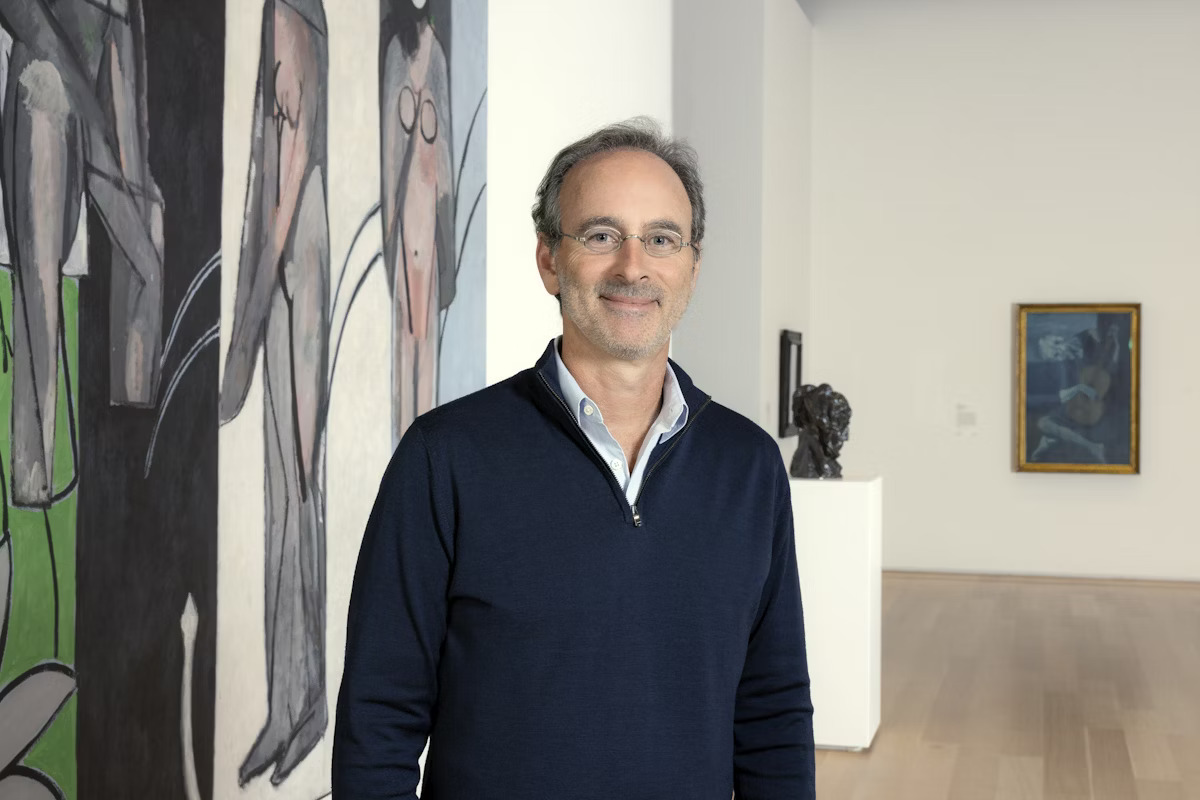
In November 2024, Lefkofsky became chair of the Art Institute of Chicago’s Board of Trustees, succeeding Denise Gardner. He had already spent fifteen years on the board and had served as vice chair since 2023. The appointment brought a longtime contemporary-art collector into a role spanning both the museum and the School of the Art Institute.
His stated ambitions included developing the campus and continuing to educate artists, designers and scholars. A company launch and a museum trusteeship run on different calendars. Here, the headline appointment followed a decade and a half of participation.
At Steppenwolf, the Liz and Eric Lefkofsky Arts and Education Center offers another expression of that involvement. Its fourth floor, The Loft, houses dedicated learning spaces and gallery walls for young people’s artwork. The institution’s education programs include student matinees, workshops, school partnerships and opportunities for early-career professionals. These are places and activities with uses beyond a donor’s name on a building.
Lefkofsky and his wife, Liz, established their family foundation in 2006 and signed the Giving Pledge in 2013. Their pledge letter credited timing, colleagues and good fortune in the accumulation of their wealth. It also acknowledged that donating money becomes easier when there is considerably more of it than a family could need. That admission gave the commitment a welcome sense of proportion.
The work after the ticker symbol
Tempus AI began trading on Nasdaq on June 14, 2024, following an offering priced at $37 a share. Another public listing added a recognizable marker to Lefkofsky’s career. In July 2026, he was still writing quarterly letters as its CEO, discussing operating results and the company’s development.
The student carpet seller now answers questions on a different scale. The useful thread is the succession of practical decisions between those two points: finding a customer, financing an idea, recruiting an operator, staying with a partner, changing an approach. Some ventures prospered. Others failed. Several demanded a different role from the one he had originally occupied.
Apex Industries gave a small business a large name. The years that followed supplied enough businesses to fill it. The more interesting achievement is how much of Lefkofsky’s story still depends on work that happens after the naming.
Follow the conversation
More from Lefkofsky and the institutions in his story.