Alan Goh makes a point of being there. At a Singapore industry congress in 2023, the co-founder and CEO of NDR Medical Technology thanked old friends and prospective partners for visiting his company’s booth. Then came a small declaration: “I will always make it a point to be physically present whenever possible.” For someone whose working life involves automation, he places considerable value on the unautomated business of turning up. A booth, a conversation, a familiar face. The machinery may be complicated. The greeting needn’t be.
That preference offers a useful way into his story. Goh’s career runs through research, manufacturing, teaching and startup investment before arriving at the company he leads today. Along the way are people who reappear in different roles: a university tutor who becomes an adviser, an engineering colleague who becomes a co-founder, overseas business partners whom he calls friends. The recurring detail is continuity. Goh keeps building with people he already has reasons to trust.
Before the pitch, the test bench
Born in Singapore in 1980, Goh graduated from Nanyang Technological University with an engineering degree specialising in mechatronics. His early work at A*STAR involved high-precision instruments and test equipment. Automotive engineering followed at Delphi, where his responsibilities included test development. His career then took him to the Institute of Technical Education as a lecturer and industrial technology consultant. He had worked on the apparatus, the production process and the teaching of technology before taking responsibility for a company of his own.
That sequence gives his later business vocabulary some weight. Development, manufacturing and commercialisation are distinct jobs in his biography. A working device needs more than an attractive explanation. Someone has to understand how it is assembled, how its performance is checked and how other people learn to use it. Goh’s route passed through those questions in practical settings. His engineering education continued beyond a degree certificate, in places where equipment had to do what was expected of it.
Learning the other side of the table
Before NDR, Goh also worked as an investment manager in a startup incubator. He helped evaluate young companies and seed them, working on business strategy, development and commercialisation. Those responsibilities placed him beside founders while they were still working out what their companies would become. Evaluating an idea and helping it survive are related activities, though the second generally involves more phone calls. For Goh, the job provided experience of both.
There is a useful change of perspective here. An engineer can explain why a machine works. An investor needs to understand why a business might work. The incubator role required Goh to consider both, helping startups connect their development plans to a commercial direction. His later move into founding brought those perspectives together. When NDR needed support, he had already spent time helping other teams make the journey from technical work towards an operating company.
An old colleague, a familiar language
Goh and Jason Ng had worked on the same engineering team at A*STAR. Their association preceded NDR and included projects across different industries. At NTU, meanwhile, Goh had spent time in the Robotics Research Centre after entering mechatronics. Louis Phee, his undergraduate tutor, later advised the NDR team. The company’s beginnings drew on relationships formed around engineering work rather than an introduction arranged after the business plan was finished.
NDR’s name expands to Nexus Development Research. The order is revealing: development has a place before research. Goh has explained his interest in turning technical work into something commercially usable. The company’s identity contains that preference in three initials. It also puts a practical obligation on the founders. There is a considerable distance between making an idea intelligible to colleagues and making a product useful to someone who had no part in inventing it.
“Good partners last a lifetime.”
Alan Goh, on long-term partnerships
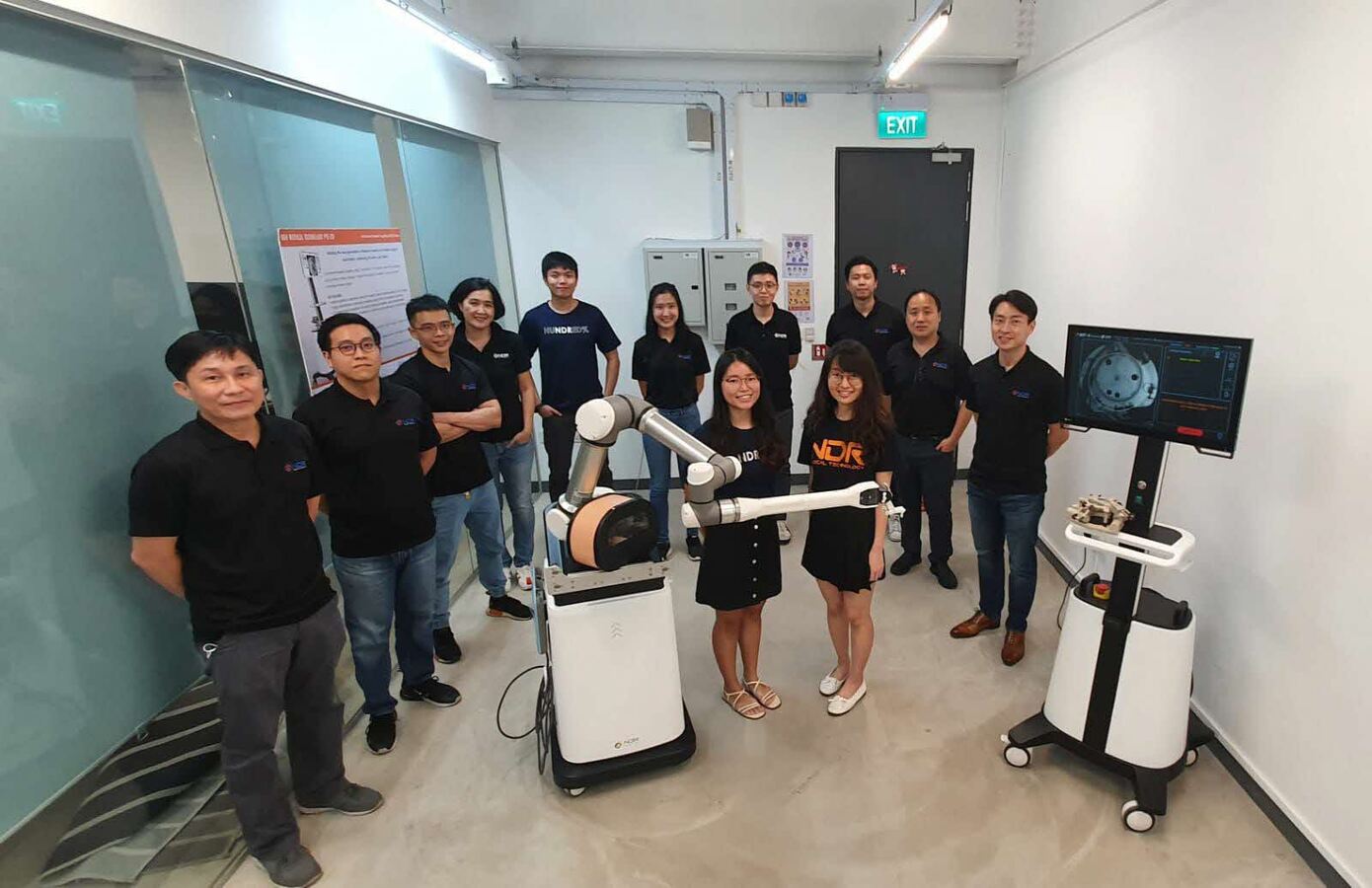
The invitation was quite specific
By 2017, Goh could describe his remit succinctly: corporate direction and product strategy. Asked what kinds of collaboration he wanted, he named partnership, investment and distribution. Each word implies a different kind of help. Capital funds the work. Partners contribute capabilities and access. Distribution gets a finished product beyond the people who developed it. His answer left room for several kinds of expertise without treating them as interchangeable.
He also spoke about the encouragement he took from users’ responses. That is a telling place for a founder to look for satisfaction. A demonstration can win attention before a product has earned a place in someone’s routine. Goh’s stated interest was in acceptance and use. The commercial question was already larger than whether the technology could impress an audience. It concerned whether someone else would make room for it in their working day.
A prize, then a change of neighbourhood
In 2018, NDR finished as first runner-up in Enterprise Singapore’s Slingshot competition and received S$150,000. The company subsequently moved to LaunchPad to be closer to Singapore’s startup community and government agencies. An award became part of a decision about proximity. The address mattered because of who else might be nearby. A company making physical technology still needs conversations, introductions and people who can help with the next problem.
Goh’s account of entrepreneurship includes a strikingly expansive view of its possibilities. That sits alongside a practical preference for a short learning curve in the systems his team develops. The pairing is appealing: room to attempt something difficult, followed by the obligation to make the result easier for someone else. Ambition gets a generous allowance. Complexity, once it reaches the user, has to justify its presence.
The awkward business of selling something physical
Goh has been frank about the capital a hardware company requires. In 2021, he described the challenge of financing physical devices in an investment environment where many regional funds preferred businesses with fewer physical assets. He also explained why NDR would depend on distributors and partners to enter markets. Scale required other organisations, with their own capabilities and local knowledge. Shipping hardware gives international expansion a weight that a slide marked “global” cannot convey.
That assessment makes the partnership emphasis in his earlier career easier to understand. It is a commercial necessity for the kind of company he chose to build. More money alone does not supply every missing capability. A distribution relationship must be established; a prospective partner needs reasons to commit. Goh’s public discussion of growth makes space for that work and for the time it takes. The engineer who became a founder still has to attend to the connections between parts.
Japan was a set of introductions
NDR established a Japanese subsidiary in 2022. Goh later described how Leave a Nest helped the company make connections there, introducing investors, corporate partners and distributors. Invitations to events also brought opportunities to learn about Japanese manufacturing. International expansion, in this account, was a series of introductions and encounters with an industry. The map acquired names, organisations and people with whom the team could work.
His language about that relationship went beyond transactions. He valued the friendship alongside the professional connection, and described company success in terms that included values, culture and social contribution as well as profit. These are broad ambitions, but he attached them to a specific working relationship. The statement gains something from that setting. It concerns people who had helped his team enter a market, rather than an abstract audience being asked to admire a corporate philosophy.
When the handshake had to wait
Another overseas agreement arrived through a screen. In a 2021 post about a new partner in India, Goh congratulated his team for getting the relationship established despite travel restrictions. He would have preferred to sign in person, he wrote, but a video call would do. The moment has a modest charm. A founder working with advanced machinery wanted the old-fashioned satisfaction of being in the room when an agreement was made.
Elsewhere, he described engagement with stakeholders as a favourite part of his job. He named Kihoko Tokue and Daiki Kumamoto, spoke of them as friends and recommended them to startups considering Japan. “Good partners last a lifetime,” he wrote. It is an unusually long horizon for a business relationship. The recommendation also passes a connection onwards: someone who helped his company might help another. A network becomes more useful when introductions travel in more than one direction.
Breakfast, with a long backstory
A year-end breakfast with Louis Phee and Kok Hwee Sim prompted another observation from Goh: the three companies represented at the table had connections to NTU’s Robotics Research Centre. He saw possibilities for future collaboration emerging from their conversation. The undergraduate research environment had remained relevant well into the founders’ working lives. People who had followed different routes could sit down together and discover that their routes still crossed.
By the end of 2025, Goh’s account of company life included hard work, coffee, wins and challenges. He thanked people for encouragement, introductions and belief. It is a recognisable founder’s inventory, with the caffeine sensibly left in. Across his public reflections, the thanks recur: to his engineers, to collaborators, to investors who supported an early idea. The machines are the company’s visible work. Around them sits the quieter effort of keeping a group of people willing to build together. Goh’s preference for showing up belongs there.