A cash advance and a grocery receipt seem to belong to different businesses. One gets somebody through the week. The other usually gets crumpled into a pocket. At Attain, they belong to the same system: useful consumer apps on one side, a record of what people actually buy on the other. Advertisers pay for ways to put that record to work.
- Consumers exchange data permission for financial tools and shopping rewards.
- Marketers use purchase signals to build audiences and measure sales.
- The useful trick: change the campaign while there is still money left to spend.
First, give people a reason to join
Brian Mandelbaum and Dominic Bennett started the business as Klover in 2019. Its proposition was unusually explicit: consumers could share data in exchange for access to financial services. In August 2021, Klover announced $60 million in financing, with Mercato Partners Traverse Fund leading the Series A. The company said it would expand its teams and its then-1.5-million-user base.
In November 2022, the corporate name became Attain. Klover remained the consumer app. A newly announced $25 million Series B, led by Mercato Partners, accompanied plans for a self-service commerce-data platform. Coca-Cola and HBO Max were already named as advertisers using its data. The rebrand made the enterprise ambition visible.

Here is the business logic. A brand usually knows what happened in its own shop. A consumer’s purchasing life runs through many shops. By building the relationship with the shopper, Attain can assemble a view that crosses retailer boundaries. Its expertise sits where consumer-app engagement, transaction data and advertising measurement meet.
A healthy-shopping app changes the sample
Attain launched the rewards app Frisbee in 2023, then acquired Merryfield in September 2024. Merryfield rewards purchases of better-for-you products. Its founders included Zooey Deschanel, David Mayer and Joe Dickson. For an advertising-data company, the interesting acquisition detail was the reported $110,000 median income of Merryfield’s users.
That number explains something about the strategy. A panel becomes useful through the people it includes, not simply its headcount. Adding affluent grocery shoppers broadened the kinds of households Attain could observe. The acquisition also brought product-level purchasing detail and relationships with consumer brands. A different shopping basket could improve the enterprise product.
Company-reported coverage, October 2026. Consumer spending is not Attain revenue.
Put the receipt inside the workflow
OutcomeHQ is where that data becomes a working tool. Its July 2025 expansion brought purchasing insights, audience creation, activation and sales measurement into one platform. A planner can investigate buying behavior, turn a finding into a target audience, then distribute that audience to buying platforms. The announcement listed more than 20 integrations, including Meta, TikTok and The Trade Desk.
The jobs are concrete. Find customers who stopped buying. Study where a competitor’s shoppers also spend. Separate frequent buyers from occasional ones. Shopper Insights examines switching, loyalty and basket associations; Outcome Audiences turns those patterns into segments. Brands, agencies, retailers and media platforms are the buyers of these tools.
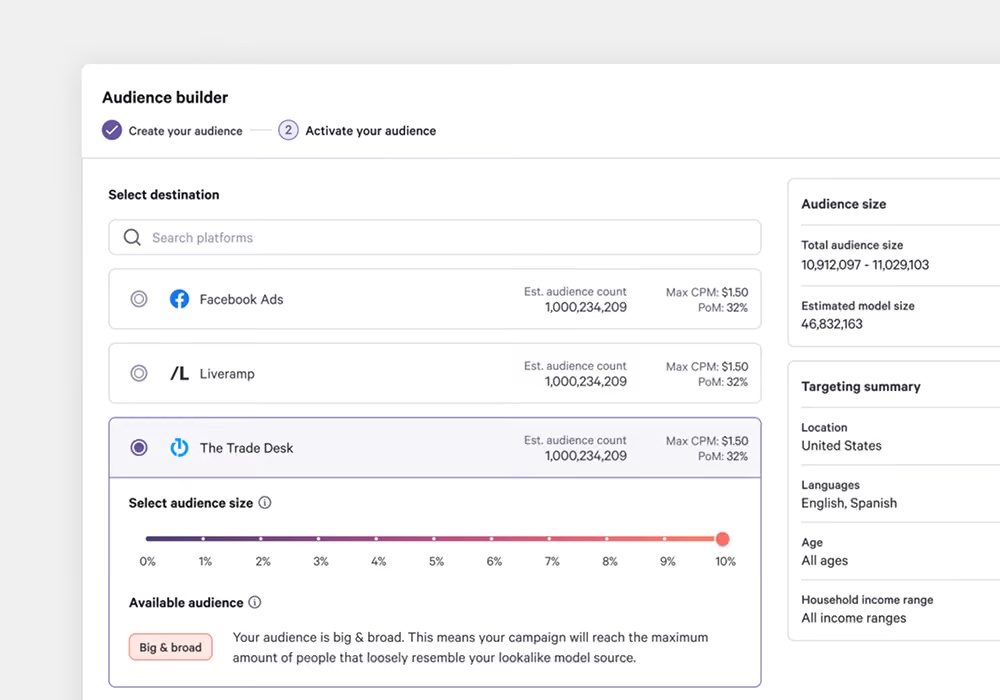
Attain’s commercial position is the connection between these jobs. Transaction-data providers such as Affinity Solutions also sell purchase-based insights and measurement. Attain’s particular wager is that owning consumer apps, maintaining direct permission and connecting the resulting signals to media decisions will make its service useful enough to keep buying.
The customer pays for enterprise data and software services. The consumer supplies permission in return for app benefits. Capital funded expansion; ongoing consumer value helps sustain participation. A buyer still needs a scoped commercial proposal covering data access, activation and measurement. The financing amounts are not the cost of running a campaign.
McDonald’s asks the useful question
Consider the published McDonald’s example. Working with OMD, the restaurant brand used a joint OpenX and Attain solution to connect programmatic advertising exposure with purchases. OpenX supplied the activation infrastructure; Attain supplied purchase measurement. Daily insights let the team adjust media while the campaign was running.
“With OpenX and Attain, we’re optimizing based on verified outcomes.”
Ronald Barillas · OMD
Attain’s case study reports 1.29% total sales lift and $10.92 incremental return on advertising spend. These are vendor-published results for one campaign. They illustrate the intended workflow, not a forecast for another advertiser. The practical change was giving the team purchase feedback while it could still alter the buy.
- 01 Observe purchases
- 02 Activate audiences
- 03 Measure sales
- 04 Adjust the buy ↺
Keep the learning inside the campaign.
For another customer, the first thing to break may be the measurement design. A purchase after an ad does not establish that the ad caused it. Attain distinguishes attribution from incrementality and describes holdout methods for the latter. It also checks exposure-to-panel matching before measurement. Without enough matched buyers and a credible comparison, a confident-looking result can answer the wrong question.
Fourteen million people are still a sample
Attain says it balances its panel against Census benchmarks and uses modeling to represent the wider U.S. adult population. Observed transactions and population estimates therefore deserve separate treatment. Its measurement page specifies daily updates and signals within 24-48 hours. “Live” should be understood in that operational context.

The company keeps extending the idea. January 2026 brought Foot Traffic Measurement. Its later Till 1.1 announcement describes a demand model evaluated against subsequent purchases. October research with dentsu found Gen Z spending roughly 25% less annually while shopping across 6% more merchants. Each development gives the purchase record another job.
The part a marketer can copy is straightforward: define the sales question, check the sample, agree on the comparison, and schedule a decision before the campaign ends. That requires enough observable purchases and room to change spending. A receipt is useful evidence. Its value grows when somebody knows what to do next.