Imagine running a shop with no windows. You know who comes through the door, what they look at and whether they buy. Outside, another shop has a queue around the corner. Your books tell you business is improving. The street tells a different story. Hitwise sold marketers a way to look out of the window.
- It measured browsing and search behavior beyond a customer’s own website.
- Marketers used it to compare rivals, find audiences and choose where to advertise.
- It closed in 2020 after losing a primary data supplier.
The company’s useful trick was changing the denominator. A retailer could count its visits and feel pleased. Hitwise could place those visits against a category, exposing whether the retailer was actually gaining ground. Growth and competitive progress are different questions. Marketing departments had plenty of tools for the first. Hitwise made a business out of the second.
America could wait
Adrian Giles and Andrew Barlow started Hitwise in Melbourne in the late 1990s. Their early approach depended on internet service providers: observe browsing activity across a large sample, aggregate it, then turn it into reports. An individual website could measure its own visitors. This arrangement offered a view across websites, including competitors that would never hand over their internal numbers.
Expansion was less tidy than the idea. Giles later recalled that the United States looked attractive in 2000, but securing a foothold proved difficult amid the dot-com crash and the disruption around September 11. The founders concentrated elsewhere. Australia, New Zealand, Hong Kong and Britain gave them a broader base before the American launch in January 2003.
“We got the business bubbling in Hong Kong, Australia, New Zealand and the UK before trying again.”Adrian Giles · 2008
There is a practical lesson in that sequence: the biggest market need not be the first successful market. Giles believed that arriving with an international business helped. That is his account, rather than a universal expansion formula. The detail worth copying is the willingness to change the order without abandoning the destination.
Follow the person, not the page
Hitwise’s expertise sat at the intersection of search analysis, competitive benchmarking and consumer research. A travel marketer could investigate which search terms were emerging. A publisher could examine audience overlap. An agency could compare referral channels before recommending where a client should spend. These were planning questions, with consequences for content, partnerships and advertising budgets.
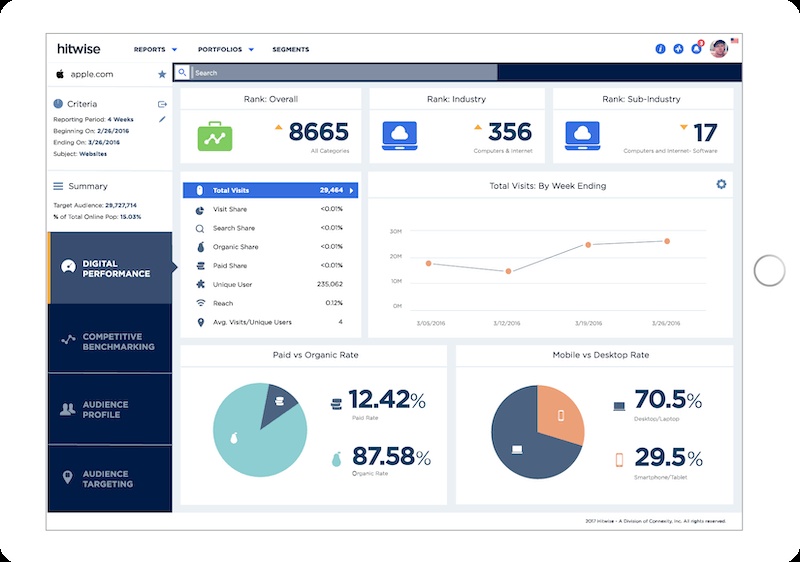
Consider a hypothetical campaign review. Visits have risen, but so has demand across the entire category. Before celebrating the creative, compare the lift with rivals and inspect the channels bringing people in. That exercise can turn a flattering chart into a more useful question about where the next pound or dollar should go.
AudienceView extended the proposition. Experian launched versions in 2012 that combined online behavior with offline consumer information. Marketers could build segments around shared characteristics, then investigate what those groups did online. Instead of beginning with a URL and asking who visited, they could begin with people and ask where to find them.
A surviving training guide makes the workflow pleasantly concrete. Define a target audience. Choose a base audience for comparison. Generate a Snapshot report. Compare demographic characteristics. The value comes from the comparison: a characteristic that looks impressive in isolation may be perfectly ordinary across the wider population.
- 01DefineWho matters?
- 02CompareWhat differs?
- 03ChooseWhere to act?
By 2016, the upgraded UK platform could examine as many as five steps before and after a visit, compared with one previously. Think of the difference between seeing a doorway and seeing the route through the neighborhood. Hitwise executive Nigel Wilson described the commercial challenge bluntly: “What we are battling against is research for research sake.”
Two owners, two ideas
The customers included retailers, banks, travel businesses and media companies. Havas Digital’s 2011 agreement brought Hitwise tools into agency research, media planning, campaign reporting and pitches across several markets. It was selling working material for decisions, rather than a report destined to sit unopened in a shared folder.
Customers generally paid annual licence fees in advance. Hitwise bought access to data, processed it and sold intelligence to multiple subscribers. Once collection and analysis were established in a market, another customer could use the same underlying resource. That recurring model helped make the business attractive to buyers.
Experian announced its acquisition in 2007 at approximately $240 million. It wanted online behavior to complement its other marketing information. In 2015, it sold Hitwise and Simmons for a combined $47 million, with up to $5 million more contingent on performance. Those figures describe different bundles of assets; they cannot support a clean calculation of Hitwise’s decline in value.
2015 consideration for Hitwise + Simmons combined, before a possible $5m earnout.
Experian said the businesses offered limited synergies with its core operations. Connexity, Hitwise’s new owner, saw a connection between audience research and advertising activation. Its ambition was to help marketers identify a group, understand it and eventually reach it from the same interface. The useful report was being asked to move closer to the purchase of media.
The feed stopped first
In early February 2020, customers learned that daily, weekly and monthly metric updates were paused. Hitwise had lost a key source of clickstream data as Jumpshot closed. The interruption reached the input before it reached the company’s public ending.
A later SEC filing supplied the economics behind that ending. Management had already planned a sale in 2019. After the primary supplier shut down, it could not find a replacement at a commercially reasonable contract value. The board chose to wind down Hitwise in February. A referral agreement with Similarweb provided a route for existing customers.
Borrow the question
Hitwise’s service is gone. Its research habit remains useful: compare your performance with the world outside your own property. Start with a decision, define the audience, examine the competing routes and test a change. A browsing sample can suggest where to act; it cannot establish why someone bought, or guarantee your campaign caused a sale.
The other lesson belongs on the buying side of the desk. Ask how a dataset is obtained, which markets it represents and what happens if a supplier leaves. Competitive intelligence needs both a meaningful comparison and a continuing supply of observations. Hitwise’s history gives marketers a reason to inspect both.