Consider the stadium wall. A bank, a beer, a carmaker: the names announce themselves with the confidence of people who have paid to be noticed. You can see the agreement everywhere. Yet the useful questions remain tucked away. What else came with that sign? Who bought something similar? What should the next buyer pay? SponsorUnited has made a business out of the distance between seeing a logo and understanding a deal.
- Find the fit. Research brands, properties and the people behind partnerships.
- Unpack the pitch. Compare audiences, assets and competing sponsorship activity.
- Bring a benchmark. Use estimated prices as context for negotiation.
The company sells subscription intelligence to brands, rights holders, agencies and media organizations. Think of a rights holder as the party with something to sell: a team, a venue, an event. The buyer wants a reason to invest. The seller wants a reason to call. Both need a wider view than their own list of contacts.
01 First, make it useful
Founder Bob Lynch had worked inside sponsorship sales, including at the Miami Dolphins and BSE Global. He understood the business well enough to find its information gaps irritating. His early demonstration was wonderfully unglamorous: a product sketched in PowerPoint, with research delivered through Google Sheets. The Los Angeles Chargers used it. Customers could recognize a useful comparison before anybody had built an elegant interface.
SponsorUnited began in 2016; its platform launched in 2018. An important ingredient was research gathered inside venues. Spectrum Equity describes scouts collecting evidence of brand activations, assembling a record that could not be conjured from a list of press releases. A sponsorship announcement tells you that two organizations shook hands. The research asks what actually appeared around the handshake.
SponsorUniversity, its education subsidiary, connects students with practical sports marketing research. Its partner program describes work for teams, venues, events and brands. That helps explain the company’s particular expertise: the research requires people who can recognize the ingredients of a partnership, then describe those ingredients consistently enough for somebody else to compare them.
Lynch bootstrapped, declined an early investment offer after reconsidering its terms, and eventually decided more sophisticated customers required more investment and expertise. His retrospective mistakes were practical: recruit a broader mix of skills earlier, and collect subscription payments upfront. Those are useful lessons precisely because they fit on an ordinary invoice.
“I wish I had told people to pay their subscription fees upfront.”
Bob Lynch · Founder & CEO · 2024
02 One deal, several questions
Imagine a sponsorship manager at a regional brand. A team sends a proposal containing signage, social posts, hospitality and an event. The total looks plausible. Plausible, however, is an expensive standard. Before approving it, the manager needs comparable packages, audience information and a view of what competitors already sponsor. This is the work SponsorUnited is designed to organize.
On the selling side, the same information changes prospecting. A team can look for brands investing in similar properties, identify contacts and study how those brands activate their partnerships. A pitch can then begin with evidence of an existing appetite. SponsorUnited’s rights-holder tools put that sequence ahead of another afternoon spent guessing who might answer an email.
A research workflow, not a promise of a closed deal.
For that hypothetical regional buyer, the first useful move is to list the proposal’s components separately. Compare the audience, geography and deliverables before comparing totals. A cheaper package with fewer useful rights may solve a different problem. The software can organize that investigation; the buyer still has to define what success would look like.
The company’s customer testimonials include ParkMobile and the Seattle Storm. Its About page reports more than 1,100 organizations using the service. That audience includes people buying sponsorship and people selling it, an arrangement that makes sense: comparable information is useful on either side of a table.
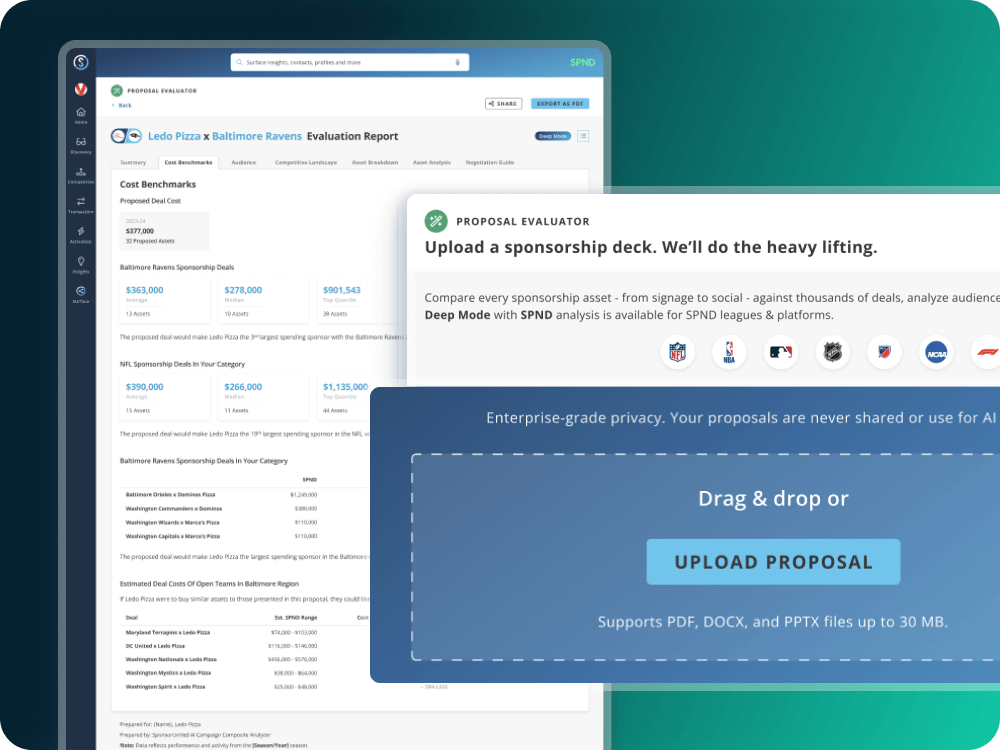
In February 2026, SponsorUnited announced version 4.0. Surface, its AI research assistant, helps users question the underlying dataset. Proposal Evaluator analyzes uploaded proposals with audience, asset, competitive and pricing context. The company also supplies a searchable creative library: real examples of how partnerships were executed, useful when a presentation needs more substance than another logo placement.
03 The number needs a label
The pricing product is SPND, short for Sponsorship Price of Negotiated Deals. Launched in November 2024, it uses models informed by deal transactions, observed assets and market characteristics to estimate transaction prices. At launch, SponsorUnited said the underlying collection included more than $13.3 billion in actual deals. Its methodology compares the exercise to estimating a home’s price from comparable sales.
- Price
- What a deal is estimated to trade for.SPND’s territory
- Value
- What the package is worth to a particular buyer.
- Return
- What the investment ultimately produces.
These distinctions matter. SPND does not disclose a secret contract or establish a buyer’s eventual return. Its published guidance says estimates arrive after a league’s season, and known in-kind deals are excluded. If your question concerns an unsupported property or an exchange of products rather than money, check coverage before treating a comparison as an answer.
This also locates SponsorUnited within its market. Nielsen Sports and YouGov Sport offer sponsorship measurement and audience research. SponsorUnited emphasizes discovery, deal context and pricing intelligence. A buyer may need both kinds of work: comparisons before signing, measurement after activation. A spreadsheet remains another alternative, although maintaining the research becomes the owner’s job.
SponsorUnited earns subscription fees for access to its software and data. Fees are set through customer order forms. The better-documented cost of expansion is the $35 million growth investment from Spectrum Equity in November 2022. Capital followed an existing research business and customer base; the database had already required years of work.
04 A better question beats a prettier pitch
The current company describes a remote team spanning more than 50 countries. In June 2026 it appointed Tim Braz as its first Chief Commercial Officer, as its AI tools became a larger part of its pitch. Its own AI guidance leaves final interpretation with users and tells them to validate outputs against underlying data.
There is a method here that travels beyond sponsorship. Start with a concrete buying decision. Make the messy alternatives comparable. Deliver something useful before polishing the delivery system. And keep the labels on the numbers. The stadium wall can tell you who paid to be seen. Deciding whether to join them takes a different kind of looking.