The Cincinnati Bengals were not supposed to be there. In January 2022, a team that had not won a playoff game in 31 years kept winning. The calendar compressed. Cincinnati had a place in Super Bowl LVI, Los Angeles had the cameras, and a Midwestern city suddenly had a few days to decide what to do with attention it had not ordered and could not reschedule.
Most public-relations firms would have written a pitch. Game Day Communications built a room.
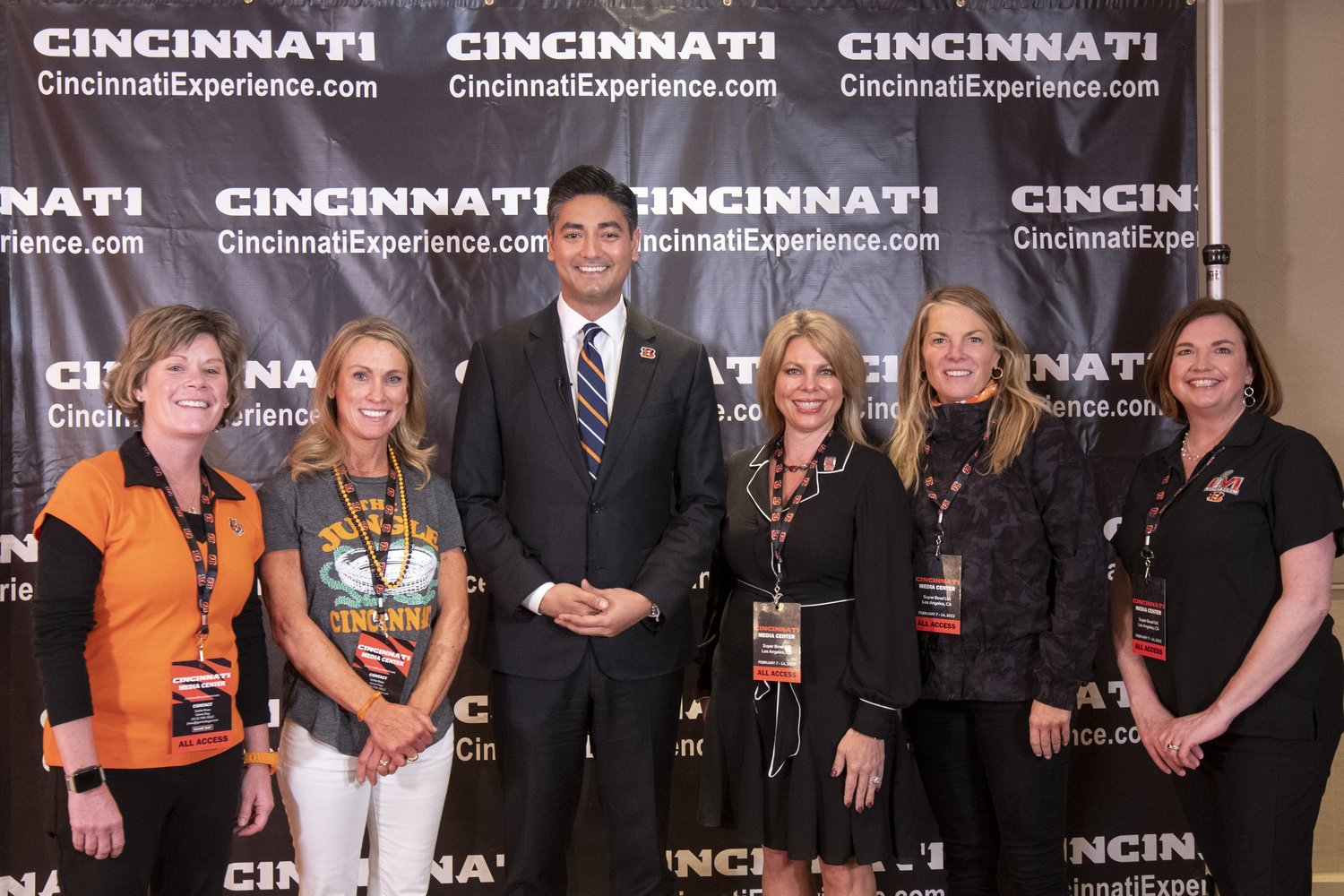
The firm created a Cincinnati Media Center about a mile from SoFi Stadium and filled it with the people who could make a football story larger: tourism representatives, economic-development officials, business leaders, celebrities and politicians. The Cincinnati USA Convention & Visitors Bureau, Cincinnati Experience, REDI Cincinnati and JobsOhio joined the effort. A playoff run became a temporary bureau for selling a region.
Those first two numbers come from the agency’s case study, using Critical Mention research, and should be read as media-monitoring estimates rather than an audited balance sheet. The third number is more interesting anyway. It explains Game Day’s habit of mind: attention is not merely something to attract. It is something to organize.
If the chair is taken, build another table
Jackie Reau came to this idea early. She had worked in public relations at The Christ Hospital and as marketing director at the Cincinnati Art Museum. Around age 30, she wanted to move into sports media without moving away from Cincinnati. The obvious jobs were with the Reds or Bengals, and, as she later put it, the men in those chairs did not appear ready to leave.
So Reau and Betsy Ross, a former ESPN anchor, sketched a sports-marketing firm on a cocktail napkin over dinner. They opened Game Day on July 1, 2002. The first client was the Flying Pig Marathon - a wonderfully Cincinnati assignment and a useful piece of corporate DNA. A marathon has an immovable date, hundreds of operational details, an audience in motion and a finish line everyone can see. There is no “ship it next week.”
Game Day’s real specialty is not sport. It is the moment with a clock on it.
That distinction explains a portfolio that otherwise looks eclectic. Game Day has worked with the Cincinnati Music Festival, Film Cincinnati, Hard Rock Casino Cincinnati, Disabled American Veterans, Downtown Cincinnati Inc., Liberty Center and the Cincinnati Comic Expo. Some are sporting properties; many are not. What they share is public consequence concentrated in time - opening night, race morning, festival weekend, a trip to Cannes, a surprise Super Bowl.
PR with load-bearing walls
Game Day describes itself as a sports and entertainment communications and marketing firm. The menu includes media relations, strategic and crisis communications, experiential marketing, sponsorship development, event staffing, social media, photography, video, graphic design, audience research and analytics. Its LinkedIn profile lists a team of 2–10. That matters: this is not a vast advertising network. It is a compact professional-services company assembling specialists, ambassadors and partners around client assignments.
The business model appears conventional - project fees and retainers for agency work - while the execution is unusually physical. A media strategy may require a live studio at a marathon finish line. A brand activation may require a paid street team. A film campaign may put Film Cincinnati’s director on the red carpet at Cannes. Tim David, the firm’s director of analytics and esports, builds custom dashboards that translate complex data into visual stories. The work moves back and forth between introductions, logistics, content and measurement.
Consider the Flying Pig’s twentieth anniversary. Game Day helped turn a new finish line into a broadcast setting, complete with a live media studio, then created the PIGGYs, an awards show scheduled for television. The agency reported 700 broadcast stories, more than 17 hours of coverage and 145 million web impressions. For the Cincinnati Music Festival, it coordinated performers, sponsors, credentialed media and concertgoers in a campaign that reported 1.75 billion impressions. At Cannes, its Film Cincinnati work produced 76 stories and nearly 48 minutes of television coverage.
The copyable part
The lesson is not “rent a room near the Super Bowl.” It is to make the desired story easier to cover. Reporters have deadlines. Producers need pictures. Partners need a reason to cooperate. Executives need a setting in which their remarks make sense. The press release is merely one component in that little machine.
Local knowledge, stadium tempo
Larger competitors can offer more offices, deeper media-buying capacity and armies of specialists. Freelancers can offer lower overhead. In-house teams know one organization intimately. Game Day sits between them: small enough for founder involvement, broad enough to produce an event, and rooted enough to know which Cincinnati institutions should share a table.
That fit is strongest when a client has a public moment, multiple stakeholders and a need for earned attention. A regional event seeking visitors, a nonprofit with a national activation, a consumer venue opening its doors or a city trying to use sport as economic narrative all make sense. The same approach is less useful when the buyer needs always-on global advertising at massive scale, pure performance marketing or a quiet software launch with no community or media dimension.
Best conditions
A hard deadline, a visible event, several willing partners and a story that benefits from access.
Poor conditions
No genuine news, no empowered spokesperson, no operational access, or success defined only as immediate sales.
There is also a revealing side bet. In 2022, Reau founded Cincinnati Fear, described as the city’s first professional esports team. The move puts Game Day closer to a new fan community rather than leaving it on the other side of a research deck. It is an agency behaving like an operator - learning the messiness of talent, programming and audience development from inside the arena.
Reau once summarized her work ethic with a promise: when Game Day says it will do something, it does it. She mentioned the 4 a.m. live shot and the 1 a.m. event close. This is not glamorous language, which is precisely why it lands. The company’s product is confidence during the hours when a brand cannot ask for an extension.
The Bengals lost Super Bowl LVI. For Game Day’s clients, that fact did not undo the media center, the interviews or the story Cincinnati had told while the country was listening. The team had reached the game. The agency had made sure the city arrived with something to say.