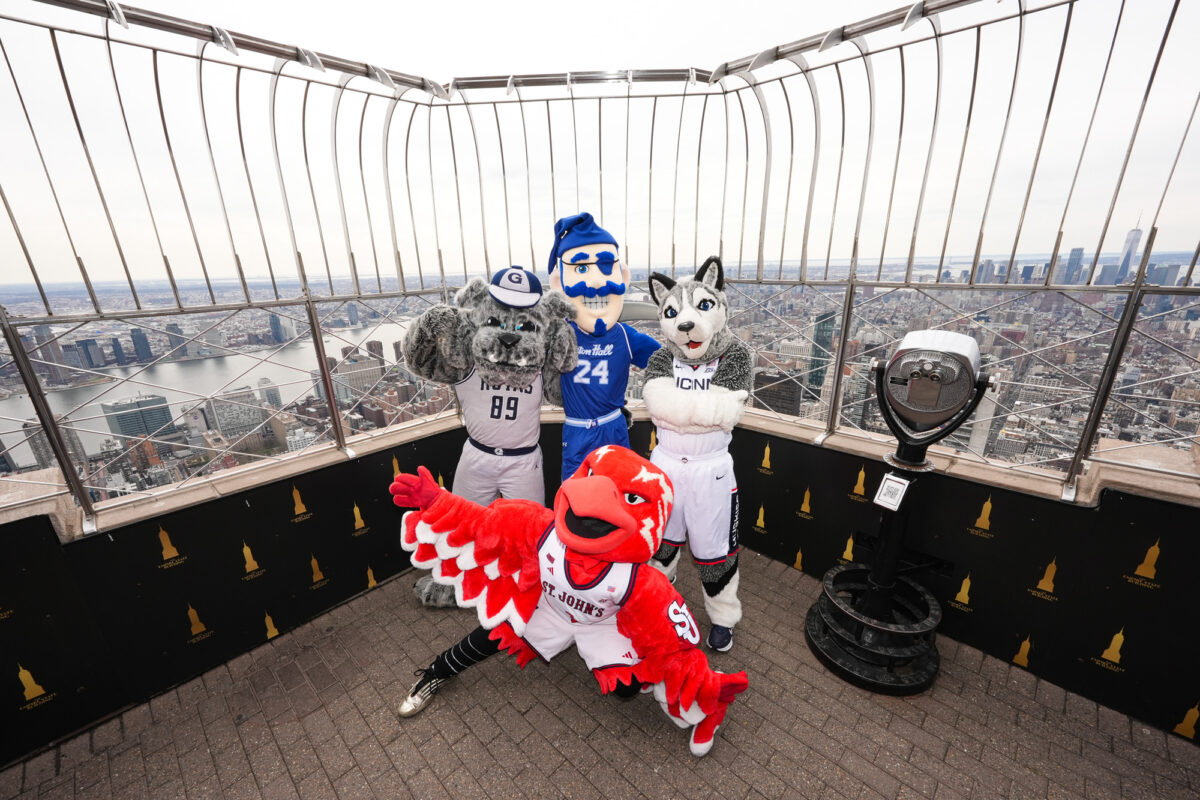
The mascot is the clue. Four of them, actually: the bulldog from Georgetown, the blue demon from DePaul, the husky from Connecticut and the red storm bird from St. John’s, all arranged on the Empire State Building as if someone had called a summit of very excitable mammals. The picture came from a DKC assignment for the BIG EAST Conference. It is funny, unmistakably New York and engineered to be photographed. In other words, it is public relations without looking much like a press release.
That distinction has kept DKC alive through several extinctions. The company started in 1991 as Dan Klores Associates, named for a Brooklyn-born publicity operator who had learned the New York trade at Howard J. Rubenstein’s firm. In the old model, access was the scarce thing. You knew the editor, understood the deadline and could get the telephone answered. DKC still puts “Access” first in its three-word pitch. But access alone is now a key to a building with no walls.
A conversation can begin with a newspaper story, an influencer’s clip, a search result, a stadium stunt, a CEO’s post or a statistic pulled from a survey. It can be accelerated by paid media and derailed by a stranger before lunch. DKC’s business became the management of that entire weather system.
A hair dryer explains the company
Consider the Dyson Supersonic. A hair dryer is a familiar object, perhaps too familiar. Its basic silhouette had settled into the bathroom cabinet decades ago. Dyson made it strange again: a hollow head, a motor in the handle and a price that invited disbelief. DKC says its launch produced more than 5,000 pre-orders and 1.6 billion media impressions.
The interesting pairing is impressions and pre-orders. One number describes attention; the other describes behavior. DKC’s website now says it wants to be judged by revenue growth, market share and valuation rather than mentions alone. That claim is convenient marketing, but it also identifies the problem the firm solves: companies do not actually need publicity. They need some consequence that publicity can help cause.
“Client success is our only benchmark.”DKC’s stated operating test
The agency’s customers therefore look less like a neat sector and more like an airport departure board. Airbnb, BMW and Delta. MAC and Dyson. Manchester City and the BIG EAST. Sesame Workshop, Ken Burns and NYU Langone Health. Resy and TikTok. They share a need to turn specialist facts into public meaning. A medical breakthrough needs comprehension. A football club needs cultural relevance in a market where it does not play home games. A startup needs a strange behavior to feel safe enough to become normal.
The lonely press hit stopped being enough
DKC’s expansion reads like a record of what the traditional model could no longer do by itself. It launched an event production arm in 2012. Entertainment grew on the West Coast. Public affairs added campaign and government expertise. A Broadway venture arrived in 2015. DKC Impact formalized pro-bono work in 2016. DKCulture connected brands with multicultural audiences. DKC Campus moved early on college athletes’ name, image and likeness rights. HangarFour added influencer programs, content, design and experiences. DKC Analytics brought polling, segmentation, search and brand-health measurement into the room.
None of this meant earned media had failed. The isolated version had. A splendid article could be invisible to the right buyer. A viral post could bring a crowd with no intention to purchase. An event could look busy and accomplish nothing. The modern agency has to connect the pieces and assign each one a job.
This is also what changed DKC’s mind about remaining independent. In September 2024, Acceleration Community of Companies bought a majority stake. The price and valuation were not disclosed. Sean Cassidy, then president, became chief executive; operating chief Matthew Traub became president. ACC already owned businesses in experiential marketing, influencers, analytics and fabrication. DKC supplied strategic communications and, increasingly, sports.
The buyer said clients wanted broader counsel. Cassidy said the network would let DKC offer more value by opening access to a wider set of capabilities. This was less a surrender of independence than a practical answer to scope. If the client’s problem crosses five channels, an agency organized around one channel starts every pitch by explaining what it cannot do.
Make the evidence before making the claim
The most copyable part of DKC is not a media list. It is the use of original evidence as creative material. In 2025, DKC surveyed 1,000 American parents of children aged eight to fourteen. The study estimated that Gen Alpha controlled $101 billion in direct annual spending and influenced 42 percent of household spending. Those findings traveled because they converted a vague suspicion - children affect what families buy - into a surprising, arguable number.
This is communications as product development. The agency does not wait for a client to possess a story. Its analytics group can commission the survey, segment the audience, test the message and locate the result most likely to matter. The creative and social teams can translate it. Earned media can give it outside credibility. Paid distribution can place it in front of a defined audience. Measurement can ask whether anyone did the intended thing.
Copy this
Begin with one audience question that your competitors answer by instinct. Collect defensible evidence. Choose the surprising result, then give every channel a different assignment.
Know the limits
The system depends on a real finding, a credible method and enough distribution to reach the intended people. Weak evidence multiplied across channels only makes a weak claim louder.
A small company can run the same logic without hiring six offices. Define the business action first. Perhaps it is a trial, a store visit, a policy meeting or a qualified application. Find one fact that makes that action feel reasonable. Put the detailed case on a page you control. Invite outside voices to challenge or validate it. Adapt the story to the native grammar of each social channel. Spend money only where the right audience is identifiable. Measure the action, not the applause.
The method becomes less useful when a company has no operational truth underneath it. Communications cannot repair a product that repeatedly disappoints, a leadership team that will not disclose hard facts or a crisis whose remedy exists only in language. Nor does DKC’s full-stack model suit every budget. A local organization with one audience and one clear channel may be better served by a focused specialist than by an integrated national network. Coordination is valuable when the problem is genuinely coordinated.
A reason to be repeated
Today DKC sells brand narrative and product launches, media relations and executive profiles, crisis plans and media training, public affairs and multicultural strategy. It sells influencer campaigns, social management, search optimization, affiliate marketing, polling, segmentation, content and events. Its analytics unit has even moved into managing how brands appear inside AI-generated answers, where the old front page is replaced by a machine’s summary.
The business model is conventional beneath the breadth: custom professional-services engagements, usually retainers or projects, with no public rate card. Industry reporting placed DKC at $58 million in fee income in 2022, although the private company does not publish current revenue. Around 500 people are publicly associated with the firm. Its six listed offices are all American, but the customers and audiences are global.
Competitors include the giant networks - Edelman, Weber Shandwick, Burson and Ketchum - and New York independents such as BerlinRosen, Sunshine Sachs Morgan & Lylis, Finn Partners and Ruder Finn. DKC sits between boutique access and holding-company range. Its pitch is that specialists in sports, entertainment, health, public affairs and lifestyle can reach across the same table to researchers, creatives and producers.
The old publicist’s question was: who will take my call? DKC’s newer question is more demanding: what, precisely, should happen after they answer? The mascot on the skyscraper is not the strategy. It is the visible tip of it - a scene designed for cameras, tied to a tournament, carrying four schools into a single New York frame. The photograph gets shared because it is charming. The company gets paid because the charm has a job.