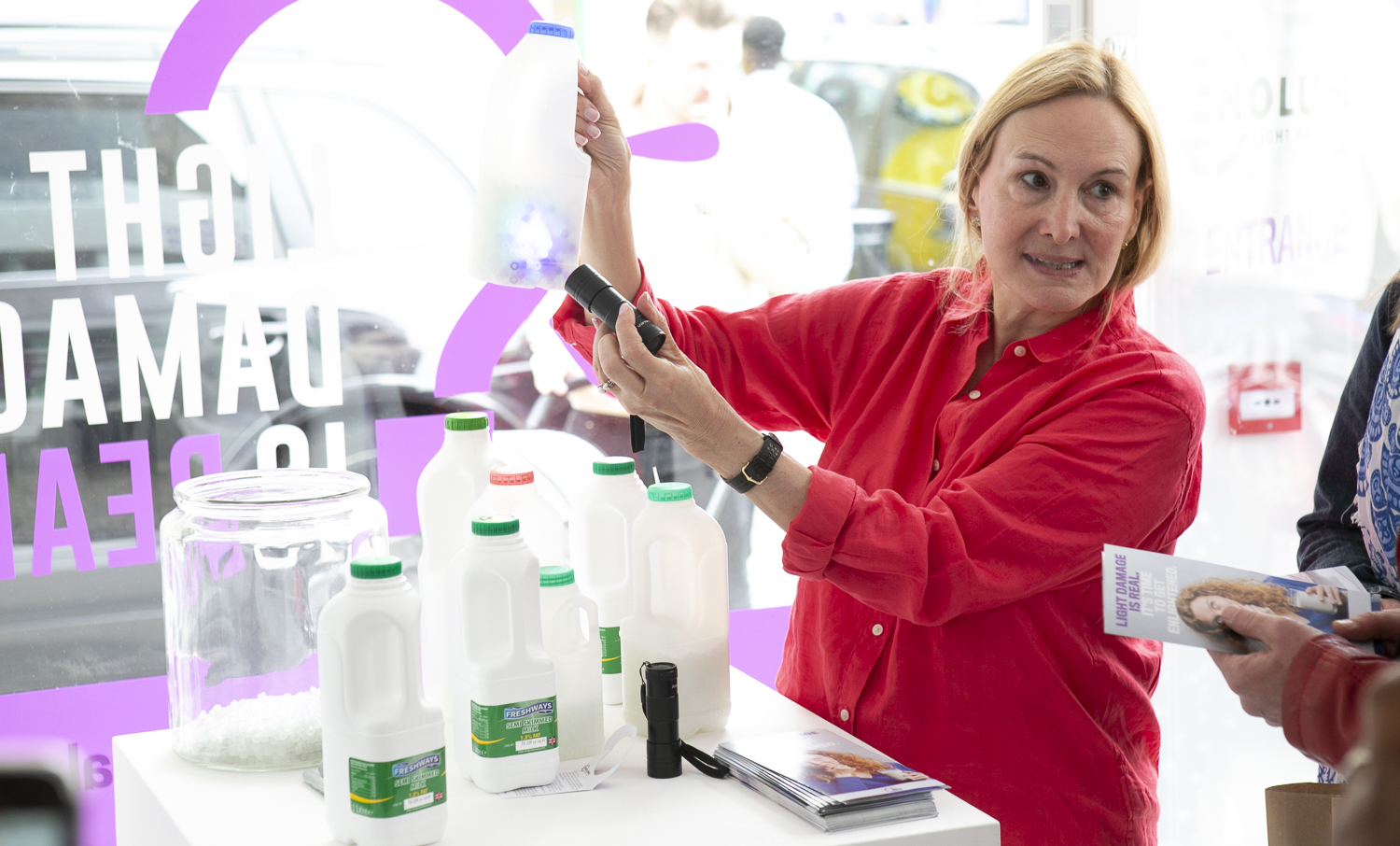
There is a shop in London where the lights are off on purpose. Bottles of milk sit in darkness. Shoppers grope, laugh and discover a fact they did not know five minutes earlier: ordinary retail light can damage milk's nutrients. The store is theatrical, faintly absurd and useful. It was built for Noluma, a packaging startup almost nobody had heard of. FleishmanHillard's assignment was to make people care about a better milk bottle.
The obvious move would have been a press release about packaging science. The agency instead ran 14 focus groups, surveyed parents, food lovers and business buyers, and found the real obstacle. Retailers would not stock light-protected milk unless shoppers first demanded it. The business problem was hiding inside a consumer problem.
So FleishmanHillard enlisted Newcastle University for an evidence-based report, opened the dark shop, recruited influencers, targeted trade publications and followed the spectacle with sales kits and LinkedIn lead generation. Two thousand decision-makers submitted forms. Three major deals and eight pilots followed. Freshways committed to putting 446 million liters of protected milk into 2,400 British stores.
The product is a changed mind
This is the cleanest way to understand FleishmanHillard. It calls itself a global communications consultancy, a phrase broad enough to cover a conference room, a camera crew and a government hearing. What it sells is a chain of events: learn what an audience believes, find the obstruction, devise something that earns attention, distribute it through the right mix of media, then measure whether anybody did anything.
Its clients are companies and institutions for which being understood has financial or political consequences: health and life-sciences businesses, banks, technology firms, food producers, retailers, manufacturers, governments and nonprofits. An airline needs bookings. A pharmaceutical company needs a difficult health conversation to reach Parliament. A chief executive needs employees to believe a restructuring plan. A company in trouble needs to keep one bad afternoon from becoming a permanent identity.
The menu reflects that range: corporate reputation, crisis counsel, public affairs, media relations, brand marketing, social and influencer programs, employee communication, research, creative work, paid distribution and analytics. Clients typically pay project fees or retainers. The precise invoices stay private. FleishmanHillard's own published guidance offers one revealing bracket: serious crisis preparation can run from $60,000 to $500,000, depending on industry and geography. Improvised mitigation can cost millions, before lost sales or market value enter the calculation.
“The boldest campaigns were the sharpest ones, not the biggest.”J.J. Carter, president and CEO
What changed their mind?
In the Noluma assignment, research did. The initial temptation was to explain better packaging. Fourteen focus groups exposed a two-sided market: business buyers required consumer noise, while consumers required a reason to notice a commodity. The agency stopped treating education as the finish line and used it as leverage. A reader can copy the sequence without copying the dark supermarket.
The copyable part
The same pattern appeared in an Icelandair campaign. With household budgets squeezed and travel still feeling unreliable, FleishmanHillard brought a miniature Iceland to London for a weekend: food, music, an ice tunnel and a chance to win the real journey. Tourism partners including the Blue Lagoon, Business Iceland and 66° North made the imitation credible. The event sold out and a special package booked more than $312,000 in travel on site. The stunt worked because the path from curiosity to purchase was about ten feet long.
From counsel to software
FleishmanHillard began in 1946 as Alfred Fleishman and Robert Hillard in a two-person St. Louis office. It now works across six continents, with nearly 80 offices in more than 30 countries. PRovoke Media estimated roughly 3,500 employees and $691 million in 2025 fee income, ranking it fourth among global PR agencies. Omnicom has owned the firm since a cash-and-stock deal announced in 1997; the purchase price was not disclosed.
Scale is its answer to competitors such as Edelman, Burson, Weber Shandwick, FGS Global and Brunswick. A specialist boutique can offer intense senior attention. FleishmanHillard offers a network that can put policy advisers, data analysts, creatives and local operators around the same multinational problem. The 2026 integration of Porter Novelli as a dedicated brand adds depth in health, technology, financial services, public affairs and social impact. That can make the network faster. It can also make it more complicated.

The newer distinction is productization. In July 2026, the firm launched three AI-assisted platforms. Risk ID scans a proposed campaign for reputational, regulatory, cultural and operational dangers. Crisis Simulator changes the scenario as executives make decisions, avoiding the polite predictability of a fixed tabletop exercise. Sage Audiences models reactions to messages before those messages meet the public. All three package the agency's accumulated judgment into something more repeatable than a partner's availability.
These tools are useful under specific conditions. They need good client context, representative signals and executives willing to hear an inconvenient answer. They are less useful when an organization mistakes simulated response for public consent, lacks authority to act on findings or wants software to bless a decision already made. The machine can make rehearsal more realistic. It cannot make leadership braver.
The day the adviser became the story
For a reputation company, the first thing that failed was painfully ordinary: billing controls. In 2005, FleishmanHillard agreed to pay $5.7 million to settle a Los Angeles lawsuit alleging overbilling on public contracts, including work for the Department of Water and Power. A former Los Angeles office executive was later sentenced to prison for fraudulent billings. The agency acknowledged that it had failed to meet the city's billing standards.
No clever message can repair a control system that still permits the underlying behavior. That is the hard lesson in the episode and the useful one for clients. Crisis communications begins before communication: clear ownership, auditable work, rehearsed escalation and the power to stop a bad practice. The reputation adviser had violated the trade's oldest rule by becoming the headline.
When does the method fail?
It fails when the claim outruns the evidence, when the experience has no route to action, when measurement stops at impressions, or when management wants persuasion without operational change. It also fails when global scale blunts local judgment. A culturally neat idea in one office can be an avoidable offense in another.
FleishmanHillard's culture statement emphasizes one team, diverse perspectives, bold thinking and doing what is right. Its FH4Inclusion program sends pro bono work and volunteers into local communities. Those are sensible commitments. They also create a test: an agency built around authenticity must demonstrate, repeatedly, that the advice it sells to clients governs its own choices.
The company occupies the broad middle of modern influence. It is not simply an ad agency, because paid attention is only one instrument. It is not simply a management consultancy, because ideas must survive contact with culture. And it is no longer simply a public-relations firm, because media coverage alone is too distant from the business result. Its best work closes that distance. Somewhere between the dark milk aisle and the executive crisis simulation lies the actual product: a decision made differently, before events make it for you.