The business plan arrived before the business stationery. Around 2000, Jackie Reau and Betsy Ross were at dinner in Cincinnati, talking about the kind of sports marketing firm they wanted to see in the city. Ross had been an ESPN anchor. Reau had built her career in communications and museum marketing. Somewhere between the plates and the check, a cocktail napkin became a drafting table. The pair sketched the idea that would become Game Day.
There was romance in the setting, perhaps, but no magic trick in what followed. Reau spent a month talking through the plan with people she trusted. She asked what they liked, what might work and where it could fail. Game Day officially opened on July 1, 2002. Its first client was the Flying Pig Marathon, an event whose very name combines local humor with the serious logistics of moving thousands of bodies through a city.
It was a fitting first assignment. Reau’s career is full of finish lines, but nearly every one of them begins with a very early call time.
The useful refusalShe would not leave, so she built the job
At 30, Reau had reached an irritatingly clear conclusion: she wanted to work in sports media, and she wanted to keep living in Cincinnati. In her telling, the obvious local seats were at the Reds and Bengals, and the people in those seats were not going anywhere. A conventional career counselor might have suggested patience or a moving van. Reau chose a third option. She designed a company around the overlap between the profession she knew and the subject that made her eager to work.
“What are you going to do on a Saturday morning at 7 a.m. jump out of bed and go do?”Jackie Reau on finding a business worth building
That question carries more weight when you know her Saturdays are not theoretical. Reau has described being present at 4 a.m. for a live television shot and still being there when an event ends at 1 a.m. The work sits near cameras, athletes and crowds, but her version of glamour is dependable execution. If Game Day says it will happen, she wants the client to see someone there making it happen.
An inherited motorFive-dollar lawns and 89-day summers
The appetite for work showed up long before the agency. At 12, Reau mowed lawns in her Toledo neighborhood for five dollars a yard. She was an only child raised by a single mother who sometimes worked three jobs. Reau has said she wanted to help provide. Later, during two college summers, she worked 89 straight days at a General Motors factory in Toledo and used the money toward tuition at Ohio University.
The factory detail makes the napkin story better because it removes any temptation to confuse a good idea with an easy life. Reau earned a journalism degree from Ohio University’s E.W. Scripps School of Journalism in 1992. Early professional roles took her through health care communications at The Christ Hospital and then to the Cincinnati Art Museum, where she became director of marketing. A hospital, a museum and a sporting event may look like separate worlds. Each asks the same difficult question: how do you make people understand why this matters now?
Journalism gave her a respect for the audience. The museum sharpened her sense of presentation. Health care taught the stakes of precise communication. Game Day let her recombine those lessons. The career pivot was less a leap than a clever piece of carpentry, joining three sturdy boards at a new angle.
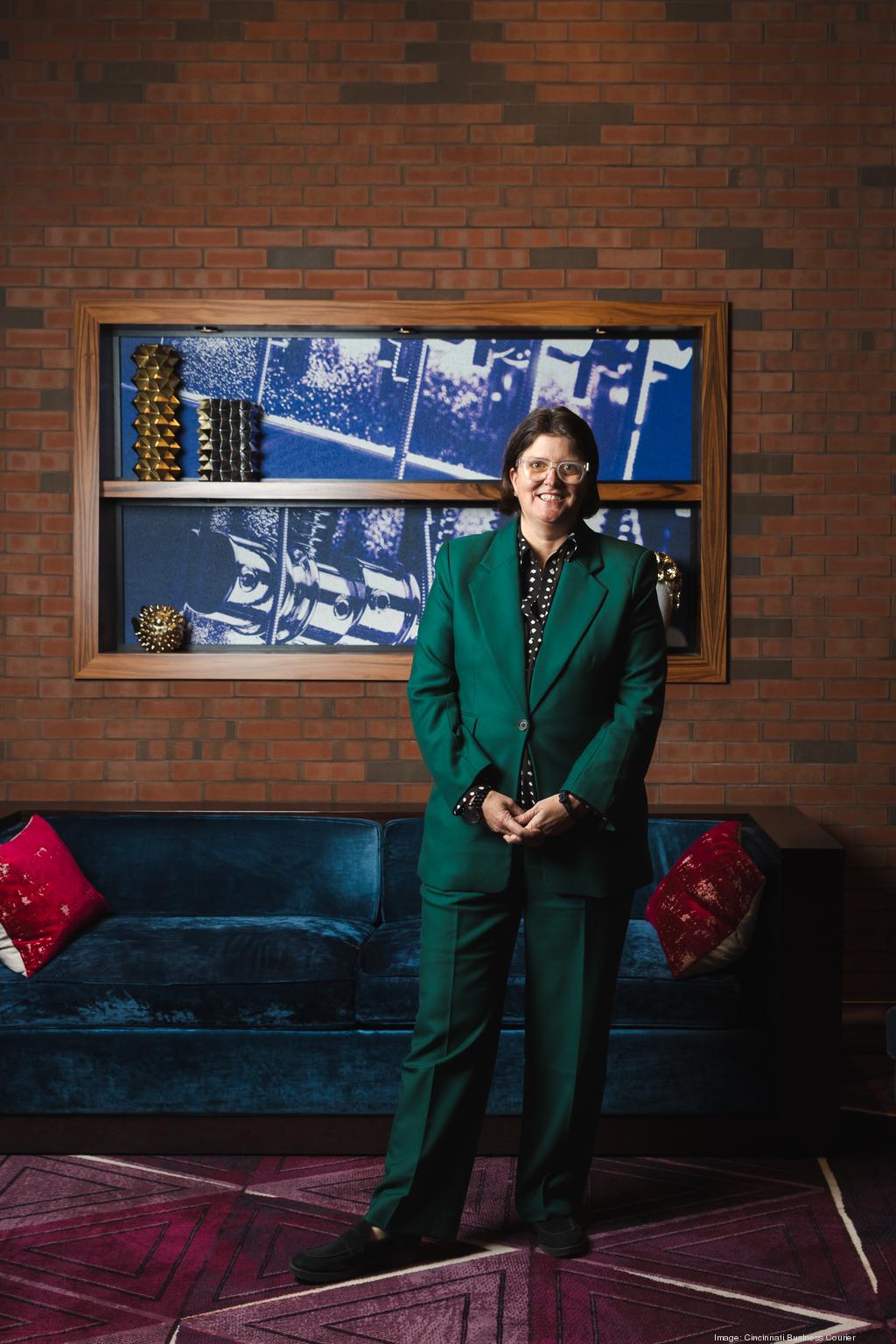
The connector’s craftA city becomes the client
Game Day’s work expanded across sports organizations, entertainment groups, arts institutions, nonprofits and corporate clients. Reau’s own specialty became the difficult middle of communications: strategy, media relations, crisis planning and the practical choreography that turns a message into an event. She was also early to social media. In 2008, when many local professionals still treated online networks as curiosities, she was telling beginners to start small and get into the game. Her example was not abstract branding. A contractor could replace a routine progress email with a short video of a newly finished roof. Show the work. Make the update useful. Respect the viewer’s time.
Her description of the job is even simpler. She likes connecting people who have like-minded missions or business objectives, then watching the collaboration come alive. This is networking stripped of cocktail-party fog. A connection earns its keep by producing something neither side could quite make alone.
- Journalism and health care communications
- Marketing the Cincinnati Art Museum
- Co-founding Game Day with Betsy Ross
- Launching the Cincinnati Fear in esports
That approach scaled from client assignments to civic campaigns. As a Cincinnati Sports Commission leader, Reau worked on the region’s bid to host matches in the 2026 FIFA World Cup. The bid itself did not win a host-city slot, but it required years of coalition-building, venue planning and a story large enough to carry Cincinnati onto a global shortlist. Reau later summarized the underlying lesson: once partnerships and relationships exist, it becomes easier to rally people around the work.
When the Bengals reached Super Bowl LVI in Los Angeles, Game Day helped create a Cincinnati Media Center about a mile from SoFi Stadium. It gave business and civic leaders a physical place to explain the region while the national spotlight was already switched on. The resulting exposure was valued at billions of dollars. The clever part was not trying to manufacture attention from scratch. It was building a useful room near attention that had already arrived.
“I enjoy connecting people who have like-minded missions or business objectives to do great things together.”Jackie Reau on the best part of her job
A new kind of arenaThe game changes; the instincts travel
In April 2022, Reau founded the Cincinnati Fear, the city’s first professional esports team, and became its president. It was a clean extension of an old habit: notice where audiences are forming, learn their rituals and give the activity a local address. Esports replaced grass with servers and grandstands with streams, but it still needed partners, stories, events and a reason for Cincinnati to care.
Reau has continued to study the changing edges of communications. In 2025 she spoke to small-business owners about using artificial intelligence as a practical productivity tool for marketing and social media. Her posture was curiosity rather than worship. Understand the customer. Learn what has changed. Take ideas back to the desk and make them useful. It is the same sensibility she brought to short-form video years earlier.
“Hustle every day.” Three words, no decorative fog, and a fairly accurate operating manual.
Public service runs beside the commercial work. Reau’s board commitments have included the Cincinnati Art Museum, Flywheel Social Enterprise, Mount St. Joseph University and the Ohio University Foundation. Her volunteer focus has often returned to women’s causes and education, including Dress for Success and the YWCA. She credits Ohio University with changing her possibilities, then repays the institution with counsel, teaching and governance. In 2021, the university’s sports administration program gave her its Charles R. Higgins Distinguished Alumni Award. She had returned there for a master’s degree in sports administration in 2012, making her a double Bobcat.
Endurance, properly dressedThe person who stays until the lights go down
Reau has completed four half marathons and visited all 30 Major League Baseball parks. These facts could live harmlessly at the bottom of a conference biography, but together they offer a compact theory of her. A half marathon rewards persistence after enthusiasm has burned off. A tour of 30 ballparks is a long study in how different cities stage the same beloved ritual. Her professional life asks for both capacities: keep moving, and keep noticing.
She seems to collect institutions as other people collect souvenirs, learning how each one gathers a public around itself. The art museum, the marathon, a World Cup bid, a baseball park and an esports team all depend on an audience deciding to pay attention together. Reau’s work happens just before that decision. She arranges the message, the room, the timing and the relationships that make attention possible.
The cocktail napkin survives in the story because it is charming. The company survives because charm has backup. There was research after dinner, a launch date, a first client, a thousand early arrivals and the repeated discipline of looking around the next corner. Reau did not abandon Cincinnati to pursue sports. She made the city itself her field, then kept widening the boundary lines.