A shoe store can have an excellent address and the wrong neighbors. That was the problem facing a global footwear retailer in Azira’s customer stories. Its estate leaned heavily toward shopping malls. As malls lost anchor tenants, the retailer wanted more freestanding shops, strip-mall locations, and downtown storefronts. But how do you compare places that look nothing alike? Walking around helps. Walking around hundreds of possible sites requires a different instrument.
- Azira turns mobile location signals into consumer and place insights.
- Retailers use it to evaluate sites; marketers use it to build audiences and measure visits.
- Its useful trick is connecting research, advertising, and measurement within one business.
The retailer used Azira to examine visitor profiles, trade areas, and shopping patterns. Over its first 18 months, it evaluated hundreds of sites and selected more than 100 for new locations. Fifty internal stakeholders used the data. Those are company-reported results, and selections are not the same as successful openings. Still, the change in working method is clear: a feeling about a street could become a question that several departments could investigate.
A phone is a clue, not a customer census
Azira sits in the location intelligence market. It collects and processes signals associated with mobile devices, then turns them into information about places and audiences. A restaurant operator might study where visitors come from. A hotel might compare its guests with visitors to competing properties. A tourism board might decide which nearby cities deserve its advertising budget.
The raw ingredients come from several sources. Azira describes a mix of software development kit signals, advertising bid-stream data, and verified consumer transactions. Its privacy policy also describes device advertising identifiers, precise geolocation, and safeguards including hashing identifiers before supplying datasets. This is consequential information, even when a dashboard presents it as tidy groups and percentages.
Its expertise lies in processing those uneven inputs: mapping places, filtering signals, estimating visitation, and making the results usable. Estimated Visits Core, introduced in May 2026, covers more than 940,000 locations across the United States and Canada. It combines mobility and transaction data in a cloud feed for existing analytics tools. Distinguishing a drive-through visit from an in-store visit is exactly the sort of apparently small detail that changes a business decision.
- 01UnderstandPlaces & visitors
- 02BuildAudience segments
- 03ActivateCross-channel ads
- 04MeasureVisits & conversions
One audience. Several screens. Then a visit.
That intelligence also feeds advertising. Azira Insights supplies analysis; Audience builds segments; Campaigns activates media across formats including display, connected television, audio, social, and digital out-of-home. Measurement connects exposure with physical visits and digital conversions. The products address a familiar organizational problem: researchers learn something useful, then the media team has to reconstruct it elsewhere.
Destination Bryan, working with agency KHM, used a shared audience strategy across connected television, display, outdoor digital screens, and Meta. Historical visitation helped shape timing, including periods associated with Texas A&M football. Segments included leisure travelers, food enthusiasts, and alumni. Audiences were refreshed every two weeks.
The October 2026 case study reports 1,990,298 impressions and 69,544 exposed visits from 11,352 visitors. Read those last two numbers carefully. One visitor can make several visits. And an exposed visit establishes an association with advertising; demonstrating additional visits caused by the advertising requires an incrementality analysis. Azira offers incrementality reporting, but the published Bryan totals should retain their actual labels.
The business behind the dots
Azira sells to businesses: brands, agencies, destination organizations, hospitality operators, and teams responsible for property and expansion. Customers can buy platform services, data access, and campaign capabilities through negotiated service orders. The commercial value depends on the decision being improved: an avoided lease mistake, a better audience, or a more useful measure of media performance.
There are capable alternatives. Placer.ai offers site-selection analysis; Foursquare sells audience and attribution products. Azira’s positioning combines consumer data, operational analysis, and media activation, with industry-specific offerings for travel, dining, and retail. Buyers should compare the coverage and workflow they need, rather than assume a large pool of signals makes every individual venue equally measurable.
Partnerships extend that workflow. Sojern uses Azira for destination footfall attribution. In August 2026, Azira announced an Adobe Advertising integration to connect ads served in one country with visits in another, initially live in Asia-Pacific. That is a particularly useful question for tourism, where the advertisement and the arrival often happen on opposite sides of a border.
A new name after a real rupture
The corporate story needs its own boundary. Azira’s business traces back to Near, founded in 2012. Near filed for Chapter 11 in December 2023. Its SEC filing records the completion of an asset sale to Blue Torch on March 1, 2024; transaction reporting describes a credit bid of at least $50 million. That purchase consideration should not be mistaken for a fresh venture round or a current valuation.
Later that March, CEO Gladys Kong introduced Azira and set out priorities including ethical data sourcing, platform reliability, and more specialized products. Today, the company describes a culture of ownership, transparency, collaboration, and customer value. Those are stated commitments. The practical test is whether customers can trust the inputs and understand the outputs.

The next interface is a question
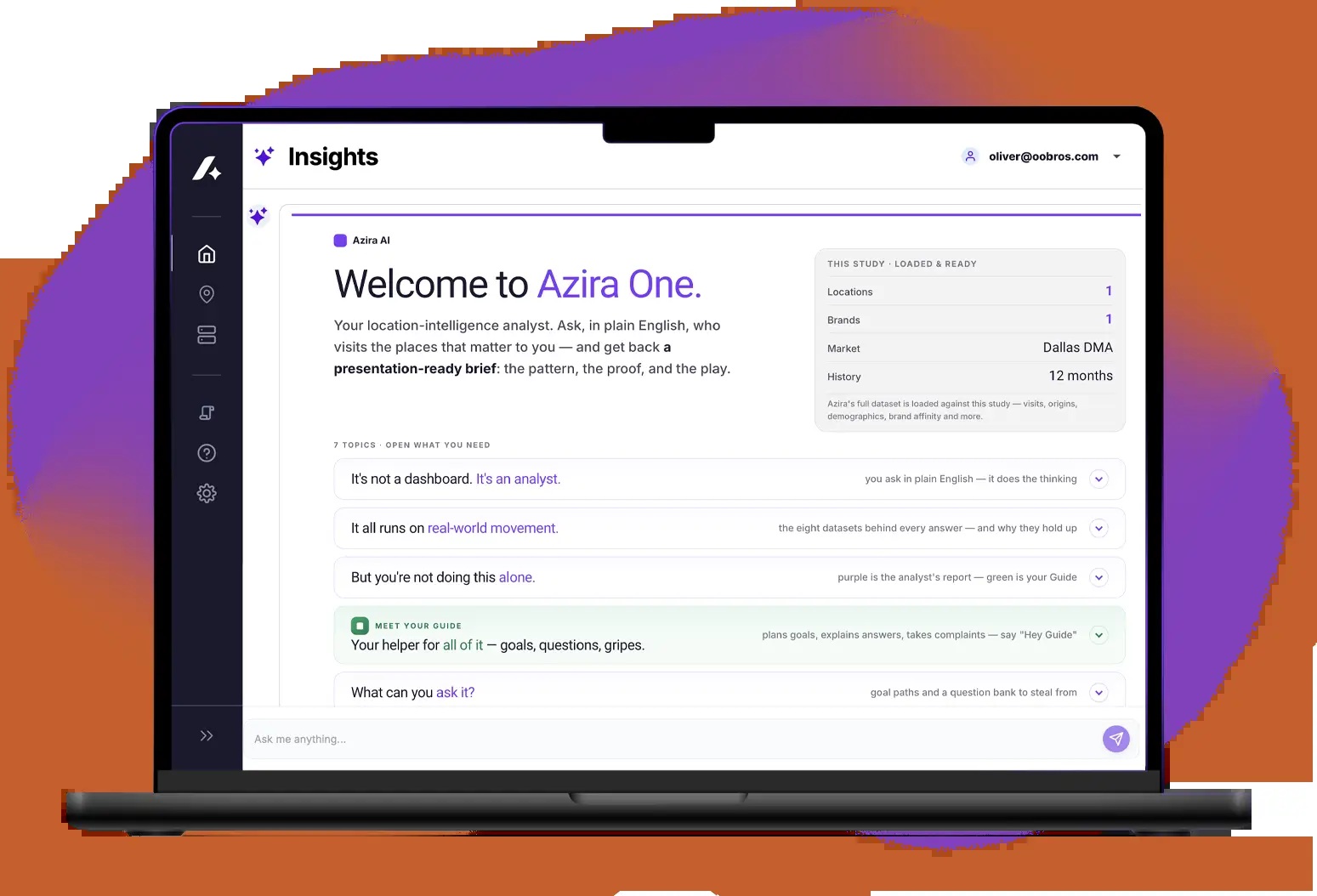
Azira One, announced in September 2026, brings conversational AI to that work. Its initial travel and tourism beta lets users ask questions of location datasets and generate analyses and visualizations. The product page offers complimentary early access. Kong described the aim as “making sophisticated analysis accessible to the people making the decisions.”
October’s Origin, Stay and Spend Report adds another dimension: aggregated transaction insights alongside visitor origins and trip characteristics. A destination can ask which markets bring spending as well as arrivals. Together, these releases show a shift toward delivering answers that a marketing or operations team can use directly.
Start with a decision you can check
The habit worth borrowing is simple: define the decision before drawing the polygon. Compare prospective sites with places whose performance you already understand. Keep visitors separate from visits, and campaign exposure separate from incremental effect. For sparsely observed venues, unclear boundaries, or decisions requiring individual purchase certainty, movement estimates need additional evidence. Teams can also agree on the comparison period and the meaning of a visit before the first report arrives. The shoe retailer’s useful lesson was to make judgment testable. Azira supplies another way to ask what a place is really doing.