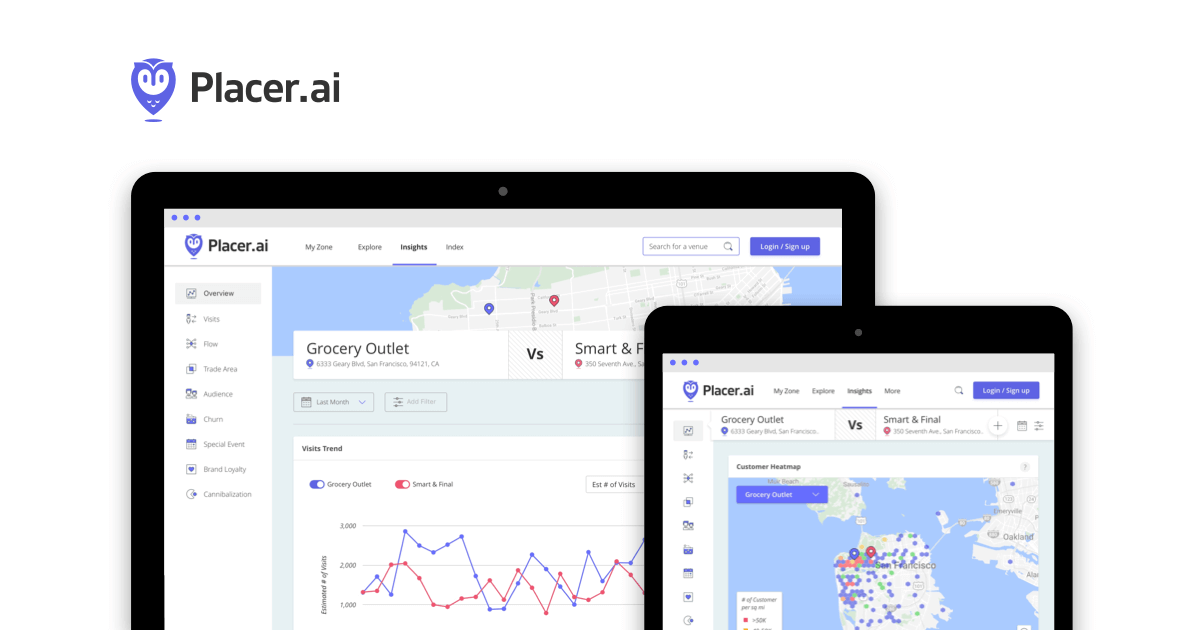
A retail analyst opens a tab and watches the street think.
It is a Tuesday morning and somewhere a leasing manager is deciding whether a shopping center deserves a new anchor tenant. She is not driving past it. She is not counting cars at the entrance with a clicker. She is looking at a Placer.ai dashboard that has already counted them for her - by hour, by visitor origin, by how many of those people also shopped the competitor three miles east.
This is Placer.ai in 2026: a location intelligence company that turned the messy, invisible movement of people through physical space into clean numbers on a screen. Retailers use it to pick sites. Real estate firms use it to price risk. Cities use it to plan. Journalists quote it when they want to know whether the mall is dying or merely napping. The company crossed $100 million in annual recurring revenue in 2024 and carries a valuation around $1.5 billion. Not bad for a business whose entire premise is that nobody could see the obvious.
The physical economy was flying blind.
Here is the irony that founded a unicorn. By the late 2010s, an online store could tell you which shade of blue button converted better at 2 p.m. on a Thursday. A physical store - which still does the overwhelming majority of all retail spending - often could not tell you, with any confidence, how many people walked in last week, where they came from, or where they went next.
Foot traffic was a guess dressed up as a metric. Trade areas were drawn with a compass and a hunch. Multi-billion-dollar decisions about where to build, what to stock, and which lease to sign rested on surveys, intuition, and the occasional person standing in a doorway counting heads. The offline world generated trillions in commerce and almost no usable data exhaust.
Four founders, one wager: phones already knew.
In 2018, four founders - Noam Ben-Zvi (CEO), Zohar Bar-Yehuda (data science), Oded Fossfeld (CTO), and Ofir Lemel (product) - made a bet. The signal already existed. Hundreds of millions of mobile devices were broadcasting anonymized location data through apps people had opted into. The hard part was never collecting it. The hard part was turning a noisy, privacy-sensitive firehose into something a leasing manager could trust at 9 a.m. on a Tuesday.
The team had history together, including prior work that ended in a Salesforce acquisition, plus a deep bench in data science. They spent more than a year quietly building before letting customers in. The wager was not that the data existed - everyone knew it did. The wager was that they could clean it, model it, and package it well enough that a skeptical retailer would pay for the answer instead of trusting their gut.
The short, fast version
What the dashboard actually does.
Strip away the marketing and Placer.ai answers a small set of very valuable questions: How many people came here? Where did they come from? Where else do they go? Who are they? And how does all of that compare to the place down the road?
The platform bundles this into named features - visitation trends, True Trade Area, customer journeys, demographics and psychographics, competitive benchmarking, and chain and industry analysis. Beyond the web dashboard, there is a geospatial data API and data feeds for teams that want to pipe the numbers into their own models, plus a data marketplace layering in sales estimates, planned development, business counts, online spending, and even climate data. And then there are the free tools - Chain Analysis, Industry Trends, Migration Trends - that turned Placer into a name analysts and reporters reach for without thinking.
For Retail
Pawn America used visits-by-hour data to fix its operating hours - and watched store sales and loan balances climb. The clipboard never had a chance.
For Real Estate
Webster Bank reworked risk management across a $1.3B retail real estate portfolio on Placer data. Foot traffic, it turns out, is a credit signal.
For Cities
Economic development offices use migration and visitation trends to plan Main Streets, transit, and recovery - the same data, pointed at the public good.
For Brands
Consumer brands measure whether an ad campaign actually moved bodies into stores, then aim the next one with fewer apologies to the CFO.
Four jobs, one panel of anonymized phones. The owl does not play favorites.
The numbers that did the convincing.
Skepticism is the right reflex for any company selling "data you can trust." So consider the proof points that are public and checkable. The customer count went from roughly 1,000 at the 2022 round to more than 4,000 by 2024. Revenue reached $100M ARR. The roster includes REITs and brands like Regency Centers, Macerich, BJ's, SeaWorld, Western Union, and Houston Airports.
Customers, before and after the bet paid off
A roughly 4x jump in two years. Either everyone suddenly cared about foot traffic, or they always did and finally had somewhere to look.
Then there is the most telling detail of the 2024 raise: Placer.ai pulled in $75 million and declined to name a single new investor, because there weren't any. Existing backers - the people who had already watched the company up close - put up the money. In venture, that is a quieter and more credible vote than any press release.
Seeing the world as it actually moves.
Placer.ai frames its mission as helping organizations understand what is happening in the physical world around them. That sounds soft until you remember what the alternative was: decisions worth millions made on the strength of a hunch and a windshield survey. The company's own framing is about visibility - not just where people go, but the forces that shape every market.
There is a privacy spine to all of this that the company is careful about: the data is anonymized and aggregated, drawn from opted-in app panels rather than from naming names. The product sells patterns, not people. That distinction is the difference between a useful tool and a creepy one, and it is load-bearing for a business that lives or dies on trust.
The map keeps getting more honest.
The physical economy is not shrinking; it is being instrumented. As Placer.ai stacks more layers - demographics, planned development, sales estimates, climate - the dashboard stops being a foot-traffic counter and starts being a model of how a place behaves. That is useful to a retailer, but it is also useful to a city deciding where to put a bus line, a bank deciding how to price a portfolio, and an analyst trying to call a trend before it shows up in a quarterly report.
The competition is real - Foursquare, Unacast, SafeGraph's lineage, and a field of mobility-data vendors - and the privacy ground keeps shifting under everyone. But the underlying demand is not going anywhere. Somebody, somewhere, will always need to know whether the crowd showed up.
The leasing manager closes the tab.
Tuesday morning, again. The leasing manager has her answer. The shopping center pulls more visitors than its reputation suggested, half of them come from a zip code nobody on her team had been targeting, and the competitor three miles east has been quietly bleeding traffic for two quarters. She signs the anchor tenant. She did not drive past the property once.
A decade ago that decision would have leaned on a survey, a site visit, and a confident voice in a conference room. Now it leans on a panel of anonymized phones, modeled into something she can defend to a board. That is the whole story of Placer.ai - it did not invent the crowd, the cars, or the parking lot. It just made them countable. The clipboard, finally, can retire.
Go deeper
Official channels, the funding coverage, and a few demos worth your time.