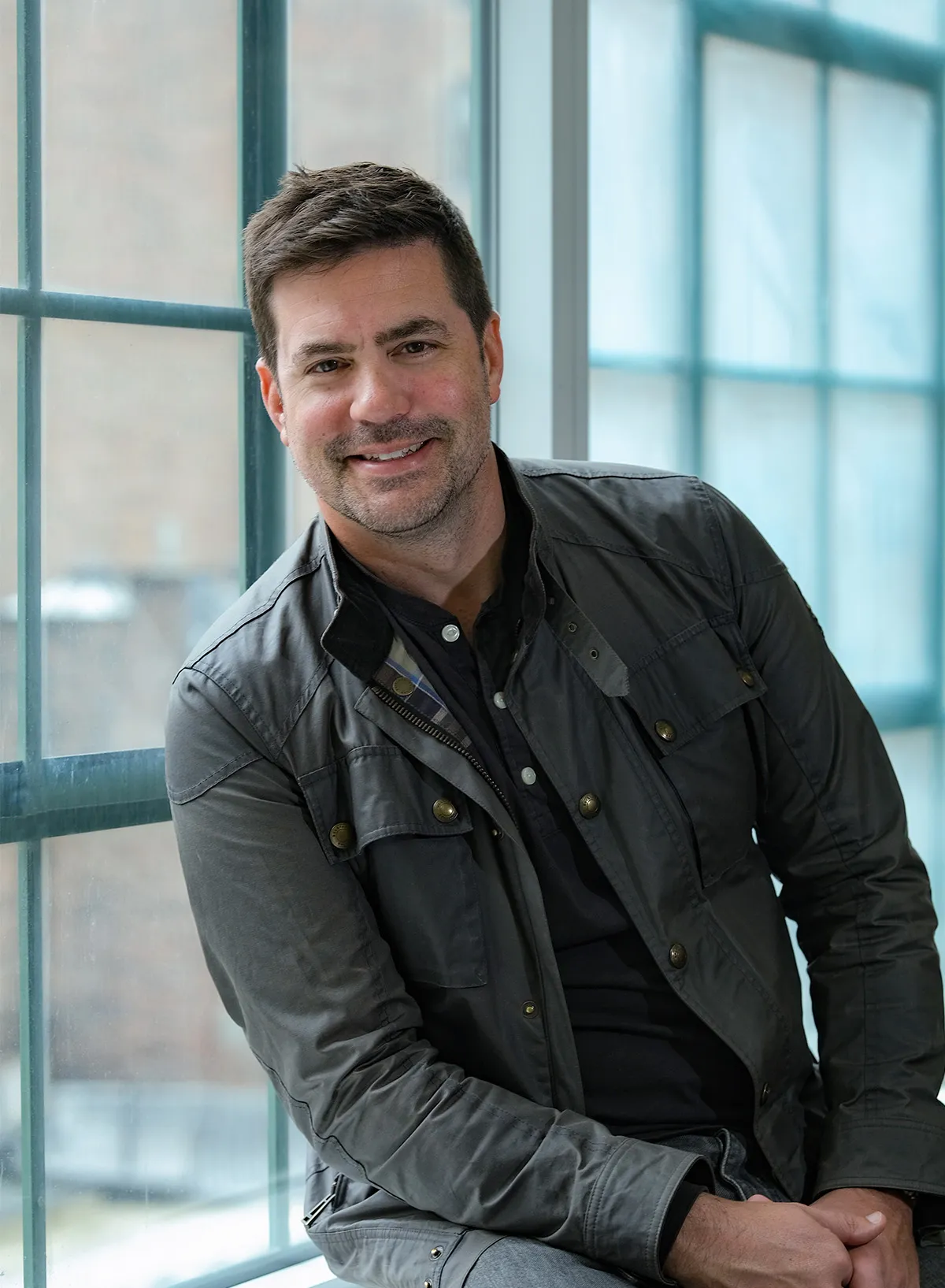
The Platform You Use Without Knowing It
When your weather app knows you're near the beach, when your bank flags a charge at a coffee shop three blocks from your office, when a retail chain plots its next location against foot traffic patterns - there's a good chance Foursquare is involved. Gary Little runs that company. He does it quietly, from Mill Valley, California, across the Golden Gate from San Francisco, in a town better known for redwoods than boardrooms.
Foursquare today bears almost no resemblance to the app that made it famous. The check-ins are gone. The badges, the mayorships, the social layer - gone. What remains is a global location intelligence operation covering 200 million points of interest across 190 countries, running machine learning models on billions of device signals, and selling that infrastructure to enterprises who need to understand where people go. It's the plumbing of the location economy. Little describes it simply: "We've gone from a products company to a platform company."
He took the CEO seat on January 1, 2021, replacing David Shim. But his relationship with Foursquare goes back further - and that backstory is what makes him interesting.
I saw a company and a technology that is becoming the single location currency for any company's tech or data stack, and the untapped opportunity is tremendous.
- Gary Little, on joining Foursquare as CEOInvestor First, Operator Second
Before Little ran Foursquare, he funded it. As Managing Director and Head of Technology at The Raine Group - a merchant bank with a reputation for backing media and technology bets others miss - he was the lead on Raine's $150 million investment in Foursquare. He also sat across the negotiating table during two of the company's most consequential deals: the acquisition of Placed from Snap Inc., and the merger with Factual, a competing location data firm that became Foursquare's foundation for enterprise intelligence.
When the board went looking for a new CEO, they didn't have to look far. Little already understood the company's balance sheet, its competitive position, and its unrealized potential. He joined as a board member in June 2019, spent eighteen months watching from the inside, and then stepped in. It's an unusual arc - investor to director to CEO - but it reflects a career built on refusing to stay in one lane.
The Long Way Around
Little graduated from Seattle University with a degree in Finance and Economics. Not Stanford. Not MIT. Not the Ivy the Silicon Valley credential-checkers expect. He went to Columbia Business School for his MBA in 2008-2009, finishing just as the financial crisis was rewriting the rules of every industry he'd been studying.
His first six years out of college weren't in finance. They were in internet operations. At Yahoo, he rose to Director of Strategy and Business Management inside the Media Group, overseeing monetization strategy for a portfolio of properties worth over a billion dollars. That's the kind of job that teaches you what internet businesses actually look like from the inside - where revenue comes from, what kills margins, how traffic translates to money. Most investment bankers advising tech companies have never held one of those roles. Little has.
Then came the pivot. Credit Suisse, where he joined as an Associate in the Financial Sponsors Group. Lazard, where he became Vice President in the same practice. UBS Investment Bank, where he made Executive Director. These weren't lateral moves - they were a deliberate accumulation of pattern recognition across industries, deal structures, and boardrooms. By the time he left UBS in late 2015, he had seen how capital moves through technology companies from every angle.
London pulled him next. He co-founded Buckthorn Partners LLP, a private equity firm focused on growth capital and acquisitions in the oil field services sector. The oil patch is about as far from location data as you can get - physically intensive, commodity-driven, cyclical. But it demanded the same skill: finding undervalued assets and thinking through their second and third-order potential. He stayed through 2017.
Running the Location Layer
The thesis Little articulates is sweeping but specific. Location data isn't a feature someone adds to a product. It's becoming foundational infrastructure - something platforms depend on the way they depend on cloud storage or payment processing. His framing: "The next 10 to 20 years in technology, there are all sorts of platforms that go from having location and geospatial data as a feature to a core part of the operating system."
Under his leadership, Foursquare has made moves consistent with that view. In 2021, the company acquired Unfolded, a platform for geospatial data unification, enrichment, visualization, and analytics - a tool built for developers who want to work with location data at scale. In 2023, Foursquare launched Foursquare Graph, a geospatial knowledge graph designed to help businesses extract more signal from location data. In 2025, Foursquare acquired Superlocal, an AI-powered personalized map app that automatically logs users' locations and uses that to generate recommendations - a consumer-facing proof point for the kind of location intelligence Foursquare has been building in the enterprise for years.
The comparison Little reportedly draws is to Amazon Web Services. AWS was a side project that became the most valuable part of Amazon. Foursquare's location data platform occupies a similar structural position: invisible, indispensable, and potentially enormous.
The Privacy Question
Running a company that tracks where hundreds of millions of people go creates a question Little doesn't avoid. Foursquare has been deliberate about positioning itself on the right side of the privacy debate - not because regulators require it (though they increasingly do), but because customers require it. The enterprises buying location data need to trust the sourcing. Little has said forthcoming products will be "agnostic to" collecting personal identifiable information - a commitment that matters as global data privacy standards tighten.
The irony is that the original Foursquare was about maximum personal disclosure. You checked in. You told your friends where you were. You competed to become mayor of the coffee shop. Now the company that built that infrastructure has rebuilt itself on anonymized, aggregated, privacy-compliant signals. The social layer is gone. The data layer is permanent.
It'll be a great privilege if we get the choice to either go public or sell ourselves and be part of something bigger.
- Gary Little, on Foursquare's futureThe Foursquare Everyone Forgot - and the One That Stuck
Ask most people under 30 about Foursquare and you get a blank stare. Ask anyone who had a smartphone in 2010-2013 and you get nostalgia. The check-in app that spawned a thousand location-sharing products - and then quietly pivoted into something harder to explain and far more durable.
The transformation happened before Little arrived. The consumer app was spun into Swarm in 2014. The company spent years building its enterprise data business. But the capital that funded the inflection - the $150M from Raine that let Foursquare acquire Placed, merge with Factual, and build at scale - that's Little's signature on the company before he even had the title.
He stepped into the CEO role during a global pandemic, leading a company of 530 people working in location intelligence at a moment when nobody was going anywhere. Foot traffic data hit zero. His core product's primary input - where people physically are - suddenly had nothing to report. The company survived by leaning into its infrastructure role: the data pipelines, the developer tools, the enterprise contracts that don't depend on a single month's check-in volume.
What He's Building Toward
Little's ambition for Foursquare isn't modest. He talks about location becoming "a core part of the operating system" of the next generation of technology platforms. He's building toward a world where knowing where something is - a business, a device, a movement pattern - is as fundamental as knowing what it is. Foursquare Graph is his bet on that: a geospatial knowledge layer that maps relationships between places, not just points.
On a potential exit - IPO or acquisition - he's measured: "It'll be a great privilege if we get the choice to either go public or sell ourselves and be part of something bigger." That's the language of someone who thinks Foursquare has real options, not someone angling for a lifeline.
From Mill Valley, across the bridge from the city that keeps reinventing itself, Gary Little is running an infrastructure company with a pop culture backstory and a B2B future. He was the investor who saw it first. Now he's the operator proving it.
"I saw a company and a technology that is becoming the single location currency for any company's tech or data stack."
"We've gone from a products company to a platform company."
"The next 10 to 20 years, platforms go from having location as a feature to a core part of the operating system."
"It'll be a great privilege if we get the choice to either go public or sell ourselves and be part of something bigger."