Somewhere in Mexico City, a cafe exists in three databases at three addresses, with two phone numbers and one set of opening hours last checked before the pandemic. To a person walking past, the truth is obvious. To a retailer sizing a neighborhood, a delivery app recruiting merchants or an insurer pricing a building, it is an expensive little mystery. Dataplor built a company out of resolving millions of those mysteries.
The New York-based enterprise data firm maps the commercial world: what a place is, where it sits, which brand it belongs to, when it opens or closes, the shape of the building and, increasingly, how people move around it. Its current inventory covers more than 370 million places and 15,000 brands across more than 250 countries and territories. Customers can license the dataset into their own systems or use a visual platform to compare markets, brands, trade areas and foot traffic.
In July 2026, Dataplor put an agentic AI interface on top. A strategist can type a question such as where a category is growing, which brand is winning or where a market has white space, then inspect maps, charts and exportable records. The interface is new. The useful part took a decade: making the answers less likely to be nonsense.

First, the map was wrong
Geoff Michener came to the problem after working at LivingSocial and building ProspectWise, a crowdsourced US small-business data company that was later acquired. A mentor who had run the data company Infogroup pointed him toward international business records. Mexico became the test. The official directory looked authoritative, but Dataplor's analysis found only a fraction of records fully correct. Many small businesses had no website or verified online identity at all.
The first answer was people. Dataplor recruited local “Explorers” to visit or verify storefronts, helping small businesses appear online while producing structured records for enterprise customers. By 2019, the company said it had put about 150,000 businesses onto Google. It also used public sources, image recognition and call bots that asked simple questions in the local language: Is this the cafe? Is it at this address? Does it accept cards?

Gather broadly
Ingest public, commercial and proprietary sources rather than trusting one supposedly definitive list.
Match and deduplicate
Use machine learning, spatial signals and image analysis to decide whether inconsistent records describe the same place.
Call the street
Automated local-language calls verify simple facts at scale, especially where digital footprints are thin.
Give ambiguity to humans
Native-language validators handle the cases where an algorithm finds confidence easier than truth.
Refresh, because reality moves
Businesses close, relocate and rebrand. The product is not the file; it is the continuing correction.
What failed first
Dataplor's early operation was service-heavy. It could solve a customer's local-business problem, but each new request threatened to become another custom job. People had to be managed, fieldwork had to be commissioned and the result could be hard to reuse. Michener has described the lesson bluntly: services were difficult to scale.
What changed his mind was the residue of the work. Every project left behind a better database and a repeatable method for collecting it. Instead of charging for one-off research, Dataplor could mine a country once, keep the records alive and license the same market to multiple customers. The team shifted toward a Data-as-a-Service subscription. In a historical investor interview, Michener used $50,000 a year for Mexico as an illustrative contract - not a current list price - and said customers paid annually in advance. Current public pricing remains enterprise-negotiated.
That is the part founders can copy. Look for reusable exhaust inside a bespoke service: a dataset, workflow, benchmark or integration that improves with every engagement. Standardize the output. Charge for continued accuracy, not the first delivery. It works particularly well when information decays, because updates are not a manufactured retention trick; they are the reason the customer stays.
The customers are not buying pins
A point on a map is merely the beginning. Wolt feeds Dataplor records into CRM and geospatial systems to understand merchants beyond restaurants, prioritize leads and improve prediction. In Dataplor's case study, Wolt said the data expanded its view of the market by nearly 40 percent in certain countries. FLO, the EV charging network, uses richer place attributes to forecast charger demand and identify potential hosts. It reported 65 percent more POI records in benchmark areas than its previous source.
Tensorflight combines place data with imagery and property records to classify building occupancy and estimate replacement costs for insurers. Retailers and quick-service restaurants use it for site selection and competitor benchmarking. CPG companies inspect distribution gaps. Logistics teams plan routes and facilities. Financial firms study risk and market momentum. Earlier public customer lists included Google, Uber Eats and American Express.
The company sits between raw mapping infrastructure and decision software. Alternatives include Foursquare, HERE, TomTom, Precisely, SafeGraph, Placer.ai, Google Maps Platform, Data Axle and Dun & Bradstreet, depending on whether a buyer needs POIs, movement, mapping APIs, company records or a finished analytics product. Dataplor's pitch is one globally consistent supplier with better coverage outside North America, plus both raw files for technical teams and a platform for operators. Esri, which could otherwise look adjacent, is a partner: Dataplor joined its partner network in 2024.
The AI is a door, not the house
Dataplor launched its visual Global Platform in February 2026, then rebuilt the experience around conversation in July. The assistant can analyze openings, closures, foot traffic, trade areas, category performance and brand momentum. A user can ask where to open the next store, inspect the mapped evidence and export the data into an internal model or presentation.
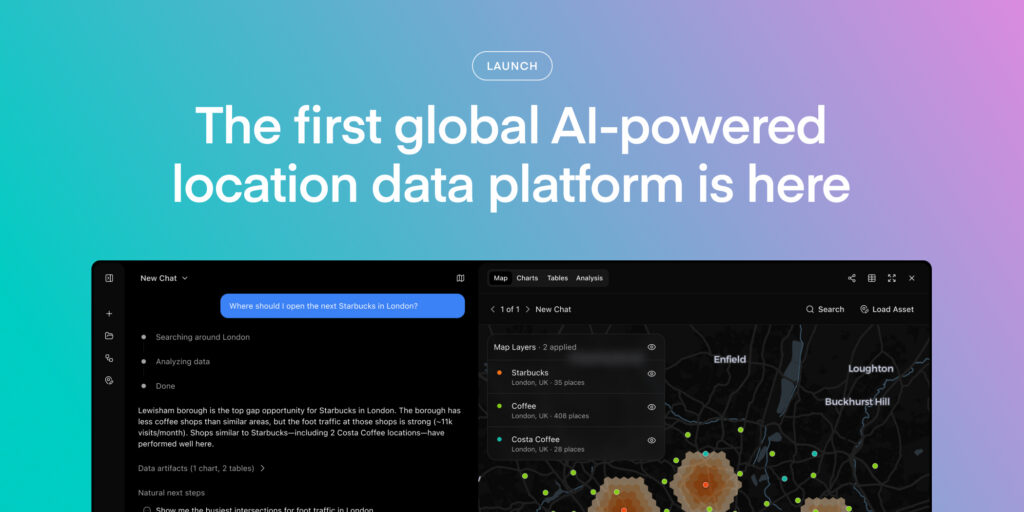
This is a credible use of AI because the model is constrained by a proprietary corpus and the answer can lead back to data. It also widens the buyer. A real-estate director no longer needs to know the right category code or wait in an analyst queue. The risk is familiar: conversational confidence can make a probabilistic answer feel final. Dataplor's years of validation reduce that risk; they cannot abolish it.
Privacy is part of the product boundary, too. Dataplor says its movement data is anonymized, aggregated and designed for rules including GDPR. That makes it useful for measuring visitation patterns, not following individuals. The distinction is commercially important: multinational customers need a dataset they can use across jurisdictions without rebuilding the compliance logic market by market. It also limits the questions the product should answer. A foot-traffic trend can show that demand moved; it should not identify the person who moved with it.
Where the playbook breaks
The Dataplor model is strongest when many customers need the same changing facts across many markets. It is weaker when the question is unique, the observable signals are sparse or the decision requires knowledge a POI record cannot contain. A beautifully verified store location does not reveal lease terms, local politics, unit economics or the queue forming tomorrow.
- Do not use it alone for live safety, legal, credit or underwriting decisions that require primary local checks.
- Expect lag around brand-new openings, closures and informal businesses with few machine-readable signals.
- Foot-traffic estimates are modeled from anonymized, aggregated signals; they are not a census of every visitor.
- Rural and low-connectivity markets can remain harder to observe even with human review.
- The subscription model loses leverage if a customer's need is narrow, static and unlikely to recur.
Dataplor has raised $37.6 million across its publicly disclosed rounds when the reported $500,000 convertible, $2 million seed, $4 million venture round, $10.6 million Series A and $20.5 million Series B are counted together. The latest round, led by F-Prime in June 2025, financed more coverage, mobility products, integrations and hiring. The company lists New York as its headquarters and promotes a culture of authenticity, connection, excellence, entrepreneurship and ownership - language that fits a system where a neat output depends on someone taking responsibility for an ugly edge case.
The lasting lesson is pleasantly unflashy. Dataplor did the manual work, found the repeatable asset inside it and built software around the asset. Then, when AI made conversation cheap, it had something expensive and specific for the AI to talk about. Anyone can copy the sequence. Very few will enjoy checking whether the cafe is still there.