The trouble with a map is that it begins lying almost as soon as it is finished. A cafe changes its hours. A grocer moves around the corner. A family business opens without building a website, while an old listing remains online like a ghost with excellent search ranking. Geoff Michener looked at this daily mutiny of the physical world and saw more than bad records. He saw a company.
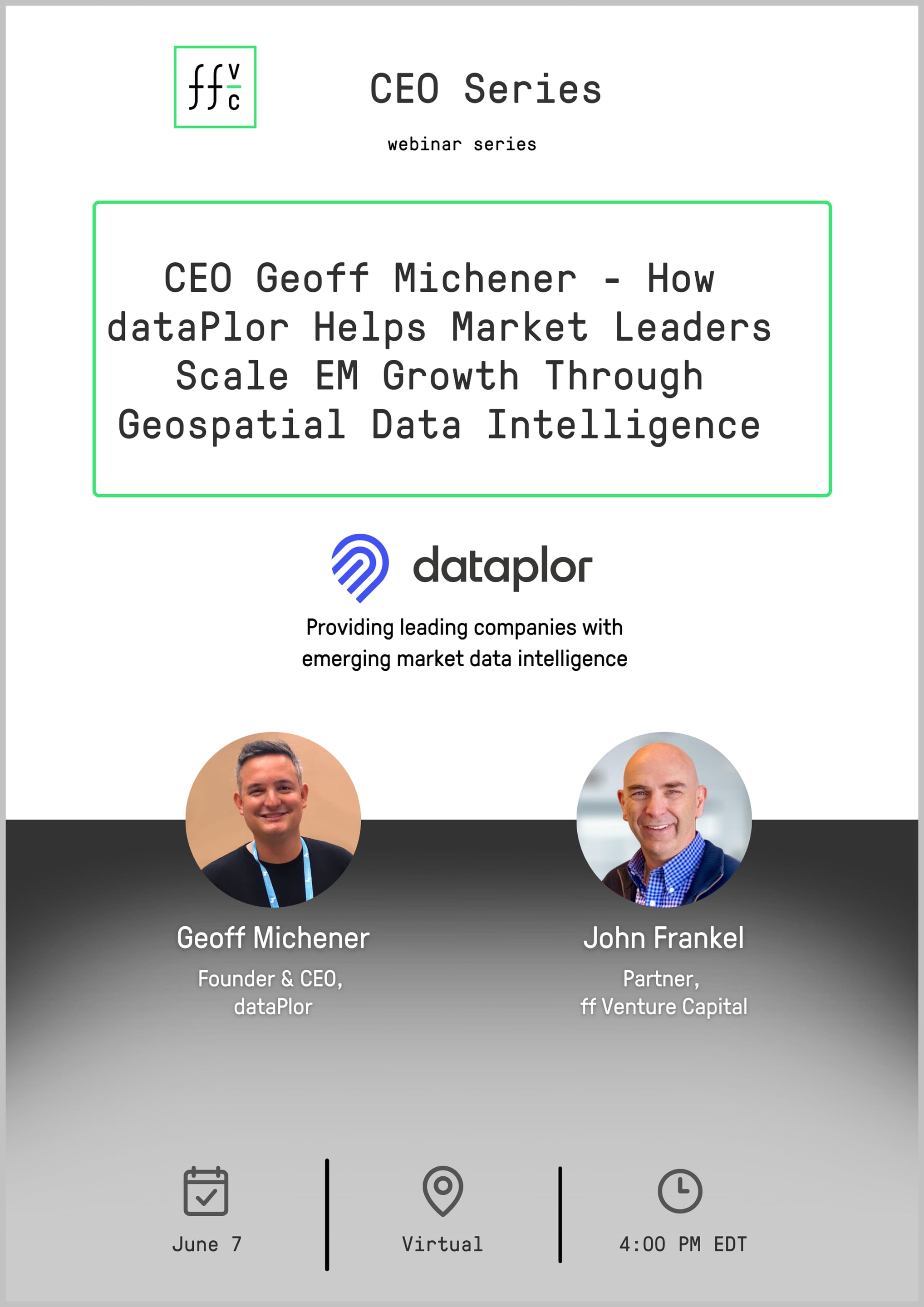
Dataplor, which Michener started in 2016, now describes a decidedly large canvas: more than 370 million points of interest across over 250 countries and territories. The numbers make the company sound like a feat of industrial computing, which it is. Its more revealing habit, however, is smaller. When software cannot decide whether a place is real, someone may call. A native-language reviewer may check. The machine gets a witness.
This is Michener's recurring theme. The physical world is messy; useful systems should admit it. His career is an argument for looking at the untidy parts longer than most people can bear, then building a process that makes them legible.
01 / A promise, kept sideways
The route through Nicaragua
Michener grew up in Denver with an interest in international trade and economics. As an undergraduate, he studied abroad in Nicaragua and learned about foreign investment. The region caught him. He promised himself that he would return to Latin America to do business.
Life, being a careless travel agent, booked a route with several connections. There were internships tied to the White House, the Pentagon and a think tank. He grew frustrated with government red tape. A friend offered him a startup job, and curiosity did the rest. At LivingSocial, the deals company that once sparred with Groupon, he worked around business development and data partnerships. He saw the cost of incomplete location data from the buyer's side: sales, marketing and mapping teams can make very polished mistakes when the underlying place is wrong.
Next came ProspectWise, a crowdsourced small-business data company he co-founded. Thousands of outside salespeople could contribute information from places they were already visiting. The venture did not become his lasting company. Michener has spoken plainly about shutting down that first startup and treating the ending as instruction rather than mythology.
One relationship survived the wreckage. A former customer suggested he investigate small-business data in Latin America. Mexico became the test. The official directory looked authoritative until the records met reality. In a later investor conversation, Michener said Dataplor's analysis found only 19 percent of the government data it examined was correct. In a region where many small businesses had no website, scraping the web harder was an exquisitely technical way to remain uninformed.
“The dirtier the better, harder the better.”Geoff Michener, on choosing international data
So he returned to the promise he had made in Nicaragua, though not in the expected costume. He would not be trading containers or drafting foreign-investment policy. He would be finding the shop that existed beyond the browser.
02 / The useful residue
Mine the country once
Dataplor's early answer was a field network. Local “Explorers” gathered and verified information about small businesses. The work helped merchants establish a digital presence while giving enterprise customers a clearer picture of the market. It was useful. It was also heavy with service work, and service work has an appetite for repetition.
The pivot hid inside the residue. Every custom collection project left Dataplor with a better database, a trained method and a market it could maintain. Michener and his team began turning that accumulated work into a subscription data product. Build a country, keep it fresh, and let multiple customers use the same maintained asset. The question changed from “Who will pay for this survey?” to “Who needs this living map?”
That sequence contains the lesson worth stealing. Automation does not have to swallow a workflow whole. It can sort uncertainty. Dataplor starts with inexpensive signals, moves through machine processing, and spends human attention on the stubborn remainder. The human is neither a sentimental ornament nor a substitute for scale. The human is where unresolved cases go.
Customer demand also helped choose the map. In the investor interview, Michener offered Saudi Arabia as an example: a large consumer-goods customer wanted the market, effectively covering the cost of building it, after which Dataplor could offer the same database to other customers. Expansion followed paid need rather than a founder's pinboard of glamorous countries. It is difficult to get lost when the customer buys the compass.
03 / Entropy pays the renewal
A database with a pulse
Recurring revenue can sometimes look like a pricing department's clever attempt to make departure inconvenient. Dataplor has a more honest engine: reality decays the product. Yesterday's accurate file becomes today's near miss, then tomorrow's fiction. The work is not complete when a place is found. It is complete for now.
This makes maintenance the product. Retailers can study white space. Consumer-goods companies can see where stores actually operate. Logistics teams can estimate demand around a location. Financial and insurance users can connect physical places with risk. Dataplor added global mobility data to show aggregated foot-traffic patterns around those points of interest, while saying its approach does not expose personally identifiable information.
The distinction matters because “location data” can sound like a polite euphemism for following a person around. Michener's public case is about places and aggregated movement: how busy a location is, when visits rise, where demand may be shifting. Dataplor says it does not track individuals. The commercial value comes from understanding the behavior of a site or market without turning a passerby into a named record. Privacy here is not a ribbon tied around the product after collection. It constrains what the product is designed to reveal.
The map keeps opening - reported company coverage
The company raised a $10.6 million Series A led by Spark Capital in April 2024. Fourteen months later, it announced a $20.5 million Series B led by F-Prime, with participation from existing and new investors. The stated plan was practical: expand coverage in under-mapped markets, improve point-of-interest and mobility products, smooth customer integrations, and hire.
Capital did not erase the original contradiction. Dataplor sells global scale by taking local disagreement seriously. Its systems use artificial intelligence, machine learning and language models, but its public description keeps returning to native-language human review. A business can be technologically ambitious and still concede that the bakery owner knows where the bakery is.
04 / Candor as infrastructure
Share the ugly part, too
Michener's preferred management vocabulary is unusually unvarnished: open, direct, transparent communication. Early in Dataplor's life, he said leaders should share “the good, the bad, and the ugly,” even with investors. Fundraising was exhausting and stressful, he acknowledged, so he talked about it instead of embalming the strain inside a brave face.
He carries the same realism into hiring. “If I was the best at everything, I would do it all myself,” he once said. He wanted employees smarter and better than him at particular things, which is the sort of founder statement that only matters when the org chart proves it.
Dataplor was fully remote before the pandemic. Michener has described asynchronous code review across time zones, daily stand-ups, and deliberately scheduled days off after hard sprints. Rest, in this system, is maintenance for people.
His interests away from work rhyme neatly with the company without appearing selected by a publicist. Michener has spoken about studying American Indian history and spending time outdoors. He connects both to resilience, adaptability, patience and preparation. His shorter public bio adds marksman and Colorado sports fan. One imagines a map, at least, is rarely far away.
There is a temptation to polish this into the usual founder fable: early fascination, painful failure, triumphant scale. The more useful shape is loopier. A study-abroad promise led through bureaucracy. A startup ending preserved a customer relationship. Fieldwork produced a database. A database demanded constant correction. Each apparent detour left an asset.
“Share the good, the bad, and the ugly, and share it even with investors.”Geoff Michener, on transparent leadership
Michener's stated ambition is to map every business on the planet with precision. The sentence is large enough to be faintly comic. The method is refreshingly modest: look, compare, call, ask, correct, return. The map grows through acts of doubt.
He also keeps writing about the uses around the map: insurance risk, public policy, international growth, competitive analysis and supply chains. The subjects vary, but the underlying request is consistent. Before a company decides where to build, insure, deliver or expand, it should know what is actually there. Strategy sounds grand in a boardroom. On the ground, it may begin with confirming the coordinates of a loading dock.
That may be Dataplor's most transferable idea. A company does not need to automate away uncertainty. It can become very good at locating uncertainty, pricing the effort to resolve it, and remembering what it learned. In a market drunk on synthetic confidence, the person who checks whether the door is still there has found useful work.