A queue is a peculiar place to conduct market research. Nobody has come for a conversation. Everybody would prefer to leave. For Dhruv Saxena, though, the people carrying parcels into Chicago post offices were unusually well-qualified prospects. They sold things online. They had orders to dispatch. And here they were, spending part of their working day waiting to hand over a box.
He understood the inconvenience because he shared it. Before ShipBob, Saxena and his childhood friend Divey Gulati ran SnailMailPics, a service that turned phone photos into physical mail. They had automated much of the business. Packing and posting still required human beings, and the human beings had other jobs. Their side project was becoming an excellent demonstration of the problem they would eventually sell a solution to.
The familiar founder story begins with an idea. Saxena’s becomes interesting at the point where an idea acquired a queue of people who might pay for it. The queue was inconvenient, unglamorous and remarkably informative. It also had rather less patience for a pitch than a room full of investors.
Two friends, one unfinished automation
Saxena and Gulati grew up in New Delhi and came to the United States in 2007 to study engineering. Saxena earned bachelor’s and master’s degrees in electrical engineering at Purdue. By 2012, both friends had moved to Chicago. Gulati worked in consulting; Saxena became a software developer at InContext Solutions, after earlier research work at Purdue.
It is an engineer’s route into a business that eventually needed shelving, loading docks and people who could get orders out the door. Their 2013 photo venture offered a useful education in the gap between a digital transaction and a physical delivery. A customer could send a picture electronically with very little fuss. The resulting print still needed to travel through the world.
That last obligation kept bringing the friends back to the same place. Other sellers were there, too. ShipBob emerged in 2014 from this shared irritation, beginning in Saxena’s Chicago apartment. Their potential customers were already assembling themselves in public, parcels in hand. Finding them required leaving the keyboard.
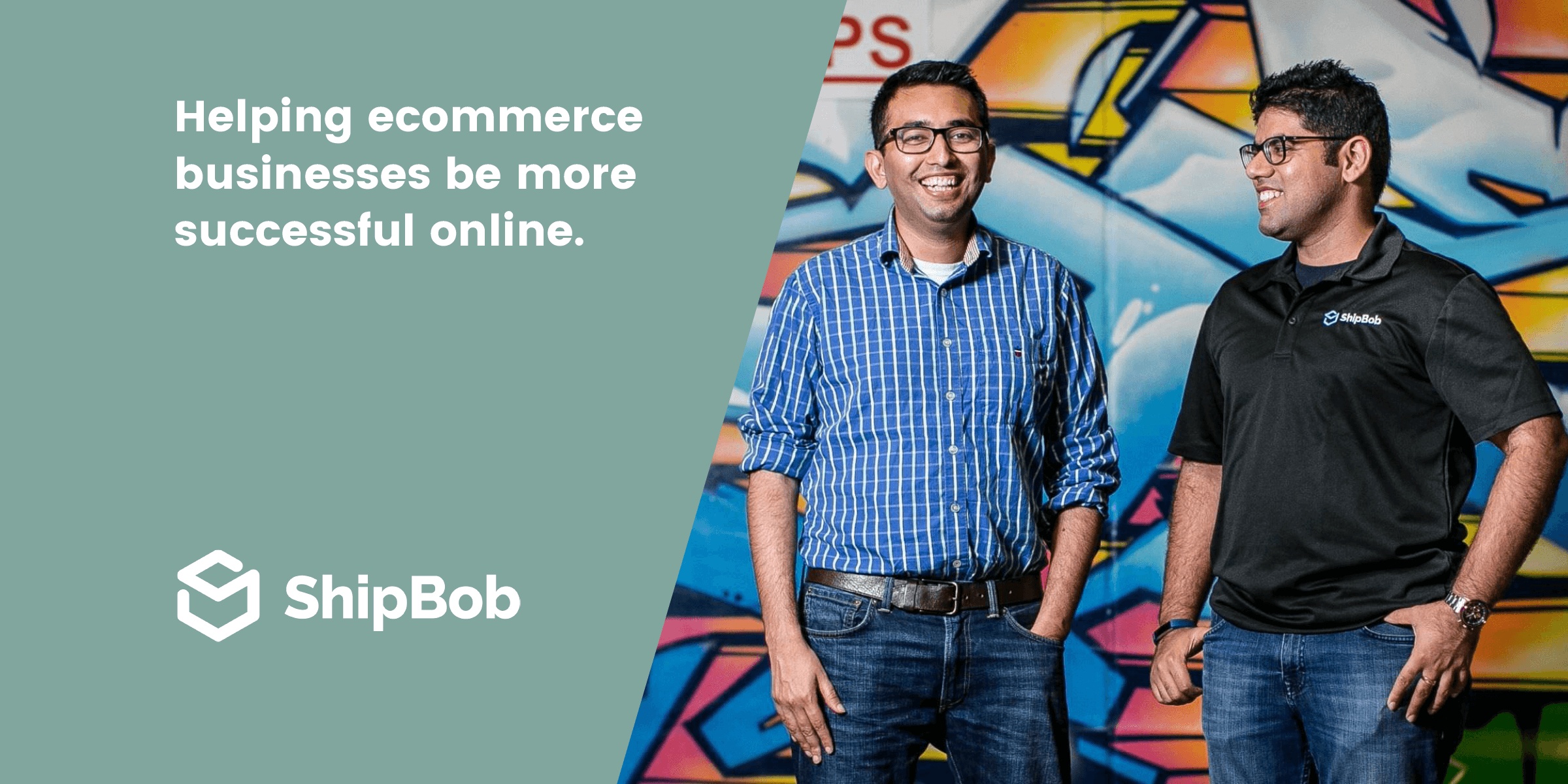
The customers who didn’t order
The early arithmetic was sobering: 1,800 signups produced zero orders. That is an awkward result for any young business, especially one whose purpose is to move orders. The founders went to local post offices to find paying customers. A registration had proved easy to obtain. Getting someone to entrust a shipment to them required considerably more.
They spoke with sellers about what they needed and what they would pay. Later, laptops became part of the routine, allowing prospective customers to critique the application. There is something pleasingly literal about software being reviewed outside the building it might save somebody a trip to.
The original service collected inventory from merchants each day. Customers asked ShipBob to store it instead. That request changed the operating model: keeping products on hand could remove a repeated pickup and make fulfillment easier for both sides. The company’s enduring idea was helping merchants run their businesses. The precise service was available for revision.
A Tuesday deadline, a very long commute
ShipBob joined Y Combinator’s summer 2014 batch. Saxena and Gulati chose to stay close to their Chicago customers while traveling to the Bay Area for weekly dinners. The accelerator experience came with an unusually substantial commute. On Tuesday mornings, they wanted their package count to be 10 percent higher than the week before.
The arrangement gave the week a sharp deadline, but it also kept them away from the everyday company of other founders. Saxena later described the pressure and isolation of that choice. Chicago supplied customers; California supplied a recurring appointment at which progress had to be visible. An airline ticket makes an expensive reminder to get something done.
He is willing to recount decisions that aged less gracefully. One early Brooklyn fulfillment center occupied a sixth-floor space with limited freight-elevator access. Staff formed a human chain to move packages along the stairs. Cheap rent had come with an operational catch and a three-year lease. The stairway was an unusually concrete lesson in the cost of a bargain.
The year the money nearly stopped
The company’s vulnerability became acute in 2015. A better-known logistics startup had raised $50 million, and Saxena found investors treating the category as though its eventual winner had already been selected. ShipBob had only four or five months of runway left. He remembers the embarrassment of thinking he had let colleagues and family down.
His counterweight was the existence of paying customers who would miss the service if it vanished. That distinction shaped his advice to founders: investor reactions should not become the sole verdict on a business. People using the product were delivering another verdict every time they paid.
“Venture capitalists don’t get to decide whether you are building a great company or not. Your customers get to decide your fate.”
Dhruv Saxena, 2021
By 2021, ShipBob had reached a $1 billion valuation and announced a $200 million Series E led by Bain Capital Ventures. The company had also changed how it expanded: experience operating its own warehouses informed a partner model in which other operators used ShipBob’s technology. Learning the physical operation first gave the software something practical to organize.
$1bn company valuation at that round. These figures describe ShipBob, not Saxena’s personal wealth.
The hiring test lasts sixteen hours
As the business grew, Saxena’s questions increasingly concerned the people doing the work. His hiring criteria included whether a candidate could become better at the role than the interviewer, whether they had distinctive strengths, and whether you could sit beside them on a sixteen-hour flight to India.
The last question has a certain economy. A long flight strips the glamour from the prospect of spending time together. It turns an abstract conversation about working relationships into a practical seating decision. The broader point was to build a team whose abilities would raise the standard of the company, rather than merely avoid obvious weaknesses.
His public writing reflects those concerns. In 2018 he published pieces about hiring, leadership and purpose alongside commentary on fulfillment. That combination fits the job he had acquired: a software engineer now responsible for a business whose performance depended on people across offices and warehouses.
ShipBob’s founders described another practice that year: everyone, from finance executives to analysts, spent a week in a fulfillment center, learning the operation and helping during the holiday rush. A box waiting to be packed offers a useful corrective to an elegant office theory.
There is a change of scale hidden in those questions. At the start, the founders could stand outside a post office and hear a complaint themselves. A larger company needs other people to notice the same sort of thing, make a judgment and act. Hiring and time on the warehouse floor offered ways to keep that practical knowledge close to decisions. The habits of listening had to survive the growth of the organization that listening helped create.
What an impatient shopper sets in motion
The attraction of ShipBob for merchants rests on an ordinary asymmetry. A small brand can build a product customers like without having the infrastructure of a large retailer. Yet the buyer still expects the parcel to arrive promptly. The fulfillment problem begins after the store has succeeded in making a sale.
Saxena has spent years talking about the practical consequences. A 2019 logistics interview covered international expansion and the challenge of growing a team. An eCommerceFuel appearance examined warehouse capacity, carriers and the difficulty of same-day delivery. These are subjects with awkward physical constraints. An appealing checkout page cannot create another loading bay.
“Adding space is one of the hardest challenges to solve.”
Dhruv Saxena, eCommerceFuel
He has argued that better logistics should let independent brands compete through their products. That ambition explains why shipping remains a demanding place to work even when the underlying proposition sounds simple. Each extra service has to fit into a system that people rely on to keep their own promises.
From the post office to a live operations screen
Recognition followed the years of building. In 2024, Saxena received 1871’s Outstanding Tech CEO award and was named an EY Entrepreneur Of The Year national winner in Technology Software. They are public markers of a career whose earlier milestones included an empty order book and an inconvenient warehouse staircase.
The work has continued to change. In July 2026, ShipBob listed a summer product-release webinar hosted by Saxena and chief supply chain officer Melissa Nick. Its updates included retail compliance tools and more visibility into charges. The questions had become more detailed as the operation had become more extensive.
In August, ShipBob announced an AI suite connecting assistants to live fulfillment operations through an MCP connector, alongside its Bobby dashboard agent and warehouse automation. The announcement described systems intended to act on operational data. Whether the interface is a laptop outside a post office or an assistant inside a dashboard, the useful test remains what work the merchant can get done.
At ShipBob’s Fulfilled 2026 merchant event in Las Vegas, Saxena spoke about the infrastructure behind AI-powered operations. He and engineer Sagar Kohli also introduced Bobby. The setting brought him back into a room with the people whose orders depended on the system. Years after those early conversations in Chicago, the company was still explaining what its tools could do for a seller with work waiting.
One of Saxena’s quieter pieces of advice is to take pictures of everyday company life; he regretted not taking more himself. It is an apt thought for someone whose photo-mailing venture helped start all this. The mundane details deserve a record. Sometimes the business is already there, standing beside you, waiting for the line to move.