In 2014, Dave Eckley put a clock on the future of shopping. The distance between placing an order and receiving it, he predicted, would shrink from days to hours. For a customer, that sounded convenient. For the president and chief operating officer of a company handling the machinery behind online retail, it was a rather substantial assignment. A website can accept an order in an instant. A shoe still has to leave a shelf.
Eckley was the co-founder of TradeGlobal, a Cincinnati business whose work extended from digital storefronts to fulfillment and customer care. Its clients sold fashion and beauty products. TradeGlobal supplied much of the less visible work that allowed those brands to sell online: the site, the imagery, the marketing, the systems and the movement of merchandise. It occupied the space between wanting something and having it.
That position gives Eckley's prediction its interest. He was speaking from inside the chain of tasks that faster delivery would squeeze. Every minute promised to a shopper has to be recovered somewhere: in processing an order, locating stock, preparing a shipment or moving it onward. The customer sees a delivery estimate. The operator sees the dependencies behind it. “Soon” is a pleasant word until somebody has to put it on a schedule.
THE 2014 PREDICTION“a matter of hours”
Dave Eckley, on the wait between ordering and receiving
His career offers a way to look at e-commerce through those dependencies. The familiar version begins with a brand and ends with a purchase. Eckley's part of the story concerns the connections that make the ending possible, and the people required to keep them working as the geography gets larger and the allotted time gets smaller.
Three names, a widening map
The company began as Filltek in 2001, with Eckley and Dave Cook as co-founders. It became Netrada North America in March 2011, then TradeGlobal in August 2014. The sequence of names carries a small history of the business: fulfillment at the beginning, a regional identity in the middle, and an explicitly international ambition by the third act.
The 2014 change arrived with practical developments behind it. TradeGlobal announced the acquisition of Netrada China and the launch of Asia-Pacific operations from Hong Kong. Bregal Sagemount had invested to support expansion and technology development. The business was serving more than 50 international fashion and beauty brands and retailers. Eckley was identified as president, COO and co-founder.
He drew attention to the company's Celerity Innovation and Research Center, where clients and partners could work on commerce technology and retail concepts. That detail is useful. Alongside the warehouses and existing services, the company was making room to try things with the businesses that would use them. An innovation center has a better chance of being useful when the customer is allowed through the door.
The rebranding also described TradeGlobal Enterprise, intended to connect retail channels while reducing inventory across the supply chain. This was the operational question beneath the expanding map: how could a brand give a shopper a coherent experience while stock, information and service crossed different locations? A larger territory made coordination more valuable. It also supplied more opportunities for an apparently small mismatch to become somebody's disappointing afternoon.
North America
The storefront has a back room
TradeGlobal's offering covered an unusually long stretch of an online purchase. Demandware development and website content sat alongside digital imaging, marketing, fulfillment, logistics and customer care. Those activities often appear in separate business conversations. A shopper encounters them as parts of a single experience, with very little interest in which department owns the problem.
Consider the ordinary mechanics of buying a pair of shoes. The photograph needs to show the product clearly. The website needs to present it and accept the purchase. Inventory information needs to correspond to something that can actually be shipped. The parcel needs to reach its buyer. If something goes wrong, the person answering the question needs useful information. This is an illustration of the work such a service joins together, rather than a story about a particular TradeGlobal order.
Seen that way, Eckley's hours-long delivery horizon was a demand for coordination. A quicker final journey cannot make an unavailable item available. A handsome product page cannot correct a badly handled shipment. Each function has to hand something usable to the next. The elegance, when it works, belongs to the customer experience; the effort belongs to a much longer list of people.
For Eckley, the role changed from president and COO in 2014 to CEO by the following year's acquisition announcement. The continuity was the operating business itself. Cook was executive chairman when the international deal was announced, while Eckley was chief executive. The two founders had different titles and a shared place in the company's next ownership arrangement.
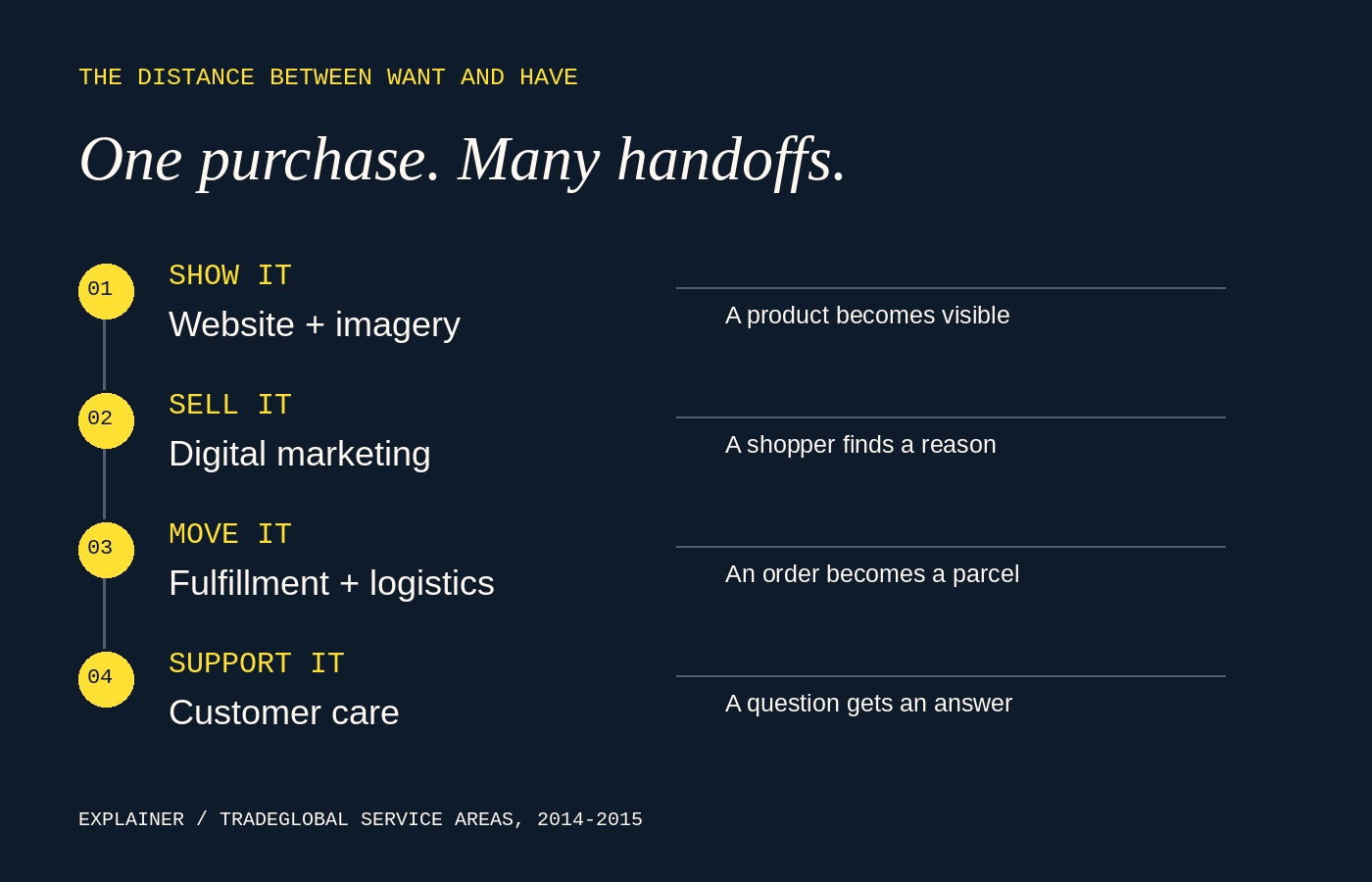
- Website + imagery
- Digital marketing
- Fulfillment + logistics
- Customer care
Cincinnati meets Singapore
In October 2015, Singapore Post announced an agreement to acquire a 96.3 percent interest in TradeGlobal for US$168.6 million. The other side of the transaction was a business backed by Bregal Sagemount. Eckley and Cook would continue as executives and shareholders. The figure describes a corporate acquisition, rather than either founder's personal proceeds.
The commercial idea was to connect complementary territories. TradeGlobal brought its American e-commerce operations; SingPost brought its Asian network and international logistics experience. Brands looking outward from the United States would gain access to capabilities in Asia, while customers in Asia could reach into the American market. By then, TradeGlobal served more than 60 brands.
Eckley presented the deal in terms of what clients could use: knowledge of the Asian market, international logistics and additional resources for expansion. The ambition was concrete enough to understand without the merger vocabulary. A retailer could want customers in another country and still need help with the ordinary, stubborn business of serving them there.
Marcelo Wesseler, then leading SingPost's e-commerce business, also singled out the founders when discussing the acquisition. He pointed to their customer relationships and described the business as having grown sustainably. That was a buyer's assessment at the time, and it adds a human dimension to the transaction. Systems and warehouses were being acquired, but confidence in the people running them mattered too.
The later corporate history was harder. In September 2019, TradeGlobal entities entered Chapter 11 proceedings alongside Jagged Peak. Substantially all of TradeGlobal LLC's assets were subsequently sold to Visible Supply Chain Management; SingPost announced the closing in December 2019. The expansion plan of 2015 and the outcome four years later belong in the same account. A promising combination still has to endure the business that follows its announcement.
For a 96.3% interest in TradeGlobal.
A company transaction, not a personal net-worth estimate.
A retirement with a short shelf life
Eckley's subsequent chapter brought him back into operations through Apax. He joined its Operational Excellence team in 2018 and is now listed as Senior Advisor, Operations. His work has included helping Moda Operandi, Tosca and Azelis with IT, operations and logistics projects. A BS in Management Information Systems from Peru State College sits neatly beside that combination of responsibilities.
There was a brief attempt at retirement first. His account of the detour includes golf, with a joke at his own expense about the pursuit of greatness. Then Seth asked him to help assess a prospective acquisition. The work led to an advisory role. After years of ownership, he had wondered about working for someone else; his description of joining Apax was “coming home.”
It is an appealingly modest turn in a founder's story. Retirement makes a tidy final paragraph, but it need not be a permanent occupation. In this case, there was another business to examine and another practical problem to work through. The golf course had competition for his attention. Corporate diligence is an unusual rival to leisure, though at least its terminology makes room for a fair amount of scrutiny.
The move also changed the scale at which his experience could be applied. A founder learns one company's interlocking problems in considerable detail. An operations advisor encounters those problems across different businesses, with different products and teams. The useful question becomes which lessons travel, and which need to be reconsidered before they are used somewhere else.
Still following the connections
His board roles keep him close to the movement of goods and information. Magaya lists him as a director; its software serves logistics businesses. Apax lists him on Inspectorio's board. In July 2026, Apax Digital Funds announced an investment in Inspectorio, whose platform connects brands, retailers and suppliers around production-chain quality and risk management.
That puts a current chapter beside the earlier TradeGlobal story. The work now reaches into how supply chains are monitored and managed, as well as how orders are fulfilled. The common subject is coordination across organizational boundaries: making information useful to the people who must act on it, and making the consequences visible before they arrive at the customer's door.
Eckley's 2014 prediction remains a useful place to finish because it begins with something anyone can understand: waiting for a purchase. Behind that simple wait lies a business full of handoffs. His career has repeatedly put him near those handoffs, first as a co-founder and operator, later as an advisor and director. The clock on the order is easy to display. Getting everyone behind it to agree on the time is the work.