The most important thing Fetch ever learned arrived in the form of a broken product. In 2017, after nearly four years of experiments, the Wisconsin startup released an app that let people photograph receipts and collect points. Demand rushed in. Receipt processing buckled for weeks. The sensible response from users would have been to delete the app and move on. Instead, they kept feeding it paper.
“The product was broken, and people still used it,” founder and CEO Wes Schroll later recalled. It is the kind of sentence founders laminate after the fact. At the time, it meant a queue, anxious engineers and shoppers waiting for points. But it also answered a question Fetch had spent years and millions of dollars trying to settle: had the company found a behavior people actually wanted?
Before the receipt, there was a checkout lane
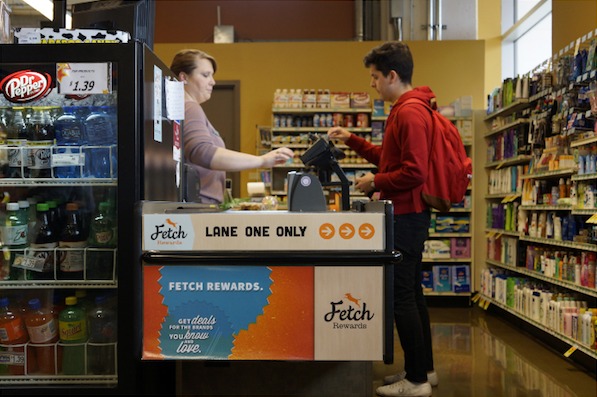
Schroll’s original irritation was ordinary. After moving out of his University of Wisconsin-Madison dorm, he began buying groceries and disliked the whole ceremony: no running total, annoying coupons, slow checkout. He and co-founder Tyler Kennedy built a scan-as-you-shop system. Customers scanned products with a phone, discounts appeared automatically, and a cashier spot-checked the basket at the end.
It worked in local stores. By 2015, Fetch said it was operating in more than 20 locations with contracts for at least 30 more. It also carried a fatal distribution tax. A shopper could not simply download the product and use it at any supermarket. Fetch first had to persuade a retailer, connect to its point-of-sale operation, train the store and keep the experience humming at checkout. Schroll called the setup a three-legged stool: retailer, shopper and Fetch. Every new market began with a sales negotiation.
The first thing to fail, then, was not the premise that people wanted easier savings. It was the route to them. Growth was chained to retailer-by-retailer integrations. The founders’ change of mind was gradual and expensive: they needed proof of purchase without permission from the place that made the sale. The paper receipt, already handed to nearly everyone, was the escape hatch.
The winning product did less at checkout and learned more after it.The Fetch pivot, in one line
The tiny habit that built the machine
Fetch’s consumer proposition is deliberately plain. Submit a physical receipt from an eligible U.S. purchase and receive at least a base number of points. Specific brands and offers can pay more. Eligible online purchases can arrive through connected retailer or email accounts. Users can also earn through Fetch Shop, referrals, clubs and Fetch Play, which rewards milestones in mobile games. Points become electronic gift cards, merchandise or charitable donations.
The difference from coupon-first rivals is sequencing. A person does not have to activate every deal before entering the store just to earn something. The universal base reward preserves the habit; richer offers steer attention toward participating brands. Retailer loyalty schemes see one retailer. Fetch’s pitch is that any-receipt coverage sees the household across supermarkets, restaurants, fuel stops, ecommerce and payment methods.
That breadth matters because a receipt is more than a timestamp. It contains a store, basket, item descriptions, prices and often a payment clue. Receipts are also grubby little dialects: shortened product names, retailer-specific codes, crooked photographs and fading thermal ink. Fetch built computer-vision and product-intelligence systems to translate them into standardized products. Staff even shopped at hundreds of retailers and manually mapped abbreviations to train the models; the purchased goods were donated to charities across 17 states.
The receipt flywheel
Free app in front, advertising platform behind
Consumers are users, but brands hold the budget. Fetch says partners pay to appear in special offers much as they once paid for newspaper coupons. The modern version is more ambitious. A marketer can define an audience from verified purchase behavior, place a reward in front of it, observe subsequent receipts and estimate whether the campaign caused incremental sales. Fetch calls itself an outcomes-based advertising platform because the loop ends at a purchase, not a click.
Its customers span packaged-goods makers, retailers, restaurants and agencies. General Mills uses Fetch to power Good Rewards, a club that connects offers across brands from Cheerios to Pillsbury. Fetch Syndicated Audiences makes purchase-based segments available through ad-buying systems including The Trade Desk, Nexxen and Yahoo. A 2026 partnership with Unity carries those audiences into mobile games.
The company has been adding new things to monetize and new reasons to return. Fetch Play launched with adjoe in 2024. In 2025 came an American Express-network credit card, managed by Imprint and issued by First Electronic Bank, that adds points based on how a customer pays. FAST by Fetch lets business users ask natural-language questions of the company’s purchase panel and connect an answer to campaign activation. It is powered by OpenAI and was announced for beta in late 2025.
In July 2026, Schroll described Fetch as profitable, with 13 million monthly active users, roughly 900 employees and a $700 million gross revenue run rate. The qualifier matters: run rate annualizes a recent pace; it is not the same as booked revenue for a completed year. Fetch had previously announced a $500 million annual revenue run rate for the fourth quarter of 2024, up 65 percent year over year.
The attention trade gets more explicit
Fetch’s newest format makes the bargain unusually visible. After scanning a receipt, a shopper can choose to watch a branded video for points. Advertisers pay for completed views. In August 2026, Fetch reported a 96 percent completion rate in early results, a 9.2 percentage-point lift in unaided awareness and an opt-in rate 85 times a traditional digital advertising benchmark. Those are company-reported launch figures, not a neutral verdict, but the placement is clever: the ad arrives while the user is already thinking about shopping and the payment for attention is explicit.
Unilever tested the format early, and WPP Media helped bring it to clients. This is Fetch’s strategy in miniature. A receipt scan begins as a reward claim, becomes a high-intent media moment and ends as another measurable event. The app is not merely collecting shopping history. It is trying to own the brief window in which a consumer reviews what was just bought and considers what to buy next.
The bargain has edges
Fetch works because three values stay in balance. The shopper must believe the points justify the effort and disclosure. The advertiser must see incremental sales, not merely subsidized purchases that would have happened anyway. Fetch must keep fraud, reward expense and processing errors below the value of the resulting campaign.
Privacy is not an abstract footnote here. Fetch’s policy says the service handles commercial histories and can disclose information to brand partners and advertising platforms for offers and ads. The eReceipt program can retrieve transaction details from accounts a user chooses to connect. That is a real exchange, and a user who dislikes it should not pretend the gift card is free. The honest price includes attention and purchase information.
The loop also suffers when receipt recognition fails, points feel stingy, an expected offer does not credit or redemption becomes frustrating. Competitors such as Ibotta, Rakuten Rewards, Upside and retailer programs can win on richer rewards, a preferred category or less scanning. Banks and card networks can observe transactions without asking for a photograph, though they generally lack item-level basket detail. Retail-media networks sit closer to a retailer’s checkout, though their view stops at that retailer’s walls.
What builders can copy - and what they cannot
Fetch’s first system needed a retailer deal. The receipt app could spread through downloads. Find the participant who can block distribution and redesign the workflow around them.
A photo after purchase is easier than a new checkout ritual. The reward does not need to be huge if the action is quick, repeatable and broadly compatible.
Advertisers already have impressions and clicks. Fetch’s useful distinction is a path to verified purchase outcomes. Build toward the budget-holder’s unresolved measurement problem.
Users continuing through a broken system told Fetch more than a polite survey could. Watch what customers tolerate when the product disappoints; persistence is evidence.
What cannot be copied cheaply is the accumulated panel. A new receipt app starts without millions of daily submissions, product mappings, fraud history, advertiser relationships or a rewards currency people recognize. The playbook is portable; the dataset is not.
Nor does this pattern work everywhere. It needs frequent transactions, a data trail that can be normalized, consumers willing to exchange that trail for value and businesses with enough margin to fund rewards. It breaks in rare purchases, low-margin categories, markets with weak gift-card demand, contexts where the information is too sensitive, or campaigns where incremental lift cannot be demonstrated. “Add points” is not a strategy if neither side can measure the trade.
Fetch’s story is amusing because the treasure was the thing shoppers throw away. The company began by trying to modernize the front of the grocery trip. Its durable business emerged from the scrap at the back. A checkout redesign required an industry to change. A receipt photo required one person to remember. Thirteen million times a day, according to Fetch, they do.