The AI company that shows up when the stakes are real
A hospital administrator in 2024 faced a choice that many institutions face quietly: trust a vendor's demo, or keep doing things the slow, expensive way. Most AI companies would have sold her a pilot. Brain Co. told her they'd only show up if they could commit to production outcomes.
That administrator is now part of Brain Co.'s growing roster of Global 2000 clients. Her hospital's patient care workflows run 40% more effectively. The inefficiency that once cost lives and dollars has been replaced by AI that her compliance team can explain to regulators line by line.
This is what Brain Co. does. It takes the world's most capable AI models and makes them useful in the world's most difficult environments - regulated, high-stakes industries where the words "it hallucinated" are not acceptable answers.
The world's most important institutions deserve more than a proof of concept. They deserve production AI tied to real outcomes.
- Brain Co. MissionSince launching from stealth in September 2025 with a $30M Series A backed by some of Silicon Valley's most recognizable names, Brain Co. has moved fast. The company has deployed AI across government permitting offices, hospital systems, energy plants, hotel chains, restaurant networks, and supply chain operations - not as experiments, but as live, audited, production systems.
Why the most important institutions are the last to get AI
There's a particular irony in the current AI moment: the industries with the most to gain from automation are also the ones least equipped to use it. Governments can't deploy a model that can't explain its reasoning. Hospitals can't run a system that fails audits. Energy companies can't trust an algorithm that produces no paper trail.
Generic AI is great at many things. Explaining itself to a federal regulator is not one of them.
The gap isn't technical - it's architectural. Most LLM deployments treat compliance as an afterthought, a layer of documentation bolted on after the fact. The models are powerful, but the outputs are opaque. For a government official signing off on a construction permit, opaque isn't good enough.
Decisions in healthcare, government, and insurance take too long and cost too much - not because the data isn't there, but because the AI doesn't speak the language of accountability.
- Brain Co. on the problem they exist to solveThe result: billions of dollars in inefficiency that persist year after year, not because better tools don't exist, but because those tools can't be trusted in the places that need them most. Construction permits take months. Hospital intake processes remain manual. Supply chains carry risk that spreadsheets can't model.
Brain Co.'s founders saw this gap not as a limitation of AI, but as a failure of AI deployment strategy. The frontier models were ready. The frameworks for deploying them responsibly into regulated environments were not.
Silicon Valley heavyweights, institutional patience
Brain Co. is not a typical AI startup founded by two grad students with a GPU cluster. The founding team reads like a deliberate assembly of complementary expertise: technical depth from the frontier AI world, operational experience from global institutions, and business acumen earned at scale.
CEO Clemens Mewald built the TensorFlow ecosystem at Google Brain and led AI product at Databricks. He knows what it takes to deploy AI in production environments at scale. President Dan Ashton came from Clubhouse (as VP) and McKinsey - a rare combination of consumer-product instincts and institutional consulting discipline.
The founding cohort also includes Elad Gil, one of Silicon Valley's most respected AI investors and operators, and Jared Kushner, whose Affinity Partners fund co-led the Series A. Luis Videgaray, Mexico's former Foreign Minister, and Eric Wu, founder and CEO of Opendoor, round out a team with reach into governments and real-asset industries that few pure-tech startups can match.
The bet they're making: the next decade of AI value won't be captured at the model layer. It will be captured by whoever learns to deploy AI reliably inside the institutions that run the world.
From stealth to production: a rapid ascent
Q1
Brain Co. incorporated in San Francisco. Core team assembled from Google Brain, TensorFlow, Databricks, Tesla, and NVIDIA. First industry engagements begin quietly.
MID
AI goes live in healthcare and construction permitting environments. Not pilots - production systems. Early results outperform benchmarks set during procurement.
JAN
Strategic relationship with OpenAI established, giving Brain Co. enterprise clients access to the latest GPT capabilities through a compliance-first infrastructure layer.
SEP
Brain Co. launches publicly with a $30M Series A led by Affinity Partners and Gil Capital. 16+ elite investors. 10+ Global 2000 clients already live. Marne Levine (ex-Meta/Instagram COO) joins as Chief Operating Officer.
OCT
Partnership with G42's Inception division announced at GITEX Global in Dubai. Targets Middle East expansion into public services, healthcare, and energy sectors across global markets.
Rules engines, not magic boxes
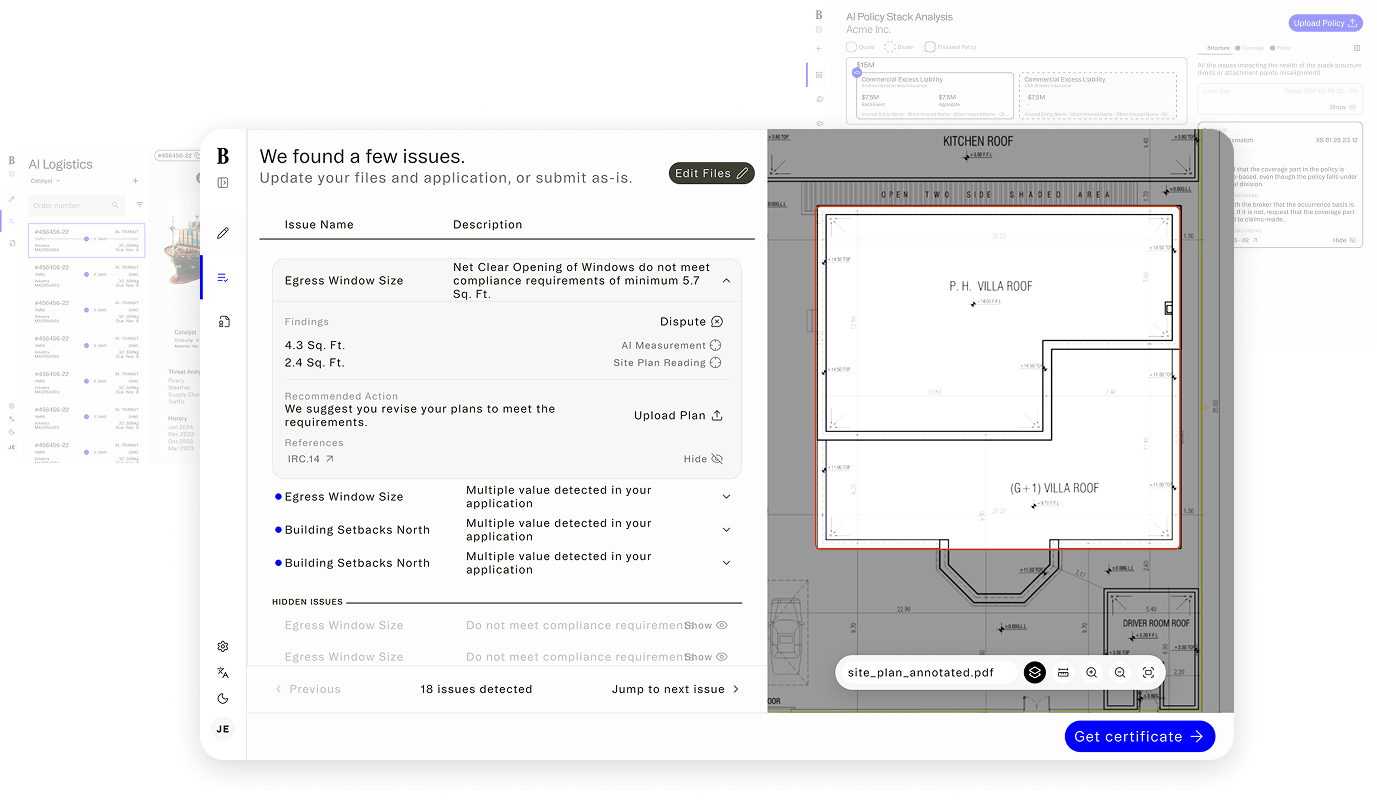
The core of Brain Co.'s technical approach is something deceptively straightforward: it converts unstructured documents - regulations, compliance manuals, clinical guidelines, procurement contracts - into structured, executable rule sets. IF this condition, THEN this outcome. MECE: Mutually Exclusive, Collectively Exhaustive.
This matters for a reason that's easy to underestimate. Most enterprise AI fails not because the underlying model is wrong, but because the decision it produces can't be audited. A hospital can't justify a care decision to a regulator by saying "the model said so." A government can't approve a permit based on a black box recommendation.
Brain Co.'s rules engine turns LLM reasoning into auditable logic. Every decision traces back to a specific rule extracted from a specific document. That traceability is the product. The AI is the delivery mechanism.
Government & Permitting AI
Automates complex municipal permitting workflows. Construction permit processing time reduced by 80% for live government clients.
Healthcare Pathway AI
Streamlines patient intake, clinical decision support, and care pathway management. 40% improvement in measured outcomes.
Energy Optimization AI
Real-time AI monitoring and scheduling for industrial plant energy consumption across complex multi-variable environments.
Supply Chain AI
Stochastic optimization for enterprise supply chains. 30% cost reduction and 99% reliability for live logistics deployments.
Hospitality AI
Voice and conversational AI agents for hotel chains and restaurant groups. Customer interaction automation at institutional scale.
Rules Engine Platform
The core platform: convert any regulatory document into auditable IF-THEN logic. Bayesian confidence scoring. HIPAA-ready. SOC 2-compliant.
Numbers that aren't projections
There's a reason Brain Co. insists on production deployments over pilots: production deployments produce real data. And real data, in this case, is striking.
The client list includes Sotheby's, Warburg Pincus, and over a dozen Global 2000 organizations whose names Brain Co. keeps confidential. The company claims to have generated "hundreds of millions" in measurable value for clients - a figure that, if accurate, makes the $30M Series A look very affordable from an investor standpoint.
We don't do pilots. We don't count a project as complete until the client's financial results say so. That's the only scorecard that matters.
- Brain Co. on their delivery modelThe strategic partnerships reinforce the production thesis. OpenAI's involvement means Brain Co. clients get access to cutting-edge GPT capabilities through an infrastructure layer that already meets their compliance requirements. The Inception (G42) partnership opens Middle East and global institutional markets - government and healthcare systems that are moving fast on AI adoption and need exactly the kind of compliance-first approach Brain Co. provides.
When the cap table reads like a conference lineup
Brain Co.'s Series A investor list is worth examining not just for the dollar amount - $30 million is a respectable but not enormous Series A - but for what it signals about the thesis. This is not a list assembled through warm intros and FOMO. It's a group of people who understand regulated industries, frontier AI, or both.
The missing layer of the AI economy
The AI industry has a distribution problem. The models get better every six months. The ability to deploy them in regulated, high-accountability environments improves much more slowly. That gap - between what AI can do and what institutions can actually use - is where Brain Co. operates.
It's a large gap. Healthcare, government, energy, logistics, and financial services collectively represent the majority of global GDP. They are also the sectors with the most manual, rule-bound processes - and therefore the most to gain from intelligent automation. And they are historically the last to adopt new technology because the consequences of getting it wrong are visible, immediate, and severe.
Brain Co.'s MECE rules engine is, in its own quiet way, an answer to one of AI's most persistent criticisms: that it can't be trusted where it matters most. If you can convert any regulatory document into auditable IF-THEN logic, and if you can attach Bayesian confidence scores to every decision, and if you can run all of that on HIPAA-ready, SOC 2-compliant infrastructure - then the trust argument collapses.
The question is never whether AI can solve the problem. The question is whether the institution can trust the solution enough to act on it.
- Brain Co. product philosophyBrain Co. is early. The Series A is a beginning, not an arrival. But the architecture they've built - production-first, compliance-first, outcome-measured - is a credible answer to a real problem. And the institutions they're serving are not early adopters. They're the ones who waited until someone built something trustworthy enough to use.
- The "MECE" in Brain Co.'s rules engine approach is borrowed from McKinsey consulting methodology - fitting, since co-founder Dan Ashton is a McKinsey veteran.
- COO Marne Levine previously scaled Instagram as COO and served as Meta's Chief Business Officer. She's built platforms that handled billions of users. Now she's applying that at Brain Co.
- Andrej Karpathy - who wrote some of the most-watched AI educational content on YouTube and helped build Tesla's autonomous driving stack - is an investor. When he backs enterprise AI, people pay attention.
- Brain Co. does not take an engagement if they can't commit to production outcomes. Not a policy - a business model. If they can't win in production, there's no contract.
- The cap table includes the current and former chiefs of three of the world's largest AI labs (OpenAI's CPO, OpenAI's CEO of Applications, and Perplexity's CEO). The AI industry's opinion of Brain Co.'s thesis is embedded in that fact.
- Brain Co.'s team was assembled largely from Google Brain, TensorFlow, Databricks, Tesla, NVIDIA, Apple, and Instabase - institutions where "production at scale" is table stakes, not an aspiration.
That hospital administrator, revisited
The administrator who chose Brain Co. over a pilot program didn't do so because the demo was flashier than the competition. She did so because Brain Co. told her what would change, agreed to be measured on whether it changed, and showed up with enough technical and regulatory depth to make the commitment credible.
Her hospital now runs patient care pathways through an AI system that every clinician can interrogate and every auditor can verify. The slow, costly, manual process that existed before hasn't been disrupted. It's been replaced.
That's the Brain Co. model: not disruption for its own sake, but replacement of institutional inefficiency with AI that earns the trust required to run in production. The hospital is one example. There are ten Global 2000 organizations more.
The institutions that need AI the most are finally getting it - and they're getting it from a company that won't show up unless it can actually deliver. In a world full of AI demos, that's a meaningful distinction.