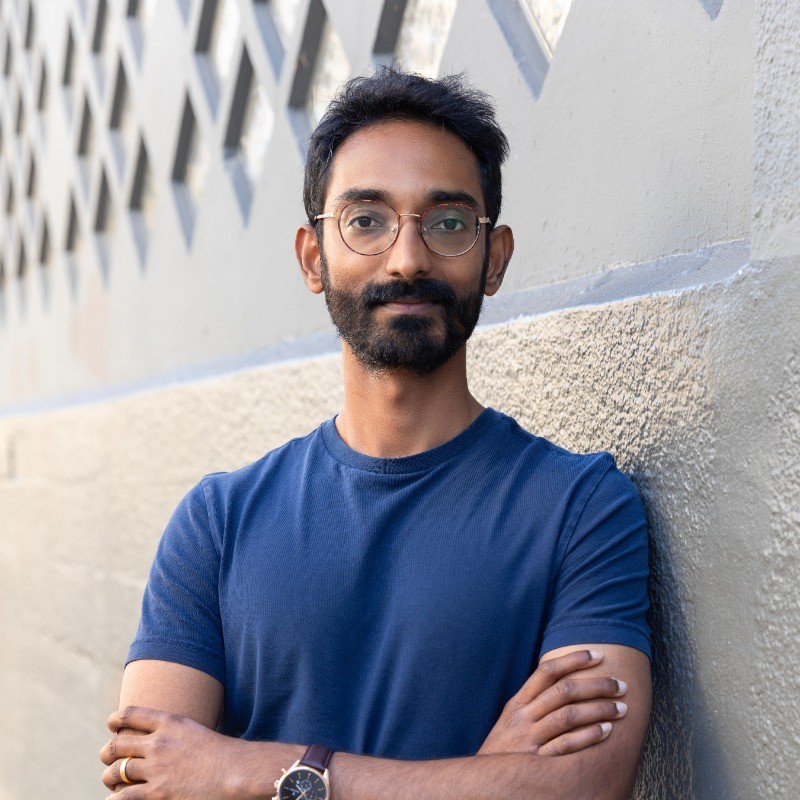
There is a number that haunts the enterprise software industry: 95. That is the percentage of AI projects that, by most credible estimates, never reach production. They die in proof-of-concept purgatory - expensive, slow, and stubbornly disconnected from the business outcomes the board approved them to deliver. Arjun Prakash spent nearly a decade at Palantir watching this failure pattern repeat itself, and then he decided to build a company that fixes it.
Prakash's path to founding Distyl AI is one of those careers that reads, in retrospect, like deliberate preparation. Cornell electrical engineering. A stint at BlackRock doing quant work. Then eight years at Palantir, where he rose to head business development and eventually led a team of 30+ Forward Deployed Engineers and strategists - the people who actually parachute into Fortune 500 operations and make the technology work. It is that last job that made Distyl possible.
The Forward Deployed model is Palantir's signature innovation: instead of shipping software and handing over documentation, you send a team to live inside the client's problem. You learn the business from the inside. You build where the friction actually is, not where the sales deck says it is. Prakash spent years doing exactly that, across industries and at a scale that most AI founders never see. When he left to start Distyl in 2022 with co-founder Derek Ho - another Palantir veteran - they weren't building a product. They were applying a playbook.
What Distyl does is deceptively simple to describe and genuinely hard to execute: it helps enterprises become "AI-native" by rearchitecting their operations rather than layering AI on top of existing processes. The distinction matters. Most enterprise AI projects fail not because the models are wrong but because the integration is wrong - the AI doesn't know enough about how the business actually works, can't observe its own mistakes, and has no mechanism for improving. Distyl builds the context layer, the observability layer, and the feedback loops that make AI systems self-improving.
The product lineup reflects this philosophy. The SME Cockpit encodes human domain expertise into system behavior - a formalization of the tacit knowledge that usually lives in the heads of the most experienced people in the room. The Context Model maintains a living representation of business operations. The AI Insight Engine handles analytics. None of this is flashy; all of it is load-bearing.
Prakash has spoken about a particular inspiration: the Indian kirana store. These neighborhood shops - the mom-and-pop general stores that are a fixture of Indian cities and towns - run on something that no enterprise software has ever successfully bottled: the shopkeeper knows what each customer needs before they walk through the door. Not from a CRM. From years of genuine, high-frequency observation. Distyl is, in part, an attempt to build that capability at scale.
The numbers have followed. Distyl closed a $7M seed round in April 2023 alongside an OpenAI services alliance - an early signal that the company was playing at the frontier of enterprise AI integration, not just reselling existing tools. A $20M Series A from Lightspeed and Khosla Ventures arrived in November 2024. By Q3 2024, the company was profitable. By September 2025, Lightspeed and Khosla led a $175M Series B at a $1.8 billion valuation, joined by Coatue, Dell Technologies Capital, and DST Global. The total raise stands at $202M.
Inside those funding announcements are case studies that tell the story more concretely. A Fortune-50 telecommunications company with $220M in projected AI-driven impact. A healthcare payor with $200M+ in annual impact projected from an AI system handling prior authorization - a notoriously entrenched, manual process. A Fortune-50 manufacturer achieving 80% faster root-cause resolution. These aren't pilot results. They are production systems, running at scale, in businesses where the consequences of failure are real and immediate.
The 100% production success claim is the number that gets attention in a room full of enterprise IT leaders. Prakash is careful about how he frames it: the industry's failure rate is not primarily a technology problem. It is an integration and deployment problem. The AI works. The enterprise doesn't know how to make the AI work for them. Distyl's vertical integration - research, product, and deployment service under one roof - is the structural answer to that problem. "The hardest technology problem," Prakash has said, "only exposes itself when you're in the field solving the customer problem." That observation is both a product thesis and a competitive moat.