Braden Ream had an audience and a problem. His team was making interactive children’s stories for Alexa, the sort of entertainment in which a listener could help decide what happened next. Families were listening. Each new adventure, however, required another round of production. A bedtime story could send its characters anywhere; the company’s bank balance had fewer possibilities.
The team had built a visual tool to help assemble those stories. When other developers asked to use it, an awkward possibility presented itself: the machinery backstage might be more useful than the show. That tool became Voiceflow. Ream’s career has followed the consequences of that discovery, through voice assistants, collaborative design and AI agents that businesses put in front of customers.
A very convincing cardboard company
Before the stories came Flare, a social network Ream worked on at university. Years later, he gave that experience a memorable description: a cardboard startup. He meant a company that looked persuasive from the outside while doing too little of the work that would make it last.
He included himself in the charge. There had been hackathons to judge, newspaper coverage and pitch competitions. The team could feel busy and successful while the product remained stuck. In an industry fond of displaying its trophies, Ream was opening the cupboard and inspecting the plywood.
His 2019 essay reads like a warning written with the receipts still nearby. Public recognition could consume time and distort judgment. He argued for measuring how much work actually moved the business forward. The embarrassing part was also the useful part: he had spent years learning how convincing activity could feel.
“User feedback is the lifeblood of a startup.”
Braden Ream, 2019
The expensive business of once upon a time
Flare also exposed a gap between designing for an imagined customer and understanding a real one. Ream described himself as an introvert who would not have used the app as intended. By the time he moved on, he had acquired a practical reason to pay closer attention to what people actually wanted.
The Alexa story project brought a different difficulty. Ream recalled production costs of roughly $3,000 to $4,000 per story against an initial $50,000. Creating more content was an expensive obligation. The team’s first visual prototype took 48 hours to build. The eventual demand came from developers who wanted the tool for projects of their own.
- 01Make the storiesInteractive audio for Alexa
- 02Build the machineryA visual tool for the team
- 03Open the toolOther builders ask to use it
There is a pleasing reversal in the origin. The team had set out to produce finished entertainment and ended up making a way for other people to create things. The recurring production bill had forced a question that enthusiasm alone might have postponed: which part of this operation could support a business?
Two interviews, two rejections, four founders
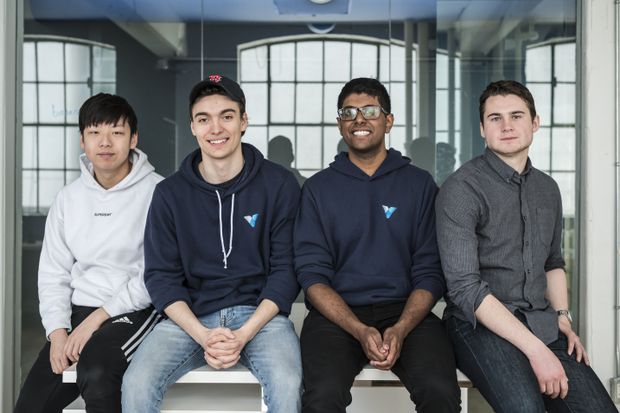
Ream built Voiceflow with Andrew Lawrence, Michael Hood and Tyler Han. The early team had already discovered that progress and approval did not arrive on the same schedule. They applied to Y Combinator, interviewed and were rejected. They spent the next six months building a product, raising $500,000 and assembling a small team. A second interview produced a second rejection.
Ream later described how much the team had attached to getting in. They had expected their work to change the verdict. When it failed to do so, they had to find a reason to continue that could survive a disappointing email.
His account emphasized flexibility, trust and explaining decisions. He described walking the team and investors through the company’s thinking each month. A changing product could otherwise look like a company wandering about. Showing the reasoning gave the people involved a chance to understand the route.
That habit mattered beyond the team. Ripple Ventures initially passed on the interactive entertainment business. Ream kept sending detailed monthly updates as the product changed. The investor returned to the conversation after seeing what the team was building. The updates had allowed a relationship to continue while the original pitch became obsolete. Occasionally, a long email earns its keep.
The name was borrowed. The problem was their own.
Ream has explained Voiceflow’s name with disarming simplicity. The team liked Webflow and used it for websites. Their own project felt like Webflow for voice apps. A name was needed; the analogy supplied one. Corporate mythology sometimes begins with rather less ceremony than the brand guidelines suggest.
The product expanded from Alexa skills to Google Actions, then into chat and other channels. Ream’s interest was in the shared work underneath: designing and building conversations. A customer might speak to a company on a phone and type to it later. The interface changed, while much of the underlying challenge remained familiar.
By the company’s 2021 funding announcement, Voiceflow reported more than 75,000 designers, developers and teams. It had added collaboration, comments, shareable prototypes and tools for testing. The $20 million round gave it money to keep building the workplace around a conversation, including the parts where colleagues needed to inspect and disagree with one another’s decisions.
2019$3M seed investment
True Ventures led
2021$20M round
Felicis Ventures led
2023$15M round
OpenView led
In August 2023, the company announced $15 million led by OpenView. It reported more than 130,000 global users and customers including US Bank, The Home Depot and BMW. The announced product direction included an AI builder powered by large language models. Ream’s original interest in tools for conversational products had acquired a much wider range of prospective users.
Some of the product lessons were gloriously ordinary. Ream recalled customers making prototypes in Voiceflow, then returning to Visio to document them. The missing ingredient was sticky notes. The team had concentrated on functional conversation blocks; designers needed the surrounding explanations, too. Voiceflow added notes, labels and images. Another customer needed diagrams to run vertically, matching the way its experienced designers already worked, rather than following Voiceflow’s original left-to-right arrangement.
These were small requests with a human explanation. People had to read one another’s work. A tool that ignored their habits could send them straight back to the software it was meant to replace. Ream’s account of building the platform made room for this unglamorous education: useful software sometimes advances because somebody finally asks why the customer keeps opening another window.
A CEO, a demo, and an inconvenient memory
Among the more revealing things Ream has shared publicly is a personal project inside Voiceflow: an agent with memory. It stored information gathered during a conversation, updated that information and examined whether a new statement contradicted something it had already been told.
In the demonstration, changing a surname prompted the agent to ask for clarification. It was a modest example with a substantial design question behind it. People correct themselves. They move. They misspeak. A conversation system needs a way to handle those events without treating every new sentence as an entirely fresh universe.
Ream showed the components and offered to share a template. The pleasure of the exercise was visible in its specificity: information being summarized, checked and merged. Here was the founder still tinkering with the behavior of the thing his company helped other people build.
Earning the next conversation
His more recent writing turns repeatedly toward reliability. In July 2026, he argued that teams should think carefully about which decisions they give a language model. A business rule with a predictable outcome can live in a workflow. Asking a model to interpret that rule repeatedly creates another opportunity for inconsistent behavior.
For Ream, that is a design responsibility. The team needs enough control to inspect where a choice happens and change the system when it fails. A convincing answer on one occasion offers limited comfort to a business that needs the same policy followed tomorrow.
The argument also appears in the way he introduced Voiceflow Core, a model tuned for the platform. The company tested it on Tico, its own support agent. Ream reported lower session costs and maintained satisfaction, while explaining the limitations of the comparison. The live before-and-after test included other changes; replaying the same conversations helped isolate the model’s contribution. These were company tests, with results specific to its own agent.
“Trust is an architecture.”
Braden Ream, July 2026
In August, he made the case for smaller initial deployments. Choose predictable customer questions, observe real conversations and expand when the results justify it. A target borrowed from a mature deployment can become a poor promise for launch day. His advice leaves room for ambition, with the inconvenient requirement that it wait its turn.
Toronto, poker, and a longer horizon
Ream grew up in Toronto and splits his time between there and San Francisco. He attended Ivey Business School at Western University. On his personal page, the interests extend beyond the company: running, travel, poker and building communities. He lists a university incubator, W5, and TechStack TO poker tournaments among his projects.
He also invests small amounts in startups, describing it as a way to return the help angel investors gave Voiceflow. His listed investments include VendorPM and Buildable. Further ahead, he has written about entering Canadian politics, with interests in educational opportunity, climate change and political division. It is a stated ambition with an open timetable.
For now, the recurring assignment is closer to the workbench. Make something, see how people use it, and accept what their behavior reveals. The children’s stories supplied Voiceflow with its first unexpected audience for a tool. Ream has spent the years since finding out what else that audience needs.