Brad Jacobs once considered calling his rubbish business Jacobs Waste Systems. His father objected. The company became United Waste Systems, sparing the family name an unusually literal association with the contents of a bin. It was a small concession in a career that would involve much larger transactions. It also makes a useful place to begin: before the stock symbols and acquisition announcements, there was a son running a name past his dad.
Jacobs has since become associated with a particular kind of business building. He enters an industry full of separate operators, assembles companies, and works on the machinery that makes them function together. Waste collection, construction equipment and freight have all received the treatment. His current company, QXO, distributes building products. The objects change considerably. The questions he asks about them have proved portable.
He is often described through the scale of his transactions. There is another way to read the career: as a long investigation into which things should be brought together, which people should run them, and when a company has become more useful in pieces.
*Career counts from QXO’s biography; businesses include XPO spin-offs GXO and RXO. Acquisitions reflect Jacobs and his teams.
01 / The oil broker who noticed the routes
Born in Providence, Rhode Island, in 1956, Jacobs attended Bennington College and Brown University, studying mathematics and music without completing a degree. The pairing is appealingly appropriate in retrospect. Mathematics offers patterns. Music asks what happens when other people join in. His later companies would require attention to both.
He co-founded Amerex Oil Associates in 1979 and led it until its sale in 1983. Hamilton Resources followed in London in 1984. Oil trading depended on information: knowing where a buyer was, where supply was available, and how to connect the two. Before the internet made information abundant, an international organization could give a trader an advantage.
United Waste, founded in 1989, put him in a different relationship with physical things. The business consolidated small waste operators, including companies with overlapping rural routes. A rubbish truck has to travel the road whether its owner has a compelling strategy or merely a compelling logo. Bringing routes and facilities together offered a practical way to change the economics.
That distinction matters. A company cannot indefinitely improve a route by announcing that it has acquired one. Someone has to organize the collection, the landfill access and the work. United Waste went public in 1992 and was sold to USA Waste Services in 1997. By then, Jacobs had a method he could try elsewhere.
02 / The equipment changed. The team came along.
In September 1997, Jacobs and seven former United Waste senior executives founded United Rentals. The move was brisk enough to suggest that nobody had spent much time browsing retirement brochures. Their new field was equipment rental, a business populated by local operators supplying the machinery that construction customers needed temporarily.
Six initial acquisitions arrived that October. The company went public in December. Capital raised through subsequent offerings helped finance further purchases. The acquisitions quickly turned United Rentals into a national equipment network. The chronology can make the transformation sound almost administrative. It involved people, branches, equipment and customers that had previously belonged to different businesses.
Bringing a team along supplied continuity without pretending that machinery rental was identical to rubbish collection. Former colleagues already knew how to work with one another. The industry still had to be learned. The interesting transferable asset was partly a set of relationships: people who had bought businesses together and then lived with the consequences.
Jacobs remained CEO through 2003 and chairman through 2007. United Rentals continued beyond his tenure. That is an important feature of this story. The companies are institutions with subsequent leaders and histories, rather than objects frozen at the moment their founder moved on.
- United WasteCollection, disposal and recycling
- United RentalsConstruction equipment rental
- XPOModern business built from Express-1
Founding / launch years shown. GXO and RXO were spin-offs, rather than companies started from scratch.
03 / A freight company with a technology habit
Modern XPO began with an existing company. In 2011, Jacobs led an investment of up to $150 million in Express-1 Expedited Solutions. The amount included money payable upon exercise of warrants. He became chairman and CEO on September 2, and the company became XPO Logistics. Calling him XPO’s founder captures the subsequent transformation; remembering Express-1 explains how it actually began.
Technology was part of the plan early. Mario Harik joined as chief information officer in 2011. Over time he took responsibility for customer functions and the North American less-than-truckload business. In November 2022, he succeeded Jacobs as CEO. An executive originally hired to build technology ended up running the transportation company.
XPO also complicated any easy description of Jacobs as someone whose answer was always to buy more. Its contract logistics business became GXO in 2021. Its North American brokered transportation operation became RXO in 2022. XPO’s North American business concentrated on less-than-truckload transportation, which combines shipments from different customers across a freight network.
A warehouse operator and a truck broker perform different work. Their economics and operating demands differ too. Separating them gave each a more distinct corporate home. The same career that joined businesses together could also make a case for taking them apart. The useful question was what arrangement suited the businesses at that stage.
“I was born to be a CEO.”
Brad Jacobs, 2022
04 / The work after the handshake
Jacobs’s industry checklist has some unromantic requirements. The market should be large and growing. It should contain acquisition opportunities. Scale should create an actual advantage. Technology should offer room for improvement. The third point is the one most likely to interrupt an enthusiastic presentation: getting bigger needs to make something better.
He also describes speed as a requirement, with limits. His image is a car travelling fast enough for the hubcaps to shake, without losing them. Anyone who has sat through a corporate meeting can appreciate the ambition of introducing even a little forward motion.
The work becomes more concrete after a deal closes. Following QXO’s purchase of Beacon, Jacobs described changes to pricing, procurement and inventory. In September 2025, he said the organization had been reduced from nine management layers to four. A national call center was intended to reactivate dormant accounts and win customers. Critical products needed replenishing. Technology projects included warehouse scanning and better routing.
These changes connect the acquisition story to the customer's day. The transaction price is distant from a contractor waiting for materials. Stock availability is close. So are a usable quote and an accurate invoice. A strategy becomes easier to judge when translated into those small encounters.
Management layers after the Beacon acquisition, as described by Jacobs. The bars show organizational layers, not employee numbers.
There is a people question underneath the systems work. In discussing Beacon, Jacobs described asking employees to score their satisfaction and say what would improve it. Branch visits and town halls followed. Buying a business gives a new owner authority. It does not deliver all the knowledge held by the people already working there.
05 / A pile of building materials, and another beginning
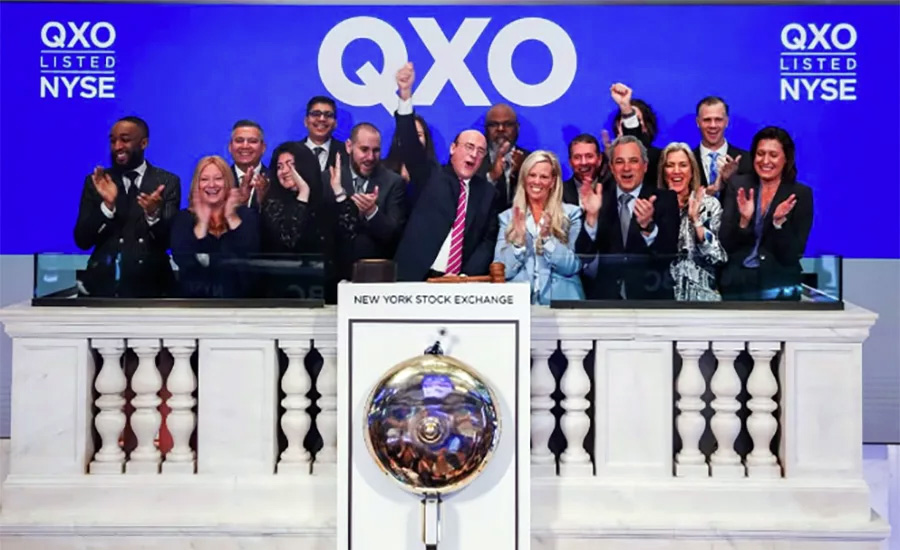
QXO gave the familiar method a new setting. Jacobs became chairman and CEO in June 2024 as the initial $1 billion equity investment closed. Several members of the leadership team had worked in his earlier businesses. The target industry was building products distribution, with room, in his view, for both consolidation and better use of technology.
The company completed its approximately $11 billion acquisition of Beacon Roofing Supply on April 29, 2025. Roofing and waterproofing supplied the first substantial platform. On April 1, 2026, QXO completed its approximately $2.25 billion purchase of Kodiak Building Partners, adding lumber and other construction materials. TopBuild followed on July 1, adding insulation distribution and installation.
The sequence expands what QXO can do for a customer. It also expands the work of making the company coherent. Installing insulation introduces capabilities beyond delivering a pallet. Each addition has its own operating knowledge, relationships and daily demands. A broader product range makes the potential connections more numerous; it makes the coordination more demanding too.
Jacobs stepped down from the XPO and GXO chairmanships at the end of 2025 to give more energy to QXO and Jacobs Private Equity. His stated ambition is for QXO to reach $50 billion in annual revenue within a decade. That remains a target. The distance between it and the eventual outcome will be filled by transactions, customer decisions and work inside individual branches.
06 / Leave room for the piano
There is more to Jacobs’s account of himself than a succession of company names. He trained in classical piano. At Bennington, he studied with musician Bill Dixon, whose teaching helped him think about improvisation, attention and responding in the moment. He continues to take music seriously. The business career did not require that interest to disappear.
His wife, Lamia, supplied another compact lesson: be patient, pleasant and polite. In a negotiation, those habits have practical value. The other party has a timetable too. Patience recognizes it. Courtesy leaves room for another conversation. It is an unusually modest set of instructions to place alongside a multibillion-dollar ambition.
Jacobs published How to Make a Few Billion Dollars in 2024 and How to Make a Few More Billion Dollars in December 2025. The second title makes its relationship to the first admirably clear. He has also kept talking publicly about the choices behind the companies, including a Morgan Stanley interview highlighted in August 2026.
Across the changes of industry, the recurring interest is in how parts work together: buyers and sellers, routes and facilities, colleagues and responsibilities. Some combinations become larger companies. Others eventually become separate ones. For Jacobs, now working through the next assortment of branches and building materials, there is still plenty to arrange.
Keep the conversation going
Read, watch and explore the businesses.