A square of fabric has an awkward relationship with the internet. It photographs well enough. Its color can be named, its dimensions listed, its performance described. Yet someone choosing it for a room will probably want to hold it. A client will want to see it beside the wood. The wood will look different beside the tile. Before long, a decision about a beautiful space has become an exercise in parcel tracking.
Adam I. Sandow built Material Bank around that inconvenience. He came to the problem through magazines, having spent years in the company of designers and the manufacturers whose products filled their pages. The connection matters. A publisher has ample opportunity to learn what an industry admires. Sandow became interested in what it found annoying.
The result joined a digital catalog to an emphatically physical operation: samples stored centrally, picked with the help of robots, packed together and sent overnight. Its early American proposition was precise enough to fit on a clock: place an order by midnight Eastern; receive the samples by 10:30 the next morning. Glamour, meet dispatch.
Before the box, a stack of magazines
Sandow grew up in Miami and attended the University of Miami. His working life had already begun. In high school, he started a graphic design business, which he expanded as he entered university. Consumer publishing followed in the 1990s, with titles including Honeymoon and Adventure Journal. The early sequence is revealing: making things for clients, then making publications for readers.
He launched Honeymoon in 1994 and sold it in 1999. A subsequent role at the digital wedding business The Knot brought him into another way of reaching an audience. By 2003, he was building the company that bears his name. Its later holdings would stretch across design publications, research, product information and services.
Two launches in 2005, NewBeauty and Luxe Interiors + Design, established different editorial territories. In 2006 came TestTube, a beauty-product sampling subscription. Readers could receive products to try. Long before Material Bank, Sandow had a business in which a publication and a package belonged to the same relationship.
He also paid attention to where publications were encountered. MediaJet developed a network of magazine newsstands in private-airport terminals. The choice of distribution was part of the product: the reading material arrived where a particular audience already spent time. Across these ventures, the page was one element of a larger commercial arrangement.
“I’m a builder.”
Adam I. Sandow, 2018
The audience was already in the room
The design connections deepened through acquisitions. In 2010, SANDOW added Interior Design and the Furniture Today Group. Material ConneXion, the materials consultancy, followed in 2011, alongside creative management agency Culture + Commerce. These were different vantage points on the same broad world: the people conceiving spaces and products, the people making materials, and the information passing between them.
By 2017, Sandow was speaking publicly about Material Bank as a business under development. His ambition for the group already extended beyond advertising. He wanted services, data and logistics to grow from the relationships that publishing had established. The magazines supplied a reason to be in the conversation; the new ventures would take on other jobs within it.
That history gave Material Bank an opening on both sides of its marketplace. Designers needed a simpler way to search and sample. Manufacturers needed to reach designers while projects were taking shape. Sandow knew both groups. Their participation, however, required more than a congenial meeting.
A manufacturer had to provide product information and commit physical samples to centralized storage. There were trucks and inventory behind the agreement. Recruiting suppliers meant asking them to trust a new intermediary with a practical part of their sales process. An established relationship could secure a hearing. The operation still had to earn the commitment.
A deadline with a warehouse attached
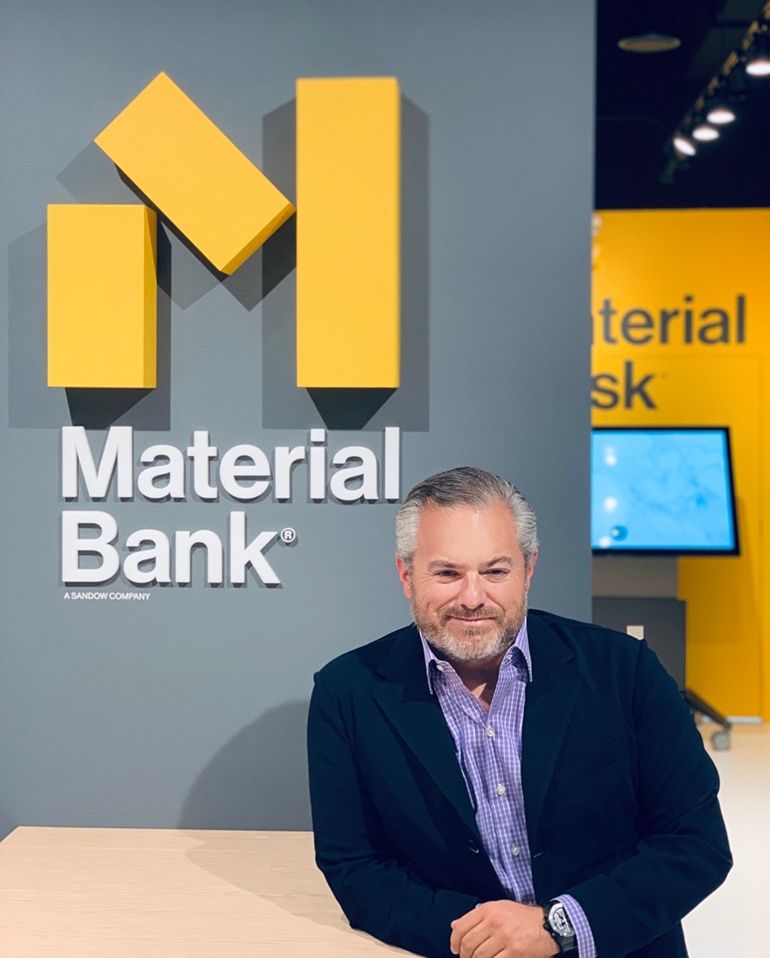
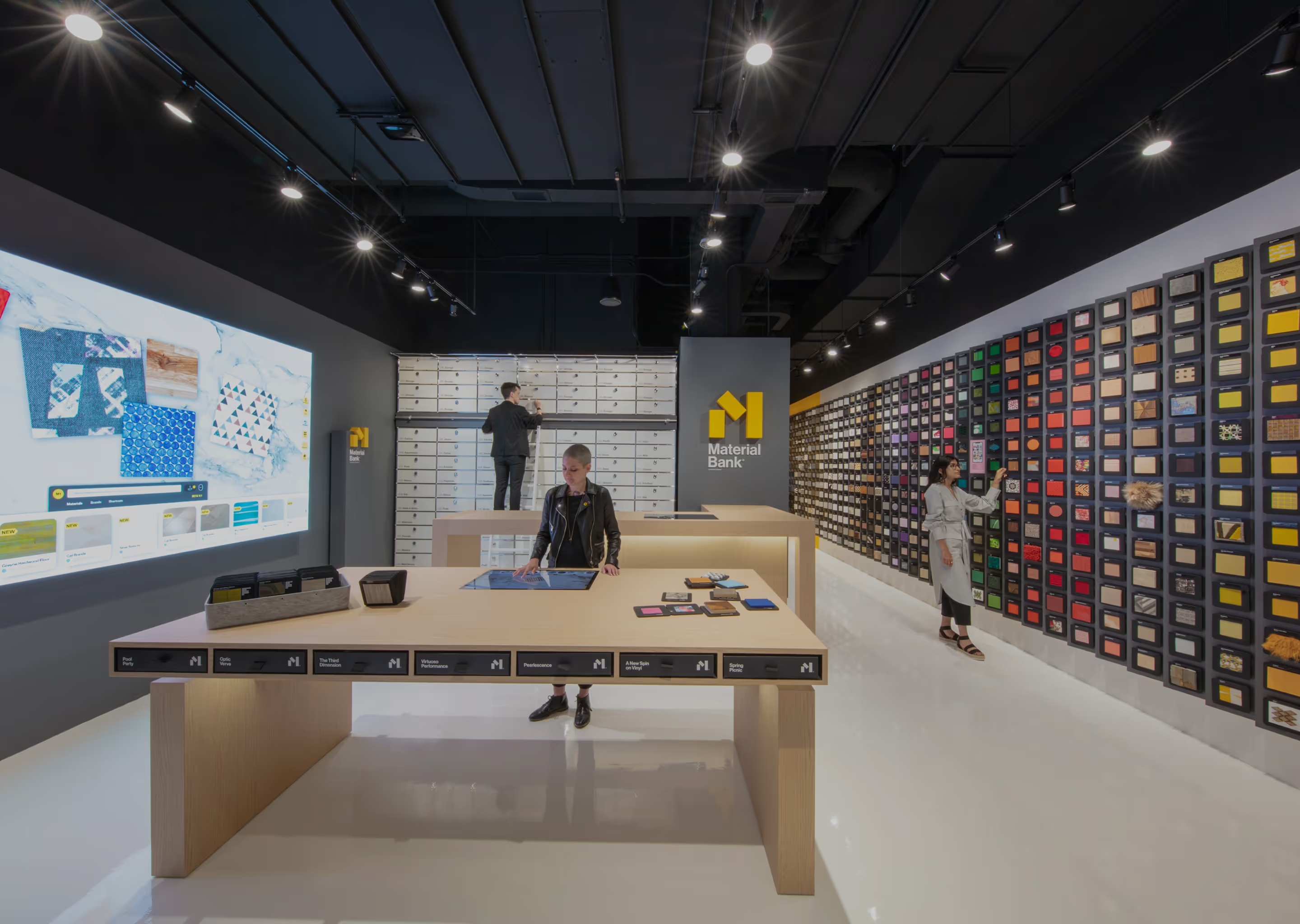
The platform launched publicly in 2019. At NeoCon that June, Sandow introduced it in showrooms at theMART, including Artistic Tile and Benjamin Moore. Material Bank Lab opened there as a permanent space. A business devoted to making samples easier to obtain was being explained in the rooms where designers came to look at them.
Behind the presentations sat a less photogenic undertaking. The team worked with Locus Robotics and built around robotic fulfillment from the beginning. Sandow recalled the internal reaction: “My team thought I was crazy to start with robots.” His choice was to organize the facility around the technology, rather than fit it around an inherited warehouse routine.
Storage and packaging received similar attention. The team developed cardboard systems and its own tray design. Samples vary in shape, weight and fragility; a finish that belongs comfortably in a room may be less agreeable in transit. Bringing different manufacturers’ materials into one package required a common operating system for objects that had little interest in being common.
The early facility was in the Memphis area, near FedEx’s hub. In 2021, Sandow described a move from roughly 80,000 square feet to 380,000 square feet. The scale helped make the promise tangible. A deadline on a website needed enough space, equipment and coordination to survive the evening.
Eastern time
sample delivery
One search. Multiple participating brands. One consolidated shipment.
Historical launch-era service promise; delivery terms depend on market and eligibility.The box also allowed a return journey. Designers could send unused samples back for reuse. Consolidating shipments and recovering materials addressed some of the waste built into scattered sampling. The physical work continued after the presentation; a useful sample did not have to retire after its first appointment.
Who pays for convenience?
For qualifying design professionals, the service was free. Manufacturers funded the platform through listing and sampling charges. That division explains much of the business: saving a designer time creates an opportunity to connect a supplier with an active project. A small piece of material can introduce a much larger purchasing decision.
Sandow’s earlier design-media work helped him understand that relationship. In 2021, he described fifteen years of industry connections as an advantage in building the platform. His advice to other founders also included a defensible product and a business model capable of supporting recurring revenue. He put the emotional preamble more economically: “winning is hard.”
The proposition had limits. Some residential manufacturers found participation expensive or preferred to manage sampling through their own representatives and showrooms. A platform can make a process easier for one participant while asking another to reconsider familiar economics. Sandow’s opportunity depended on the value of the introductions, as well as the speed of the parcel.
Capital gave the company room to work on those questions. A $100 million Series C in 2021 was followed by a $175 million round led by Brookfield Growth in May 2022. That later financing placed the company’s reported valuation at about $1.9 billion. The money supported hiring, development and expansion. A box of swatches had acquired a substantial balance sheet.
New funding in the Brookfield Growth-led round.
An overnight box crosses borders
International expansion brought the model to Europe and Japan. The underlying need traveled readily: designers still wanted to compare real materials, and manufacturers still wanted their products considered. The professional landscape varied. European operations encountered a market with many small and midsize design practices, changing the mix of companies the platform needed to recruit.
The geography also brought new leadership connections. Philippe Brocart, previously at Maison&Objet, led the European business. Former SoftBank executive Go Nakazawa headed the Japanese operation. Sandow’s platform needed people who understood the markets it was entering, alongside the technology already developed for the American business.
At home, another audience was waiting. DesignShop debuted in December 2024, extending sampling to consumers without requiring trade credentials. Its logistics ran through the same Olive Branch, Mississippi, hub used by Material Bank. Consumers paid for samples. Someone choosing finishes for a renovation could now use machinery originally assembled around professional demand.
Sandow described his interest in the “convenience economy.” The phrase suits a career increasingly concerned with the distance between seeing something and being able to make a decision about it. DesignShop also brought editorial work back into the picture, with former Luxe editor Pam Jaccarino developing its content strategy.
Back in the chair, looking outward
Sandow’s own role changed along the way. In November 2023, he stepped back from day-to-day leadership of Material Bank, remaining chairman while Sebastian Gunningham became CEO. He returned to the chief executive role in summer 2025. The company’s later chapter again had its founder running the operation.
His publishing interests continued to expand. SANDOW acquired the Canadian architecture and design title Azure in December 2025, following its financial difficulties. Editor Elizabeth Pagliacolo remained in charge of the publication. Architonic followed in January 2026, adding a product-information platform with a substantial European presence. Sandow saw possibilities in the connections across the group, while keeping Architonic and Material Bank as distinct platforms.
At NeoCon in June 2026, Material Bank introduced MTag, using NFC technology to connect physical samples with digital information through a tap. The square of material could now lead back to specifications, colorways and representatives. It was a small addition to an object whose usefulness had always exceeded its size.
Sandow’s career keeps returning to that relationship between an object and what it helps someone do. A magazine introduces a possibility. A sample lets a designer test it. A delivery makes the test possible before the next meeting. His businesses have grown around those intervals. Even a room admired for its timelessness has to be finished on somebody’s schedule.
Keep the conversation going
COMPANIES & PUBLIC PROFILES
READ, LISTEN & WATCH
- The Power of Print Media - Invest Like the Best conversation, June 2024.
- Material Bank is just getting started - Business of Home podcast, June 2022.
- Sandow discusses robotics - Fox Business video, January 2020.
- The Architonic acquisition and global expansion - January 2026.
- MTag at NeoCon - the 2026 physical-sample connection.