Junkoo Kim had a problem familiar to anyone who has finished a good comic: he wanted another one. The trouble, as he later described it, was that Korea’s comics market had taken a downturn. New material was scarce. Kim, who joined NAVER as a developer in 2004, decided to look beyond publishers and invite individual creators to contribute. The service WEBTOON dates to 2005 began with a fan’s complaint about the supply.
- Readers get serialized comics built for scrolling, with many episodes free.
- Creators can self-publish on CANVAS; earning money requires more than uploading.
- Paid content funds most of the business. Books and screen adaptations give successful stories another route to readers.
01A shortage of comics, a surplus of storytellers
“I actually started this business by myself,” Kim told Forbes in 2024. His response to a contracting market was to widen the entrance. That choice matters because publishing usually begins with selection: an editor decides what deserves production and distribution. WEBTOON made room for stories to meet readers earlier.
It expanded internationally in 2014. The US parent was incorporated in 2016. Today, WEBTOON Entertainment includes the WEBTOON comics service, the webnovel platform Wattpad, Japan’s LINE MANGA and eBookJapan, and businesses that develop stories for other media. An audience figure for that group should never be mistaken for the audience of its English-language app.

02First, earn the next episode
On WEBTOON, panels run down the screen. The reader scrolls. That sounds like a small design decision until you consider what disappears: the need to fit a printed page onto a phone. Space between panels can control a pause. A reveal can wait just below the screen. The format gives a familiar hand movement a storytelling job.
A bookshelf
for your thumb.
Readers browse romance, fantasy, horror and other genres, follow series and comment on episodes. Coins buy premium access, including early episodes. The recurring question is pleasingly old-fashioned: what happens next?
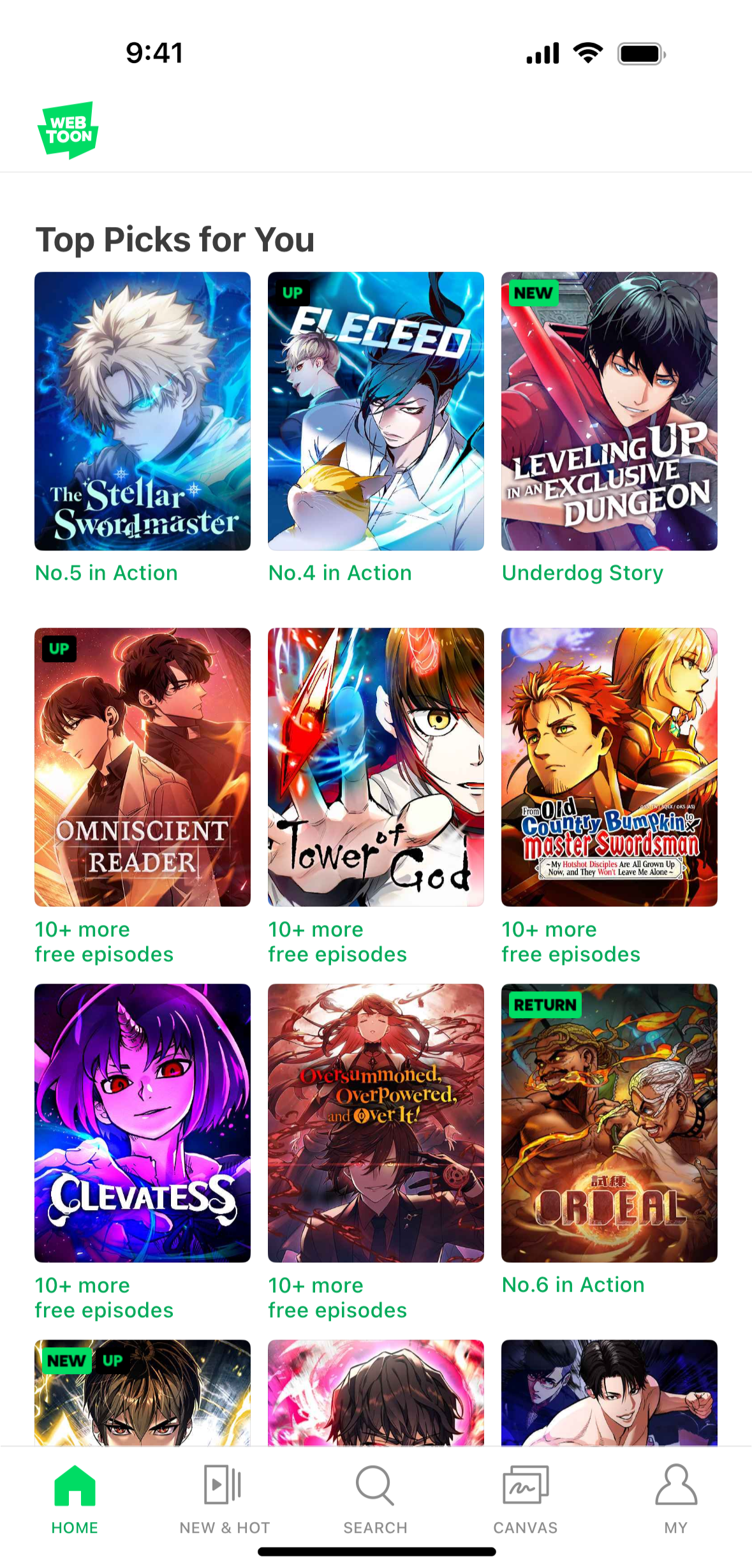
Plenty of swords. No shelf assembly. An official app mockup shows WEBTOON’s recommendations.
For an artist, CANVAS supplies a publishing route and a place to build a following. Creators retain ownership of their work while granting the platform distribution rights under its terms. That is a useful distinction: permission to host a comic and permission to turn it into a television series are different questions.
Nor does publication equal a salary. Advertising programs have eligibility requirements, and the terms promise no particular earnings. In January 2026, WEBTOON lowered its PayPal payout threshold from $100 to $25. A modest administrative change can matter considerably to someone whose balance is thirty dollars.
The support programs have changed over time. WEBTOON ended its temporary Creator Rewards Program after January 2023 rewards were paid, while continuing advertising revenue sharing. The replacement of a subsidy with other earning routes is a reminder that a platform’s current offer is not a permanent employment contract.
03A love story leaves the phone
Consider Rachel Smythe’s Lore Olympus, a contemporary retelling of Hades and Persephone. Its earliest version appeared on CANVAS. It became an Originals series, accumulated more than 1.7 billion views by March 2024, and produced print volumes that topped the New York Times bestseller list. In 2024 it won its third consecutive Eisner Award for Best Webcomic.
The audience can arrive before the expensive adaptation.An advantage of publishing in episodes
Those are separate achievements, with separate economics. A view is not a book purchase, and an award does not finance a production. Still, the sequence shows what WEBTOON can offer: a story can acquire readers before someone makes a larger commitment to another format. Audience response becomes evidence, though never a guarantee of success elsewhere.
- 01Publish
episodes - 02Build a
readership - 03Explore a
new format
04The bill for all that scrolling
WEBTOON’s 2025 revenue was $1.383 billion. Paid content supplied $1.087 billion, advertising $164.3 million and IP adaptations $131 million. For all the attention paid to adaptations, readers paying for content remained the financial center of the company.
The costs deserve equal billing. Cost of revenue reached $1.061 billion in 2025, including commissions and creator content fees among other expenses. The company reported a $63.5 million operating loss and a $373.4 million net loss, with goodwill impairments driving the latter. Its positive adjusted EBITDA of $19.4 million describes a different accounting measure. It does not erase the net loss.
There is a practical lesson here for anyone building a publishing business: make trying a story easy, provide a reason to return, and design a credible way to pay its creator. Copying the scrolling interface will not supply the catalog, readership or economics. Competitor Manta also offers digital comics, combining a membership library with episode purchases using Gems. The gesture itself is available to everybody.

05Now the old publishers want in
Disney’s approximately 2% equity investment closed in January 2026 alongside agreements for a digital comics platform. In October, WEBTOON and Marvel announced the resulting Marvel Comics app for a November 16 launch: more than 35,000 comics, traditional pages and vertical scrolling, and subscriptions starting at $9.99 monthly before tax.
For independent creators, the more immediate development may be international CANVAS. In March 2026, WEBTOON announced a unified service across seven languages, with features rolling out through the year, including an opt-in AI-powered Translation Program. The practical appeal is distribution beyond one language. Whether that produces meaningful income depends on readers finding the work and choosing to support it.
Meanwhile, HAYATE, WEBTOON subsidiary LINE Digital Frontier and Crunchyroll announced a framework to develop potential anime adaptations of around fifteen titles. These are development plans, with all the uncertainty that entails. The next chapter depends on execution.
WEBTOON began by helping new storytellers find an audience. Established publishers now want its help finding readers too. The attractive part of that progression is quite human: people still want another good story. The difficult part is making the next one pay.