Consider the distance between choosing a tile and touching it. On a screen, the tile has already done its job. It looks handsome. On a desk, under ordinary light, it may tell a different story. An architect needs that second encounter before committing a client’s money. Getting there has traditionally involved several websites, several representatives and several boxes arriving on different days. The decision waits for the delivery.
- Approved designers order samples free; participating brands pay for access and fulfillment.
- Materials from different manufacturers travel together in one overnight shipment.
- The advantage depends on inventory, logistics and useful introductions to real projects.
Material Bank has made that interval its business. Its professional marketplace brings material discovery and physical sampling together. Search for surfaces, compare possibilities, request samples, then put them on the table. The ambition sounds modest until you notice how much coordination has disappeared between those steps.
The publisher who knew both sides
Adam Sandow came to the problem through design publishing. His business relationships already reached the manufacturers seeking attention and the professionals deciding what went into buildings. Material Bank officially launched in January 2019. It arrived with something more useful than a fresh interface: a founder who knew the people on both sides of the transaction.
That background matters. A marketplace with no materials gives designers little reason to visit. A marketplace with no designers gives manufacturers little reason to participate. Sandow’s explanation, in a Bain Capital Ventures interview, was that industry trust helped secure early adoption. The lesson for another founder is quite practical: an existing audience can help recruit a market, provided the new service solves a problem that audience actually has.

Free has a customer
For an approved design professional, samples and shipping are free. The paying customer sits across the table. In a 2021 interview with Business of Home, Sandow described a monthly brand fee plus a transaction fee. Manufacturers fund the convenience because a sample request can put them in contact with someone working on a project.
This changes the meaning of an order. A swatch leaving a warehouse is also an introduction. Material Bank’s support guide explains that project information is shared with brand partners so they can offer recommendations and follow up. The designer gets a simpler procurement task; the manufacturer gets context for a sales conversation. Whether that conversation produces enough business is the economic test.
It also places Material Bank at a particular point in the market: before the finished materials are bought. Showrooms, independent representatives and direct manufacturer requests remain alternatives. The attraction here is combining brands in one workflow. The service earns its place when comparing possibilities is otherwise a small administrative expedition.
The warehouse is part of the product
In the United States, the advertised rhythm is striking: order by midnight Eastern, receive stocked samples by 10:30 the next morning. The support center qualifies that promise with stock and fulfillment exceptions. A sample sent directly by a brand can arrive later. Speed is a service built under specific operating conditions.
A simplified service flow. Delivery depends on stock, location and regional cutoffs.
The 2021 expansion included a 380,000-square-foot logistics facility near FedEx’s Memphis hub. Autonomous robots supported the nightly movement of samples. Airport proximity and warehouse organization were therefore product decisions: they helped determine what a designer could reasonably expect after clicking order.
“The hardest part was figuring out the physical logistics side of the business.”Adam Sandow, Bain Capital Ventures interview, 2021
The capital followed. Material Bank raised $100 million in its 2021 Series C, then $175 million in a 2022 Series D led by Brookfield Growth. The latter announcement put cumulative funding above $325 million. Those sums describe financing, rather than a price tag for building the service. They do suggest why copying the interface would reproduce only a fraction of the operation.

A return trip, with qualifications
The box has another job after the presentation. Material Bank encourages sample returns, with trays designed for reuse. Consolidation reduces the number of separate packages; reclamation gives usable samples another outing. Its sustainability reporting also describes donations and other recovery routes for materials that cannot go straight back into circulation.
These are distinct mechanisms. So are carbon offsets. Material Bank says it began offsetting outbound and return shipping emissions in October 2020. Purchasing credits does not make the delivery vehicle emission-free. Its stated 2040 net-zero commitment is a future target. Evaluating the environmental proposition means keeping fewer packages, reused samples and offset shipping in their respective columns.
Japan rewrites the instructions
Expansion supplied a useful complication. Material Bank Japan formally launched nationwide service in October 2023. According to a Medusa case study published in October 2025, the globally managed commerce platform constrained the Japanese team’s mobile experience, integrations and ability to adapt local workflows.
Product information was one pressure point: the account says Japanese designers needed more than 200 attributes per item, compared with roughly 120 in the US. The team decided to migrate in early 2025 and completed its new platform in four months. This is a vendor’s account, but the underlying lesson is clear. A shared business model does not guarantee identical requirements. Local control became part of making the service useful.
A box is the beginning
For a working designer, the repeatable habit is straightforward: organize a project, narrow the material choices, share a palette, then sample deliberately. Material Bank’s European tools include Boards, collaborative Desk palettes and a representative directory for questions about specifications, quotes and lead times. A convenient sample still needs to become an appropriate specification.
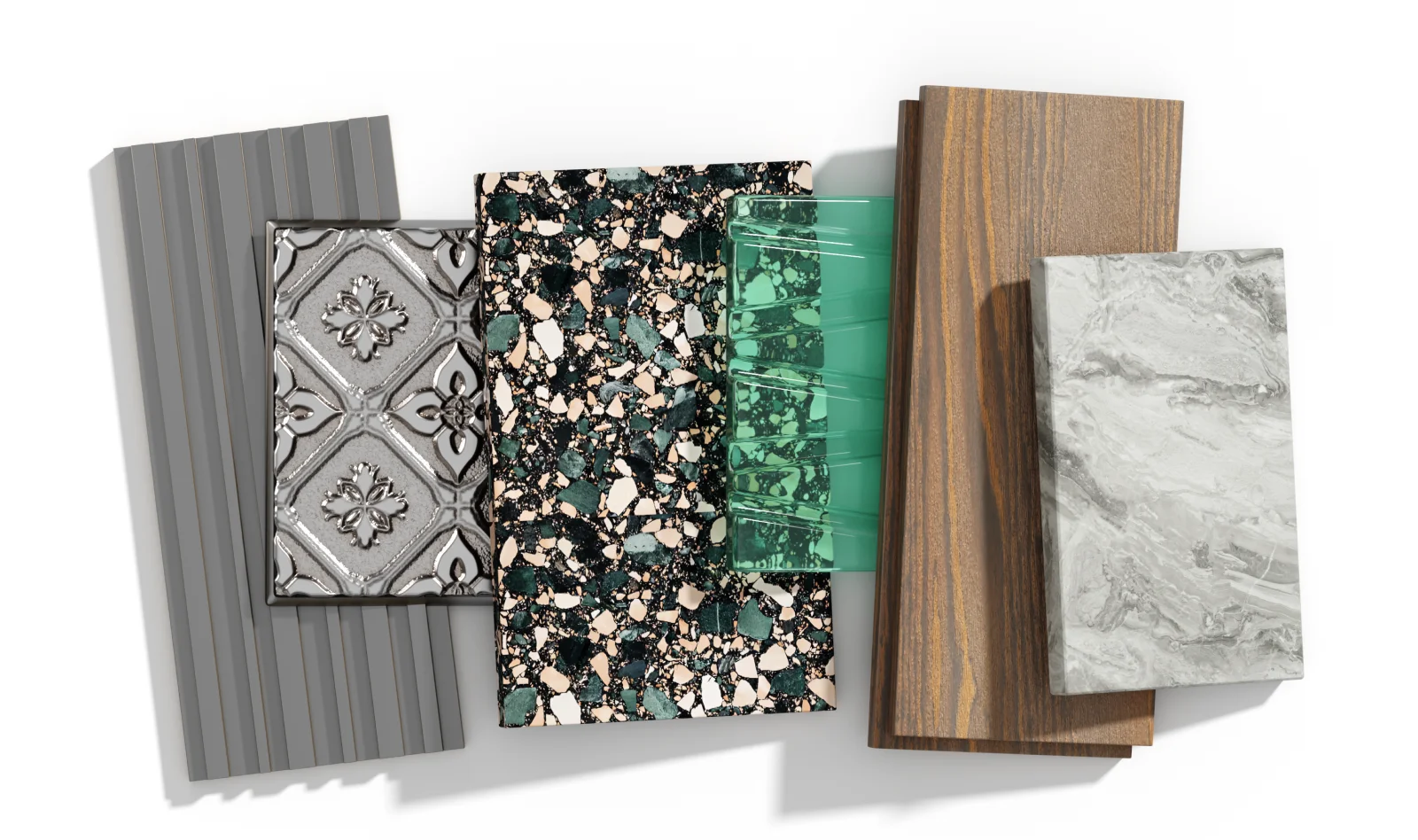
The audience has widened too. DesignShop debuted in December 2024 for consumers, with paid samples and no trade credentials required. That distinction preserves the logic of the professional offer. Someone must fund the box. Material Bank’s useful insight is that reducing the work around a decision can be valuable to both the person making it and the company hoping to be chosen.