The deadline is midnight, which is a theatrical hour for something as sober as a material sample. Before it strikes, an architect can search for paint, tile, textile, hardware or stone across many brands. By the next morning, the choices are supposed to arrive together. Not as seven boxes from seven companies on seven mysterious timetables, but as one delivery. Cinderella had a pumpkin. Farshid Tafazzoli has a logistics network.
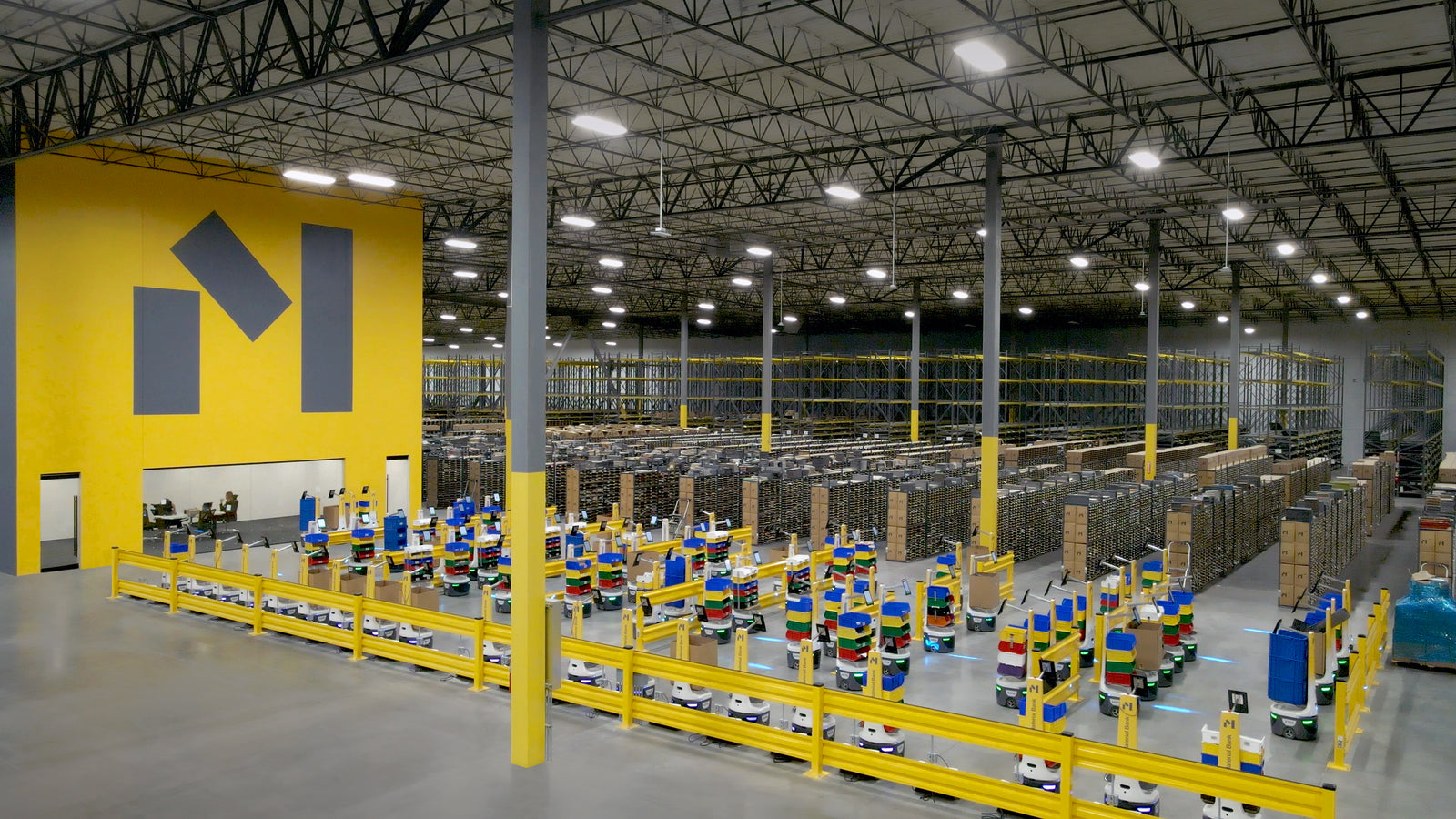
The joke works because Material Bank, the company Tafazzoli co-founded and now serves as Chief Business Officer, is built around an almost impolite level of punctuality. Its large robotics-powered warehouse sits near the FedEx hub serving Memphis. The geography is part of the interface. A search box begins the transaction; proximity to aircraft completes it.
This is Tafazzoli’s second career in moving things quickly. The first involved financial information and electronic trades. The second involves objects that refuse to become information entirely. Marble has weight. Carpet has pile. Paint changes in a room. Design may browse online, but sooner or later it asks to be touched.
“You can’t specify a hotel from a VR headset alone, you must touch the marble.”Farshid Tafazzoli
Act I / Velocity
A computer shop, a mentor and the dangerous confidence of twenty-one
Tafazzoli was born in Tehran and came to the United States with his twin brother when they were six. His parents expected the move to be temporary. Then the Iranian Revolution made the return impossible. His father was a quality-control engineer; his mother worked in a bank. The household offered security and prescribed paths. Tafazzoli developed an early appetite for financial freedom.
He says he began working at thirteen. At sixteen, he was in college and working in a computer store when chance appeared in the form of a customer: an institutional investor who became his mentor. Tafazzoli knew computers, not markets. The investor hired him anyway. By nineteen, Tafazzoli says he was managing the man’s capital. By twenty-one, the route led toward SLK, a brokerage that later became part of Goldman Sachs.
He was young enough to regard caution as an administrative nuisance. “There’s a fine line between confidence and arrogance at that age,” he has said, with the air of someone who located the line only after crossing it. In 1995, he co-founded onlinetradinginc.com, serving as a director and chief information officer. The brokerage later combined with Omega Research in the transaction that created TradeStation Group. Tafazzoli became a director and vice president of brokerage technology.
Tehran to the United States with his parents and twin brother.
Starts working, treating income as a route to independence.
Co-founds an electronic brokerage that later joins TradeStation.
Helps launch Material Bank and its single-box sampling model.
The public filings are less romantic than the later retellings, as filings tend to be. They record mergers, directorships, shares and a 2001 departure agreement. Yet the useful fact survives the paperwork: Tafazzoli learned early that a market changes when technology removes waiting. Electronic brokerage made access and execution feel immediate. Years later, he would find another industry in which delay had been accepted for so long that it looked like tradition.
Act II / Serendipity
The daughters who opened the design door
The transition from Wall Street technology to interior design did not begin at a trade show or inside a strategy deck. It began with children becoming friends. Tafazzoli’s daughters befriended two girls whose father was Adam Sandow, the publishing and design entrepreneur. Sandow had the idea that became Material Bank and invited Tafazzoli, along with Peter Fain, to help build it.
Tafazzoli has called it a rule he was glad to break: never work with friends. The line is neat because the business itself depends on relationships that refuse to stay in their assigned boxes. It connects brands to architects, logistics to inspiration, data to touch. A family friendship became corporate architecture.
The problem was easy to describe. A designer assembling a presentation might order from several manufacturers, then wait as separate packages arrived over several days. Keeping a materials library current took labor. Tracking samples took more. Returning them was another small campaign. Each inconvenience looked modest. Together they consumed part of the working day.
Material Bank’s answer was aggregation. Put many manufacturers into one searchable marketplace. Stock their samples in a shared facility. Let designers place one order. Pick it with robots and people. Send it in one box. Turn that box into a return package when the studio is finished. A fussy chain of errands becomes a single gesture.
The moat / Reality
Software discovers; fingers decide
Tafazzoli’s argument for the company is not that the physical world is obsolete. It is that the physical world has been badly organized. He calls the model hybrid: digital plus physical. Search can filter the impossible abundance of materials. Data can tell a brand what colors or patterns are drawing attention. Robots can reduce the walking required to assemble an order. None can tell a designer whether a textile feels right against the skin or whether stone catches light with the desired gravity.
This gives the business a curious defense. Pure software is easy to imagine and difficult to protect forever. A large physical operation is expensive and inelegant until it works; then the inconvenience of copying it becomes part of its value. Tafazzoli looks for what he calls durability of revenue. Paint interests him as an example because it does not spoil, its distribution networks are strong and demand tolerates price movement. He is an operator, but his analysis retains an investor’s habit of asking what survives.
“Behind every failure is an experiment you’ve fully tested.”Farshid Tafazzoli
That appetite for testing has a cheerful severity. Tafazzoli has said that if promised a thousand failures in a year, he would ask for a few more. The important clause is that the experiments be fully tested. Failure here is not decorative grit for a conference stage. It is the cost of buying information.
His advice is to start early because risk tolerance tends to shrink as life acquires obligations and scars. He did. Work at thirteen, college at sixteen, markets before most people have settled on a major. The method carries obvious danger, and Tafazzoli has spoken elsewhere about losing most of his net worth when young. What remained was not a cult of caution. It was a preference for motion informed by evidence.
Act III / Scale
The box gets a passport
By 2022, Material Bank had raised a $175 million Series D at a reported $1.9 billion valuation. It acquired Architizer, adding an enormous library of architectural projects and professional users to its network. Tafazzoli had said the pain points were global. The company set out to prove it, expanding beyond North America and placing its European facility near the FedEx hub at Charles de Gaulle Airport outside Paris.
He spent six months living in Paris during that chapter, discovering that international replication has its comic details. A drinks refrigerator, he recalled, required ten weeks to install. The California operator had met the French timetable. Still, the strategic logic held: locate near the carrier network, recreate the fulfillment rhythm, add regional brands and keep the box moving.
The company has also widened its aperture. Tafazzoli has discussed Samplize, which supplies peel-and-stick paint samples to consumers, and Design Shop, a consumer tool for composing rooms and ordering samples. In Europe, he has pointed to a sampling partnership with Archiproducts. In the professional market, the search data itself has become a product: thousands of daily queries can reveal shifts in color, pattern, geography and demand before a finished room ever appears.
Yet his telling observation is the least technological. “Design is inherently human,” he says. A material marketplace may accelerate discovery, expose brands and coordinate returns. It cannot eliminate the studio visit, the trade-show conversation or the small ceremony of placing two surfaces beside each other and deciding they belong.
Tafazzoli met his wife in seventh grade and jokes that he was then more interested in video games. They married in their mid-twenties; he credits her with enduring every entrepreneurial “psychotic episode” since. He describes his parents as exceptionally energetic and suspects he won what he calls the “fallopian lottery.” The phrasing is flamboyant. The underlying idea is modest: energy is inherited, supported and, when the work matters, renewed.
That may explain why his career looks less like reinvention than translation. Electronic markets taught him to notice delay. Design taught him that not everything worth speeding up should be converted into bits. The right system does not abolish marble. It gets marble onto the table before breakfast.