Before Gozem had a wallet, before it delivered dinner, before anyone could describe it with the rather roomy phrase “super app,” Gregory Costamagna and his partners had a more immediate problem. They needed motorcycle-taxi drivers in Lomé to believe them. The founders went to the city’s motorcycle parks in 2018 and made their pitch in person. A phone would summon a passenger. The app would bring work. The network would grow. Costamagna later compressed those days into five plain words: “We were selling a dream.”
The phrase is useful because it strips away the retrospective neatness that founders enjoy once the graphs point upward. Gozem’s first completed trip, on November 8, 2018, did not yet imply food delivery, digital tickets, financed vehicles or mobile money. It meant that one driver and one passenger had used a new mechanism in a city where motorcycle taxis were already part of daily life. The grand design began with the modest success of getting somebody from here to there.
Costamagna arrived at that moment by an unusually long route. Trained as an engineer at Arts et Métiers ParisTech, he added a master’s in strategy and international business at ESSEC, including an exchange at Nanyang Business School. He began in Asia-Pacific business development at Allianz Global Assistance. Then, in 2010, he founded Asia Deal Group in Singapore and spent nearly a decade developing digital and e-commerce ventures across Southeast Asia.
The education of elsewhere
Singapore gave Costamagna a front-row view of a particular kind of company. Grab and Gojek did not remain taxi apps. They used a frequent need, urban transport, as the front door to a wider collection of services. Rides produced customers, drivers, data and a reason to open the app again tomorrow. Payments, delivery and commerce could follow. The word “ecosystem” is terribly fond of investor decks; here it described a sequence of chores people already had.
The useful insight was not that West Africa required an Asian replica. Lomé is not Jakarta with the street signs changed. Costamagna, Raphaël Dana and Emeka Ajene focused instead on the shape of a local habit. Gozem’s name itself nods to the zémidjan, the motorcycle taxi woven into urban movement in Togo and Benin. The first product spoke the language of the street before it acquired the vocabulary of finance.
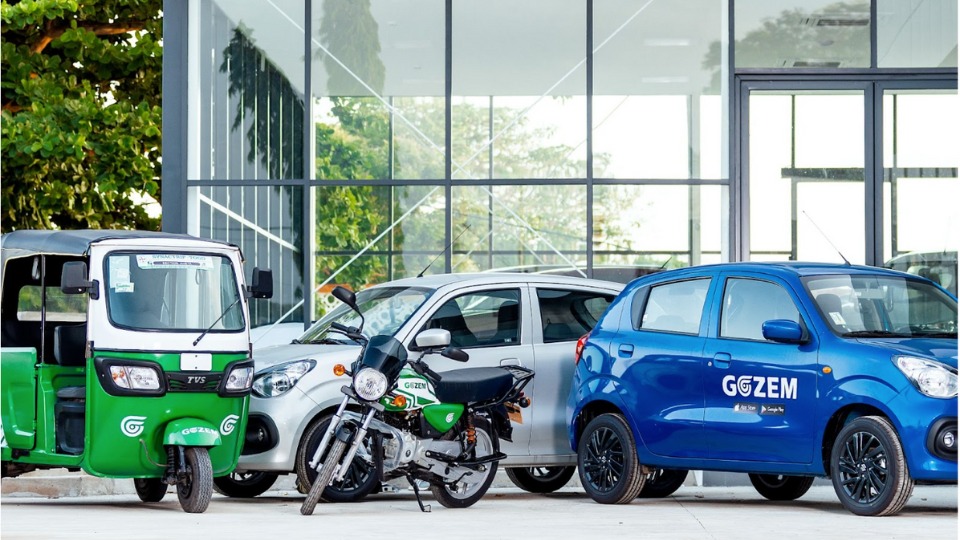
That local beginning also imposed discipline. A transport marketplace fails if drivers are absent when passengers tap. It fails if a promised pickup becomes a philosophical concept. The founders had to build both sides at once, city by city. Gozem moved from motorcycle taxis into tricycles and cars, and from Togo into Benin. Its drivers became “Champions,” a piece of company language that is equal parts morale and marketplace architecture.
“We were selling a dream.”Gregory Costamagna, recalling Gozem’s early driver recruitment
The road reveals the next product
The pandemic interrupted the tidy version of geographic expansion. Gozem went vertical instead. It acquired the Togolese delivery company Delivroum in 2020 and added food and grocery delivery, allowing merchants to list goods and drivers to carry them. Transport had supplied the network; a public disruption changed what that network transported.
Vehicle financing was the more revealing extension. Matching a driver with a passenger is useful only after the driver has a reliable vehicle. In many of Gozem’s markets, conventional credit is hard to obtain for the very people doing the moving. The company introduced lease-to-own financing for vehicles and equipment. It was no longer merely arranging work. It was helping finance the tool required to do the work.
This changed the logic of the relationship. A driver with a path to ownership is not simply inventory appearing on a map. He or she can build an asset while earning through it. By October 2025, figures released by Gozem around the opening of its new regional headquarters in Lomé said more than 7,000 vehicles had been financed, worth about $20 million. The company also said 40,000 Champions had generated more than $90 million over seven years. Those are company numbers, but they illuminate the ambition: make the marketplace a ladder, not only a switchboard.
Costamagna’s public language has long combined scale with service. In 2021, when Gozem appointed a strategic adviser, he framed the challenge as multiplying customers a hundredfold while preserving excellent service. It was a revealing conjunction. Growth attracts the headline. Preservation makes the growth survivable.
A wallet at the end of the ride
The Series A arrived in 2021: $5 million following $7 million in earlier seed financing. In 2025, Gozem announced a $30 million Series B combining equity and debt, led by SAS Shipping Agencies Services, an MSC subsidiary, and Al Mada Ventures. The investor mix was almost a diagram of where the company wished to go. One brought logistics reach. The other came from an African investment group with financial-services holdings. Gozem intended to finance more vehicles, enter more markets and accelerate Gozem Money.
The wallet launched in Togo in October 2025 in partnership with NSIA Banque. It offered a place for bills, transfers, purchases and personal financial management. Again, the service did not arrive from a brainstorming retreat in splendid isolation. Money was already moving around every ride and delivery. The wallet tried to keep that motion within one usable system.
By then, the map had widened from Togo and Benin to Gabon and Cameroon. Gozem launched in the Republic of Congo in November 2025. An IFC disclosure the following year described a business spanning those five countries and integrating ride-hailing, delivery, vehicle finance and mobile money. The legal headquarters remained in Singapore; the operating story remained emphatically African; Costamagna’s public profile placed him in New York. Three continents make for an awkward elevator pitch and a rather accurate portrait of his career.
The founder as bridge
Costamagna is not Gozem’s lone protagonist. Dana remains his co-founder and co-CEO. Ajene was central to the founding and early operating story. Local managers, drivers, merchants, banking partners and regulators determine whether a product devised across borders acquires local legitimacy. Costamagna’s role is easier to understand as that of a bridge: between the super-app lessons of Southeast Asia and the daily transport economy of Francophone Africa; between venture capital and vehicle ownership; between a smartphone interface and the physical nuisance of getting across town.
He has also operated as an investor, adviser and board member at Reengine Ventures since 2016. That work fits the same appetite for markets where digital infrastructure remains unfinished. Yet his own career warns against the romance of seeing “untapped” territory as empty territory. Lomé already had drivers, fares, habits and vocabulary. Gozem’s task was to organize an existing economy without pretending it had invented movement.
As the company widened, the founder’s problem changed shape. Recruiting the first drivers required persuasion at ground level. Operating across Togo, Benin, Gabon, Cameroon and the Republic of Congo required partnerships with banks, vehicle suppliers, investors and public institutions. The product still appeared to a customer as a few taps on glass; behind it sat credit agreements, driver training, local teams and the peculiar rules of five markets. Scale, in other words, did not remove the street. It multiplied the number of streets for which the company had to account.
The new regional headquarters opened in Lomé in October 2025 made that geography visible. A company incorporated in Singapore and led by founders with international careers placed its regional center in the city of its first ride. It was a practical decision and a symbolic one. Gozem’s expansion story could easily have drifted into the usual tale of a foreign template exported outward. Returning the institutional center to Lomé argued for something more grounded: the operating knowledge, management and next generation of products would remain close to the markets expected to use them.
In March 2026, Costamagna spoke in Washington at Transforming Transportation, the World Bank and WRI forum, about transport in a digital era. The room was a long way from the motorcycle parks where the company’s founders once rehearsed their pitch. The subject had barely changed. How can movement create access, income and a platform for other services?
There is a pleasing circularity here. Costamagna spent his early career learning how digital ventures expand across countries. Gozem taught the sterner lesson of how expansion begins: not with everything at once, but with one transaction made trustworthy. A rider opens an app. A driver arrives. The city becomes a little more navigable. Only then does the wallet make sense.
The phrase “super app” invites a picture of abundance, icons crowding a screen like guests who have ignored the seating plan. Costamagna’s story suggests the opposite. The durable part is the order. Ride, repeat, deliver, finance, pay. Each layer has to earn the next. The dream sold in Lomé was large. Its first proof was exactly the right size: one completed trip.