At DSV’s fiftieth-anniversary gathering in July 2026, Leif Tullberg had been doing some detective work. He had helped track down early shareholders and the families of shareholders who had died. Around 150 people attended, he recalled. For a company whose history is usually measured in acquisitions, the occasion offered a different unit of measurement: people who remembered when there was very little to acquire.
Tullberg had been DSV’s first Group CEO, from its foundation in 1976 until 2005. By the reunion, the small Danish transport venture had long since become an international business. He was there to remember its beginnings, meet people he had not seen for years and welcome a new book about the company. Fifty years can turn an ordinary working day into an origin story. It can also obscure how uncertain that day once was.
A second start in Skuldelev
Before DSV, there had been Dansk Tandem Transport. Tullberg directed that company between 1972 and 1974; it went bankrupt in 1974. The failure belongs near the beginning of his story, where it happened, before hindsight could tidy everything into a progression towards success.
He had been born in Aalborg in 1945 and trained as a machinist. His subsequent working life included sales and contracting. These were practical occupations, close to equipment, customers and the question of whether a job would pay. DSV’s founding in 1976 gave him another opportunity to answer that question.
The company began in Skuldelev, operating from premises at his home. Its founders were Tullberg and nine independent trucking companies. The name, De Sammensluttede Vognmænd af 13-7 1976 A/S, was almost an administrative document in itself. It identified a group of hauliers and supplied the date. Anyone seeking a mysterious origin for the initials DSV will have to make do with unusually thorough paperwork.
A small transport office suited the initial task. The owners needed haulage coordinated and deliveries arranged. Their shared company could do that work. There was a large ambition available inside this modest arrangement, but it would take years of decisions to give it shape.
Tullberg’s tenure as DSV’s first Group CEO.
The trucks were already there
The original business rested on a useful division of labour. Independent hauliers had the vehicles. DSV organised transport and earned a commission. Owning every truck was unnecessary to the office’s immediate purpose. Finding work and arranging for it to be done were valuable activities in their own right.
Today the phrase asset-light gives this arrangement a polished corporate sound. At the beginning, the proposition was easy to understand without a management vocabulary. People with trucks could work through a shared organisation. Customers could have their goods moved. The organisation had to earn its place between the two.
That position required more than an introduction. In transport, a promise has a destination and an expected arrival. Someone must coordinate the service and keep the commercial relationship working. A company that organises other people’s capacity still has plenty to do before it can count its commission.
DSV’s early history is therefore a story about cooperation among businesses accustomed to their independence. The founders created a common office without first assembling a company-owned fleet. That choice gave the enterprise a way to begin. International expansion would come through joining forces on a much larger scale.
Three jobs. One transport chain.
A simplified view of the founding model. DSV earned a commission for arranging the work.
Two temperaments, one negotiating table
DSV listed on the Copenhagen Stock Exchange in 1987. Two years later it bought Borup Autotransport and Hammerbro-Bech Trans, extending its export transport activities. The Borup transaction also brought Kurt Larsen into the story. A purchase of transport operations became the beginning of an important working partnership.
Tullberg and Larsen did not later present themselves as two versions of the same executive. Tullberg credited Larsen with putting teams together. His own contribution, in his recollection, was the appetite to push a negotiation further and keep going when the situation became uncomfortable. The distinction gave each a job beyond agreeing with the other.
“Kurt called me a steam locomotive.”
Leif Tullberg, recalling their partnership in 2010. Translated from Danish.
A locomotive is a revealing choice of office equipment. It suggests persistence, considerable momentum and a limited enthusiasm for stopping halfway through a journey. Tullberg’s reputation for wearing wooden clogs supplied a less industrial image. The nickname Træsko-Leif followed him into accounts of the early business, and eventually into television.
The partnership’s practical setting was a succession of deals. Samson Transport followed in 1997, then Svex Group in 1999. These acquisitions added businesses and extended the organisation’s reach. The opportunity was to put the enlarged company to work; a signed agreement alone could never finish that task.
Their shared recognition arrived in 2007, when both received the Tietgen Medal. The award honours contributions to Danish exports over a period of years. Its joint presentation makes a useful correction to the solitary-founder picture. DSV had a first chief executive, but its development also depended on partners, hauliers, employees and the people who backed it.
The deal that changed the dimensions
In 2000, DSV bought DFDS Dan Transport Group for DKK 5.5 billion. The acquisition supplied a broader international network, road activities across numerous European markets and logistics capabilities. The scale of the transaction altered what the company could offer and where it could operate.
It also created an apparent puzzle for anyone following the names. Transport and logistics activities continued under DFDS Transport, while the parent retained DSV. In 2001, the business was organised into three divisions covering road, air and sea, and logistics. The short name survived the longer corporate explanation.
- 1987Stock-market listing in Copenhagen
- 1989Borup Autotransport and Hammerbro-Bech Trans
- 1997Samson Transport
- 1999Svex Group
- 2000DFDS Dan Transport · DKK 5.5bn
- 2005Tullberg hands the Group CEO role to Larsen
Tullberg stepped down in 2005, and Larsen succeeded him. The distinction between the founder’s tenure and DSV’s subsequent expansion matters. Later acquisitions continued under later leadership. Tullberg helped establish the business and its appetite for combination; he did not personally manage every chapter that followed.
He continued working with DSV Miljø after leaving the group chief executive position. The environmental business had been divested in 2004 as DSV concentrated on transport and logistics. Following those separate paths prevents the letters DSV from swallowing every detail of his later career.
The business of being an active pensioner
In 2012, Tullberg became involved in new ownership of Jamas, a construction-machinery business acquired from Finansiel Stabilitet. Jens Lundgaard, who had worked with him at DSV Miljø, became its chief executive. An established working relationship was being given another job.
Tullberg’s explanation for choosing Lundgaard was specific: he knew the customers and the market, had considerable capacity for work and had helped build the earlier business. These are useful qualities when the product comes with tracks or a large bucket. An excavator can be described attractively in a brochure; a customer still needs it supplied and serviced.
By Jamas’s tenth anniversary under the new ownership in 2022, Lundgaard recalled an initial loss followed by improving results. Reported earnings had risen from just over DKK 2 million in 2014 to nearly DKK 6 million in 2021. This was a smaller stage than DSV’s international acquisitions, with a business problem sufficiently substantial to keep its owners occupied.
Tullberg’s other commitments included Kalvø and its restaurant near Roskilde Fjord. He called himself an active pensioner in a 2021 account of his life. The adjective was doing honest work. He remained interested in businesses with customers, premises, machinery and decisions waiting to be made.
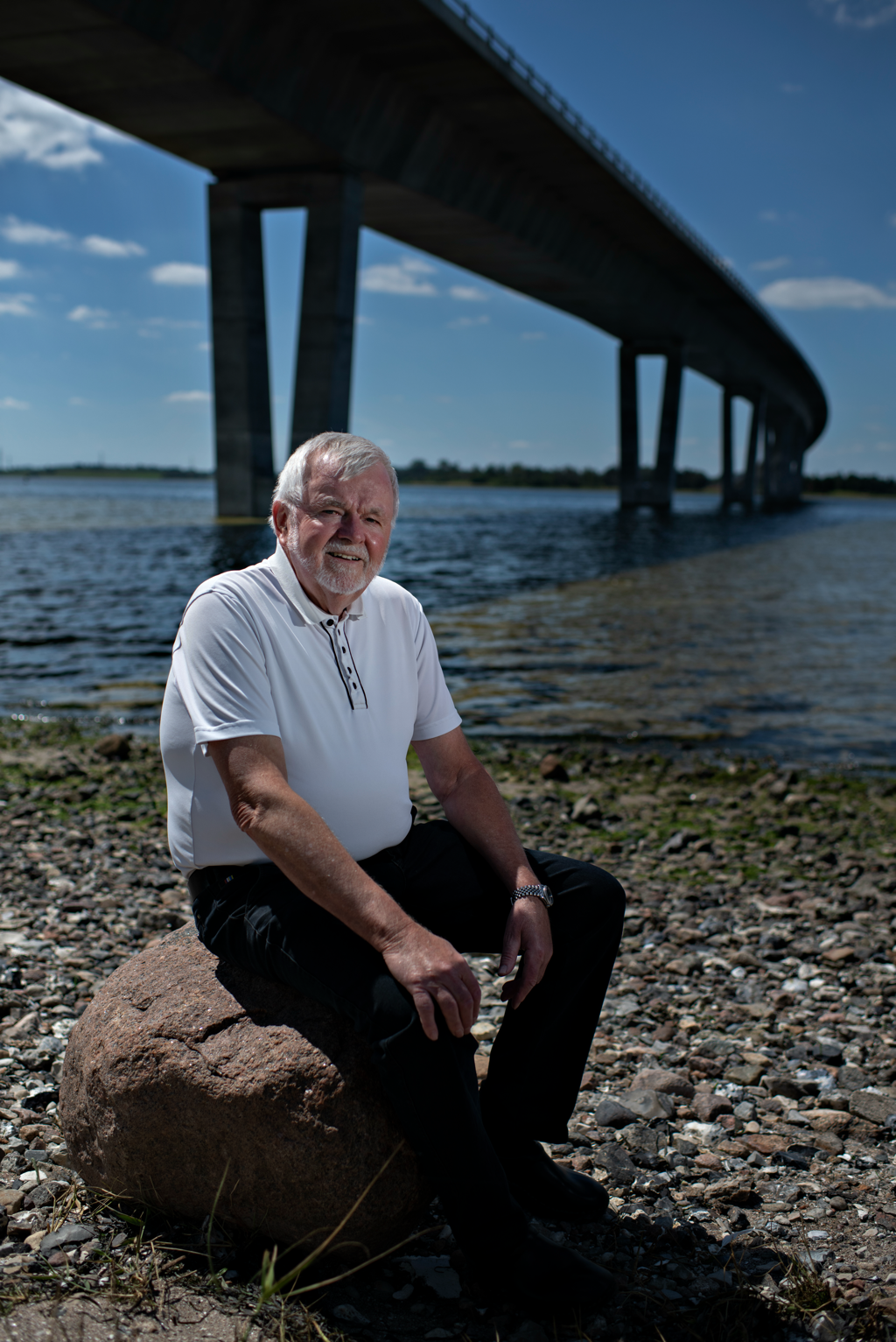
Then there was the bridge. Tullberg chaired Fjordforbindelsen Frederikssund from 2015 to 2022. In explaining why he accepted the role, he returned to the difficulties of getting people to DSV’s old Skuldelev base. Congestion at a crossing could deter business contacts and prospective employees. A delay on a local road could reach surprisingly far into a company.
His experience gave the appointment a personal logic. He had spent years organising the movement of goods. Here was an opportunity to help with a physical connection near the place where that work had begun. The photograph of him beneath Crown Princess Mary’s Bridge gives the later career a setting as concrete as the early office.
Back in the room
In April 2026, Tullberg promoted the three-part documentary Landevejens konger, which revisited the early transport business and the partnership with Larsen. The first episode carried his Bisse-Leif nickname. Half a century after the founding, the clogs and the combative beginnings were still part of the public story.
The anniversary gathering that July offered a quieter scene. Tullberg described meeting original shareholders and bereaved families, and the pleasure of seeing people after long separations. Martin Flink’s new history, Kunsten at tælle til 1, was presented. Its title translates as The Art of Counting to One. For a business assembled through combinations, it is an economical title.
Tullberg’s message to future generations at DSV was to look after its entrepreneurial spirit. His thanks went to the hauliers, employees, leaders and shareholders who had taken part. By then, he was remembering a company he had stopped leading more than twenty years earlier. The people in the room brought its first years back within conversational distance. For once, the important connections required nobody to book a truck.