Before the professorship, the patents and the chief executive’s chair, Thomas Lars Andresen wrote software for the Danish Broadcasting Corporation. He worked at Danmarks Radio between 1994 and 1996. It is an unexpected opening for someone whose later career would take him through university leadership in Denmark, company building in Boston and an executive role in Oxford. The early programming job belongs in the story of the scientist and founder who came afterwards.
Andresen was born in Copenhagen on 12 October 1972. His path into academic life included technical training, an apprenticeship and programming work. A stimulating chemistry course helped steer him towards studying chemistry at the Technical University of Denmark, known as DTU. There is a pleasing inconvenience in that sequence. A career can look inevitable once someone has put all the dates in order. His early years resist that treatment. The change of subject mattered.
The programmer’s detour
The software job lasted two years, well before the professorship and executive appointments. Yet it supplies a useful starting point. Andresen entered his scientific career with experience of doing technical work outside a university. He had already occupied a different professional world before becoming identified with chemistry and materials. The future professor had spent time making things work in a broadcasting organisation.
He completed his engineering master’s qualification in 2001, studying at DTU and the University of Auckland. A doctorate followed in 2005. The dates put some necessary distance between the change of interest and the later academic appointments. A compelling course may open a door; qualifications require considerably more time. His transition involved years of study alongside a period of research leadership at LiPlasome Pharma, from 2001 to 2007.
In 2017, he asked a wonderfully human question: “Do you think I’m a nerd?” It is a small interruption to the usual language of professional achievement. Here was a department head wondering how his intense involvement in technical work came across. The question gives the reader something a publication count cannot: a glimpse of someone sufficiently absorbed in his subject to wonder whether the absorption was showing.
Learning to build the room
Andresen joined Risø National Laboratory in 2007 and moved to DTU Nanotech the following year. He became a full professor in 2012. His responsibilities then expanded again: deputy director and acting head of department in 2014, followed by appointment as head of DTU Nanotech effective December 2016. Research and management were accumulating in the same career. Each new title added responsibility for work beyond his own.
When DTU appointed him department head, its president, Anders Bjarklev, pointed to his experience building research areas and one of the department’s larger academic groups. That is a different kind of accomplishment from completing an individual project. A group needs continuity, shared standards and enough direction for separate efforts to amount to something together. Andresen’s record was increasingly being read through his ability to organise other people’s expertise.
His own comments at the time focused on the commitment and professionalism of the department’s staff, alongside research, teaching and the creation of enterprises. It was the language of someone inheriting a working culture as well as an office. Universities reward individual names, then ask some of those individuals to keep a whole institution moving. The change can be substantial. A professor’s calendar acquires other people’s problems, and the calendar rarely objects politely.
- 1994Broadcast software
- 2012Full professor
- 2016Department head
- 2021T-Cypher CEO
- 2026Commit CEO
Flowers, funding and the next morning
On 23 February 2017, Andresen stood among the five recipients of Denmark’s EliteForsk Prize at Copenhagen’s Glyptotek. The ceremony brought researchers together with Crown Princess Mary and education and research minister Søren Pind. The photograph has the familiar ingredients of a formal occasion: suits, bouquets, carefully arranged people and an architectural setting that makes almost any achievement look appropriately solemn.
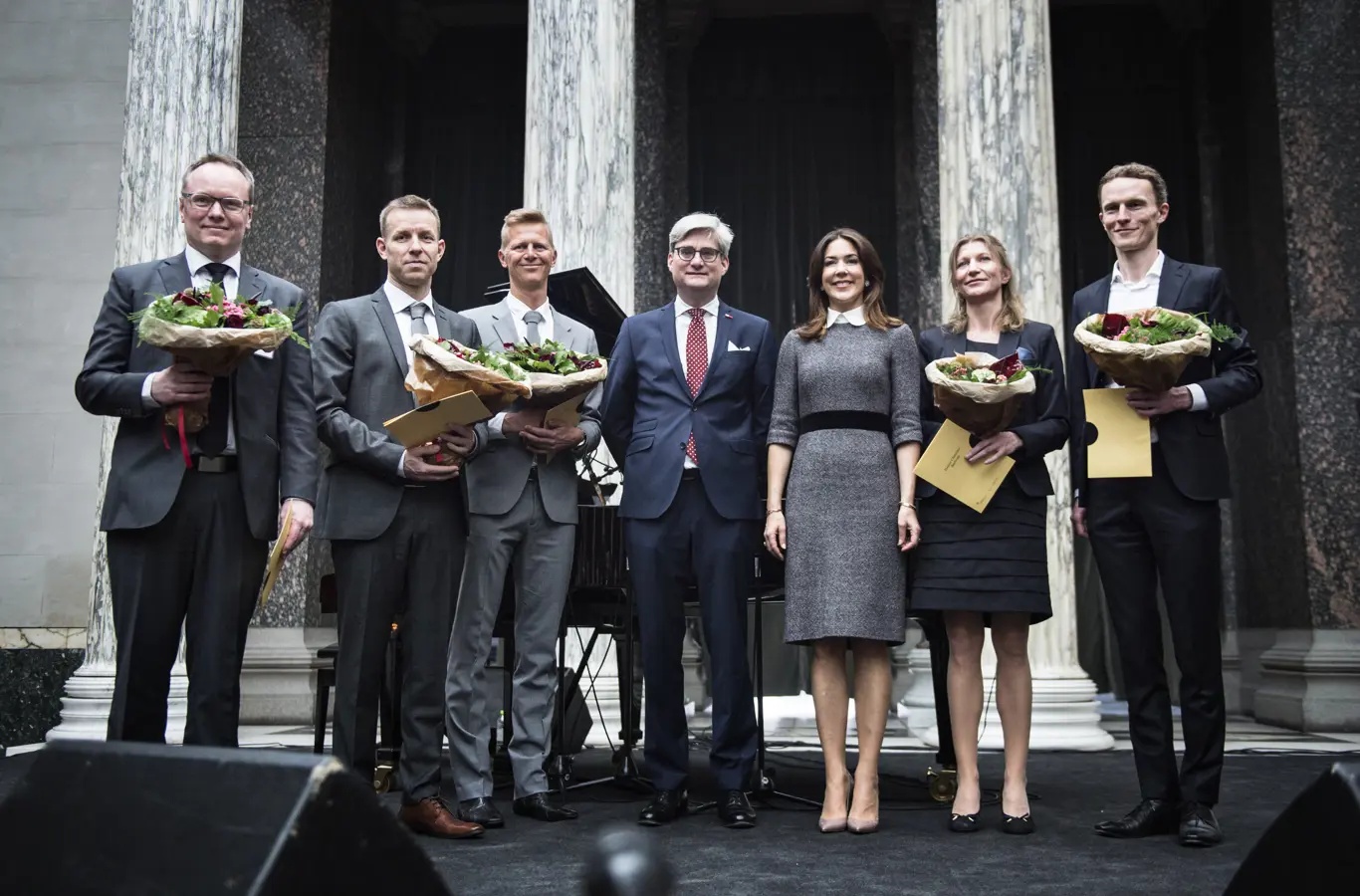
The award’s arithmetic is worth pausing over. Each recipient received DKK 1.2 million. Of that, DKK 200,000 was a personal honorary award; DKK 1 million was allocated to research activities. The structure joined public recognition to support for work still ahead. A ceremony marks a point in a career, while the larger portion of this prize was designed to keep the career’s research moving.
Personal recognition1,000,000
Research activities
Andresen had also received an ERC Starting Grant and a Sapere Aude grant. Taken together, these distinctions show repeated institutional support for his work. They also create an interesting backdrop to the next change. An academic career with a professorship, a department and research recognition contains plenty of reasons to stay. His subsequent move would take him into a different working environment, across the Atlantic.
An idea needs an organisation
Company formation had already become part of his career. He co-founded Nanovi in 2013 and Torque Therapeutics and Monta Biosciences in 2015. Those dates overlap with his university appointments. The businesses did not arrive after academia had finished; the two tracks ran alongside one another. His professional identity had room for published research, institutional leadership and the practical task of helping establish companies.
That overlap matters when reading the word “founder.” It can suggest one dramatic act, followed by a celebratory photograph and a conveniently short biography. Andresen’s record contains repeated acts of formation. Different ventures brought different organisations into being. The resulting list is less a single origin story than a series of occasions on which scientific work acquired a business structure and people acquired the responsibility of making that structure function.
From April 2018, he lived and worked in Boston as Torque’s chief scientific officer. A company he had helped establish became the setting for his working life abroad. Boston was consequently more than another city on the CV. It marked a shift in where he spent his time and how his experience was being used. The department leader was now working inside a venture he had co-founded.
His other ventures include Precision Antibiotics and Hazel Therapeutics. He has also served on Tidal Therapeutics’ board. His career is spread across several organisations, each with its own work and responsibilities. An academic paper, a patent application and a company each preserve a different part of that work. None can stand in for the others, which is why a list of credentials only tells part of the story.
Oxford adds another chapter
In July 2021, T-Cypher Bio announced Andresen’s appointment as chief executive and a member of its board, effective 1 August. The Oxford company was adding someone with research experience and a record of helping start businesses. For Andresen, the appointment added another country and another executive responsibility to a career that had already crossed between academic and commercial settings.
The announcement came with the formal optimism expected of a new appointment. There was a team to build and a company to develop. The useful detail is the timing: this was a specific role with a specific starting date, rather than a vague association between a scientist and a business. The title placed him inside the organisation’s leadership. Company building had become the central assignment.
Today, T-Cypher lists him as its founding CEO and non-executive director, while also identifying an advisory role. That distinction gives the Oxford chapter a shape. He led the company in its earlier period and remains connected through a different responsibility. A founding chief executive’s name can stay attached to a business after its daily management passes to someone else. The relationship continues, with a changed job description.
Career totals. Articles and patent applications measure different kinds of output.
A return measured in bicycle miles
On 11 March 2026, Commit Biologics announced that Andresen would become its chief executive on 16 March. The appointment brought him back into the Danish business ecosystem after years working in the United States and the United Kingdom. The company already had backing from Novo Holdings, Bioqube Ventures and Korys. He was joining an existing organisation, with a team and investors already involved.
He gave the return a personal scale. After years abroad, speaking Danish regularly again would feel unusual, he wrote. Alongside his ambition for the business came a much more everyday objective: cycling to work. He admitted that he had not done so since his teenage years and imagined the difficulty of maintaining the habit on a rainy Danish Monday.
“My first big ambition is to bike to work every day”Thomas Lars Andresen, announcing his move to Commit Biologics
The bicycle detail earns its place because it belongs to him. It cuts through the ceremonial language that usually surrounds executive appointments. A return home can involve familiar language becoming unfamiliar, an old habit needing practice and a commute becoming a modest project of its own. He wrote about polishing the bicycle and pumping its tyres before his first day. Even a serial founder has to prepare the wheels.
His interests also include trail running and nature. Set beside the commuting joke, those details give the professional chronology a little outdoor air. They do not explain every decision, and they need not. A personal story benefits from small, concrete particulars: the programming job before the chemistry degree, flowers at the Glyptotek, a bicycle waiting for another attempt.
Across Denmark, Boston and Oxford, Andresen has repeatedly changed the setting in which he works. The roles have asked him to write software, conduct research, lead a department, help establish businesses and take charge of companies. His latest chapter begins with another executive appointment and an old form of transport. After so many professional departures, he has given this return a practical first task: get the bicycle ready.