Starting a company gives a scientist a peculiar new experiment. The variables have opinions. They can accept another job. They expect the lights to work. Philip Chamberlain captured the predicament in two questions about launching Neomorph: “what if no one wants to come and do this?” and “what if they do?” The second question is where this story begins.
He shared that recollection on LinkedIn a little over a year after the company's launch, alongside his thanks to the people helping build it. The joke works because both outcomes require courage. An empty office tests an idea. A full one tests the person who persuaded everyone to arrive. Success in recruitment makes the promise heavier.
Today, Chamberlain is Neomorph's co-founder, president and CEO in San Diego. Those titles put three kinds of responsibility on one business card: helping originate the venture, running an organization and answering for its direction. His earlier role was president and chief scientific officer. The change in the final three letters tells a substantial part of the story.
A founder profile could begin with the money. Here, the more revealing starting point is the invitation. Come and do this. Behind every subsequent financing or partnership sits that smaller transaction: one person asking another to spend years on work whose outcome remains open.
“what if they do?”
Philip Chamberlain, on recruiting a founding team
Oxford, then a longer apprenticeship
Chamberlain earned his BA and DPhil at the University of Oxford, then crossed to the United States to work at the Genomics Institute of the Novartis Research Foundation. His training was in structural biology, a field concerned with the arrangement of molecules. He joined Celgene in San Diego in 2007.
At Celgene he built and led a structural and chemical biology department, eventually serving as executive director for protein homeostasis and structural biology. He also received the company's John W. Jackson leadership award. The combination matters: his professional record contains both scientific work and the work of assembling the people who could carry it forward.
A department is a useful apprenticeship for a company. It has colleagues, competing priorities and decisions that cannot be settled by enthusiasm alone. Building one means giving a research effort enough organization to outlast any single result. Chamberlain's move into entrepreneurship came after substantial time doing that inside an established business.
The familiar founder tale reserves a dramatic scene for the exit: a door slams, an idea escapes, the old employer is cast as an obstacle. Chamberlain's account leaves room for a less theatrical possibility. Experience inside a large company can be preparation for a smaller one. A good apprenticeship need not acquire a villain to make its graduate interesting.
Four founders and an early foundation
Neomorph was established in 2020 with backing from Deerfield Management. Its scientific founders were Chamberlain, Eric Fischer, Benjamin Ebert and Scott Armstrong. The company's December announcement reported a $109 million Series A. It described Deerfield's seed funding and operational support as already underway from the first quarter of that year.
The founding management group included Rohan Beckwith, Gang Lu, Mary Matyskiela, Ben Wen and Samer Chmait. A research site had been established at the Genesis Science Center in Sorrento Mesa. Chamberlain was leading the company as president and chief scientific officer. There was already a place, a group and a financial foundation around the idea.
Four scientific founders make for a different origin story from the lone inventor at a kitchen table. Expertise is distributed from the beginning. A management team adds another layer: people who must turn the shared premise into a working organization. The names belong in the story because the venture's formation was collective.
Large starting numbers can make a new company appear inevitable in retrospect. They offer no such guarantee at the time. Capital purchases the opportunity to organize work and keep going. It leaves the founders with choices about whom to hire, what to prioritize and how to make the next year more useful than the last.
The title changed in November
On November 29, 2021, Neomorph announced that its board had appointed Chamberlain chief executive officer. The scientific founder who had been leading research now formally held the company's overall executive responsibility. It was a dated, concrete transition, early in the life of the business.
An appointment announcement is a small document for a large change. A chief scientific officer's title points toward the research agenda. A chief executive's title adds the whole organization's direction. The distinction helps explain why the earlier recruitment worry remains relevant: people agreeing to join become people whose work needs a durable home.
The board's decision also placed continuity at the center of the leadership story. Chamberlain had helped start Neomorph and was already part of its management. The person carrying the scientific history forward would also be responsible for the company built around it. That does not make every decision simpler. It makes the ownership of those decisions clearer.
There is a modest comedy in the phrase chief executive officer. It sounds like an arrival, although it is really an assignment. The title supplies no answer to the questions that follow it. For Chamberlain, the appointment marked a widening of the job he had already begun, with the original invitation still hanging over the enterprise.
Three partners, three sets of terms
The next visible chapter brought outside organizations into the company's work. Neomorph announced a collaboration with Novo Nordisk on February 26, 2024. Its terms included an upfront payment, near-term milestones and research funding, with future milestones bringing the total potential value across multiple targets to $1.46 billion, plus tiered royalties.
That agreement assigned Neomorph the discovery and early research work on selected targets, while giving Novo Nordisk exclusive rights to pursue further development and commercialization. The arrangement had a division of responsibilities as well as a headline number. For a founder, a partner relationship changes who is waiting for the next piece of work.
Biogen followed on October 29, 2024. Its agreement included an upfront payment, contingent milestones and reimbursement of certain research development costs. The announced total consideration could reach $1.45 billion. Future royalties were also possible. Some milestones were described as nearer term, while others were expected later in the decade and beyond.
Then came AbbVie on January 23, 2025, through a collaboration and option-to-license agreement. Neomorph would receive an upfront payment and could receive up to $1.64 billion in aggregate option fees and milestones, with tiered royalties on net sales. An option adds a decision to the relationship; later rights depend on choices still to come.
The three numbers invite addition, but arithmetic alone tells a poor business story. Each agreement carries its own conditions, timetable and allocation of work. Potential payments describe possible future progress. They are useful evidence of the scale of the commitments, provided the conditional words remain attached. A billion-dollar headline can be perfectly accurate and still require a careful second sentence.
The investors returned
On April 13, 2026, Neomorph announced the closing of a $100 million Series B. Deerfield led the round. Participants included Regeneron Ventures, Longwood Fund, Alexandria Venture Investments and Binney Street Capital of Dana-Farber Cancer Institute. The founding investor was still present as new investors joined.
This is a different kind of number from the partnership totals. The Series B was a financing that had closed. The partnership figures described payments that might be earned over time. Put them side by side without their labels and the story becomes misleading. Keep the labels and a clearer picture emerges: an organization funding its present work while arranging possible future returns.
The round also extends the original founding relationship. Deerfield's name appears in the early support for Neomorph and again in the later financing. Continuity on that side of the table sits alongside the addition of new participants. The company's financial history therefore contains both a continuing backer and a broader investor group.
For Chamberlain, another completed round means another period in which the organization can pursue its priorities. It also gives those priorities an audience. Investors have committed capital; colleagues have committed their working lives. The recruitment question has acquired more people, more resources and more reasons to demand a considered answer.
April 13, 2026
A familiar name at the board table
In May 2026, Neomorph appointed Robert J. Hugin chairman of its board. Hugin had previously been Celgene's chairman and CEO. Chamberlain's earlier employer thus reappeared in the company's governance through a leader with experience running and expanding that business.
Chamberlain emphasized Hugin's strategic judgment and operational experience in the appointment announcement. The choice fits a recurring feature of his career: scientific expertise is accompanied by institution building. A board brings a different perspective from a laboratory or a management team. At this stage, the company was adding experience in how organizations grow.
His professional life also reaches beyond Neomorph's own rooms. In October 2022, he joined an American Chemical Society webinar with fellow co-founder Benjamin Ebert and CAS information scientist Janet Sasso. The event put academic and industrial participants in the same conversation, with Angela Zhou moderating.
In February 2025, Chamberlain and University of California, San Diego researcher Fleur M. Ferguson organized a Keystone symposium in Santa Fe. The program included a career roundtable connecting early-career researchers with people in academia and industry. Building a company and helping convene a professional community are distinct activities, but both depend on getting useful people into a conversation.
An invitation that keeps growing
San Diego has remained the geographical thread. Chamberlain worked there before Neomorph, and the company is headquartered there now. A May 2026 account reported a lease for an 80,000-square-foot laboratory facility near Sorrento Mesa, with a transition expected later that year. The reported lease describes planned capacity; the timing of occupancy was still ahead.
A building is an unusually tangible chapter in a scientist's business story. Ideas can travel light. Teams accumulate equipment, desks, routines and the need for room to work. A lease makes an intention physical. It places future work somewhere on a map and commits an organization to the practical business of inhabiting it.
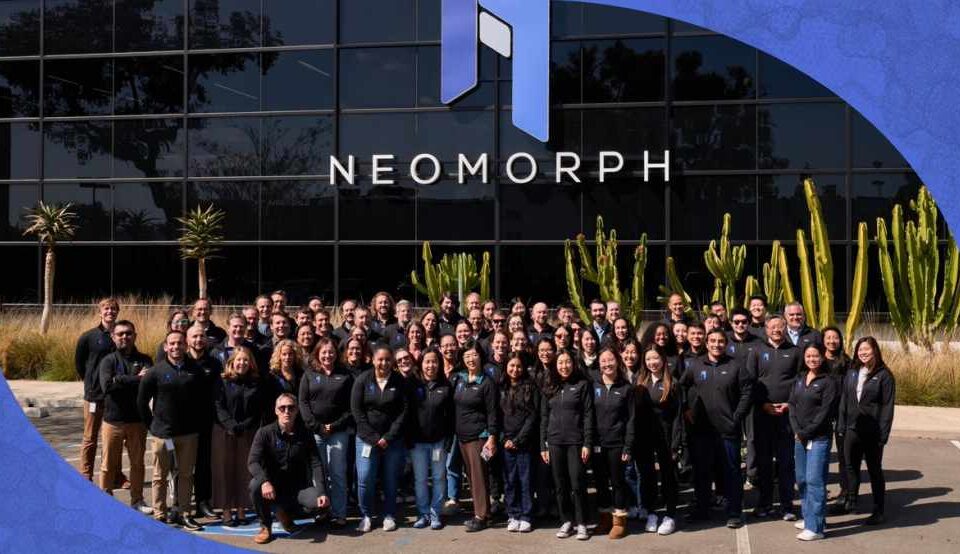
That May account also described a team of more than 80 researchers. The figure gives the opening question its human scale. Every additional colleague expands the circle of people for whom the company's choices matter. A group photograph has a way of making a financing announcement look less abstract: capital must eventually become work done by particular people.
Chamberlain's story is still in progress. The sequence already visible is substantial: training, department building, founding, a chief executive appointment, partnerships, fresh investment and an expanding organization. Its most personal detail remains the pair of worries he chose to share. People did come. His continuing job is to give their yes somewhere worthwhile to go.