In December 2010, John Beadle became the chief executive of a company assembled from two others. Myotec Therapeutics and Hybrid BioSystems merged to form PsiOxus. Both already had him in the chief executive’s chair. The new business arrived with £3.6 million in additional financing and investors from both sides of the combination. There was a new name to learn, but the person running it was familiar.
It is an unusually useful opening scene for a founder’s story. The familiar version begins with a solitary flash of inspiration. Beadle’s begins with two organisations, a shared executive, a group of investors and the decision to bring their work together. A company can be built by joining things that already exist. The paperwork may lack romance; the consequences do not.
PsiOxus later became Akamis Bio. Beadle’s connection to it is as co-founder and founding chief executive, with his executive tenure running from 2009 to 2021. The merger itself was announced in December 2010. Those dates describe successive stages of a business taking shape. His subsequent work has spread across several boards, carrying that experience into other companies.
Beadle: CEO+Hybrid BioSystems
Beadle: CEO
An exit, followed by another entrance
Before PsiOxus, there was PowderMed. Beadle co-founded it in 2004 and served as chief medical officer and a board director. He helped raise £20 million from UK and US venture capital funds. Pfizer agreed to buy the company in 2006 and completed the acquisition that December. The transaction supplied an ending to one chapter and a rather substantial change of letterhead.
For Beadle, the next position was site head at Pfizer, spanning 2006 to 2007. An acquisition can make a founder’s biography appear to stop precisely where the integration begins. His includes that intervening job. He had helped build the smaller organisation, then worked inside its larger owner. The sequence placed company creation and corporate operations next to each other, rather than in separate worlds.
There was earlier experience at PowderJect and GSK, too. His GSK career included business process improvement roles before he became vice president of global medical operations in 2000. He had also completed an MBA at London Business School in 1999. His education and earlier jobs gave the later founding roles a specific professional background. The MBA sat alongside experience inside established companies, including responsibilities for improving how work was carried out. In a biography filled with new organisations, those years inside existing ones deserve their place. The recurring business questions were practical ones: how work is organised, how a team develops, and how a promising enterprise gets the resources to continue.
“So I guess I’ve been a successful entrepreneur.”
John Beadle / 2017
The adviser takes the chair
In 2007, Beadle became entrepreneur in residence at Imperial Innovations. The arrangement put him alongside companies the organisation had already backed or might back in future. He advised on strategy and on the commercial question that sits underneath it: could the technology support a successful company? Eventually, he was expected to choose one and join its team.
Myotec was the business he chose. He had been advising it before becoming its CEO in late 2008. That move matters because it made his advice accountable to the daily work of running the organisation. An adviser can recommend a direction. A chief executive has to recruit for it, finance it and explain it again when the next meeting begins.
He also led Hybrid BioSystems. The two jobs converged in the PsiOxus merger. Imperial Innovations, Invesco Perpetual and the Mercia Fund were among the participating investors; the University of Birmingham was connected to Hybrid’s origins. Beadle’s founding story belongs to that network of universities, executives and capital. Its cast is larger than one person, even when one person becomes the most convenient name for the story.
A laboratory is an argument made solid
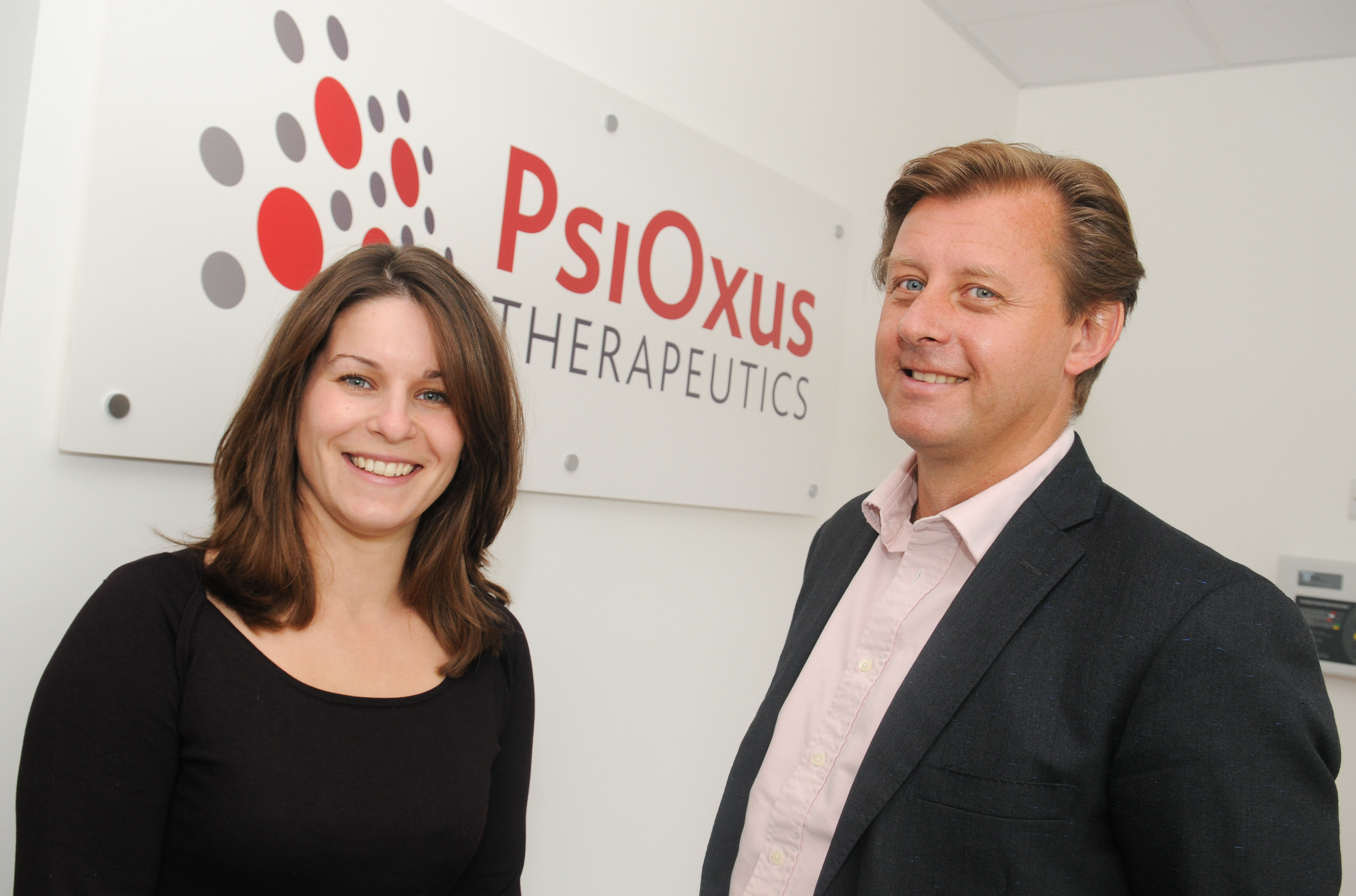
By April 2012, PsiOxus was expanding into new facilities at Milton Park in Oxfordshire. The company had a laboratory designed and fitted to its specifications. The accompanying photograph places Beadle beside Jo Szegota of Milton Park, with the PsiOxus sign behind them. It is a small ceremony for a tangible change: the business now had more room in which to work.
A new facility gives an abstract ambition a floor plan. The company has to decide what it needs, and someone has to arrange for those needs to be met. In Beadle’s account of the move, the organisation had reached the point where expansion and a purpose-designed space were necessary. The location offered the opportunity to build around those requirements.
The picture is pleasingly free of entrepreneurial theatre. Two people stand beside a sign. The visible achievement is straightforward: a young company had grown into a new workplace. For a founder, square footage can be a more persuasive sentence than anything in the presentation deck.
The number with two different meanings
The commercial story became more conspicuous in December 2016. PsiOxus signed an exclusive worldwide licence agreement with Bristol-Myers Squibb. The announced terms included a $50 million upfront payment and eligibility for up to $886 million in development, regulatory and sales milestones, alongside royalties. The potential total was $936 million. Only the upfront component was an upfront payment.
That distinction is the entire point of the graphic below. Conditional milestones describe future payments tied to specified achievements. Adding them to the initial payment produces a larger potential figure, but it does not put the whole sum into the company’s account on signing day. The agreement also assigned global development and commercialisation responsibilities to BMS and provided support for certain work at PsiOxus.
For a chief executive, the shape of a deal matters alongside its size. A partner can bring capital, responsibilities and an international organisation to the relationship. PsiOxus had already entered another BMS collaboration earlier in 2016. The December agreement therefore extended an existing connection. It showed the company building a commercial relationship over successive arrangements, with different commitments attached to each.
Other people belong in the picture
Beadle’s years as CEO included building an executive team around that partnership strategy. Karen LaRochelle joined as chief business officer in 2016 after consulting for PsiOxus and helping secure its earlier BMS collaboration. Her previous career included global business development at BMS. The appointment made a specific connection between the company’s ambitions and the experience it brought into the room.
The same executive changes included Charles “Charlie” Morris joining as chief development officer. Beadle welcomed both as reinforcement at a particular stage of growth. A company’s changing leadership chart is a quiet form of autobiography: it records the skills the business believes it now needs. In this case, the emphasis included experienced development leadership and the ability to organise strategic collaborations.
This is where the lone-founder shorthand becomes especially unhelpful. Beadle had a central role, but the work involved colleagues with their own histories and relationships. Financing, premises and partnerships all depend on people beyond the chief executive. His career is easier to understand when those people remain visible. A founder can hold the pen without having written every line.
A new name carries on without its founding CEO
After his executive tenure ended in 2021, Beadle served as a non-executive director of PsiOxus until 2022. Howard Davis was appointed CEO in the third quarter of 2022. US operations were established in Cambridge, Massachusetts, later that year. In January 2023, the company relaunched as Akamis Bio and announced a $30 million convertible note financing.
The sequence gives the founding years a boundary. The later name and financing belong to the next leadership chapter. Beadle helped create and run the predecessor business; Davis led the relaunch. Keeping those roles clear makes both careers more intelligible. An enterprise can retain its history while changing its name, its leadership and the geography of its operations.
For Beadle, the next work increasingly involved boards. Pneumagen appointed him a non-executive director in May 2022. Its CEO, Douglas Thomson, pointed to his experience in founding, funding and growing companies. The invitation was grounded in the organisational work he had already done. Experience that had once been concentrated inside one chief executive’s job was becoming something he could contribute from another seat.
The second act has several meeting rooms
Vitarka appointed Beadle chairman in November 2024. Its founder and CEO, Vineeta Tripathi, welcomed the experience he brought from early-stage businesses. By 2025, his directorships also included CamGene Therapeutics and Icosphere Biosciences. Scarlet Therapeutics lists him as a board member, and NorthLinks Bio includes him among its non-executive directors. The career has become a set of connected commitments rather than one company’s daily schedule.
In January 2026, he joined Nykode’s board. The company’s annual report also names him chair of its research and development committee. Nykode’s governance arrangements give that committee a preparatory and advisory role; decisions remain with the full board. The role places his experience in a specific part of the organisation: helping examine the work before the wider board decides.
Outside the company titles, Beadle describes himself as a sport lover, listing rugby football, athletics, cycling and cricket among his interests. It is a small personal detail beside a biography crowded with appointments. A person who appears in corporate announcements also follows pursuits with scoreboards, fixtures and seasons. The interest is his own description, and a welcome change of subject from another board membership.
The arc invites a modest conclusion. Beadle has repeatedly moved between forming an organisation, running it and helping another leadership team. PowderMed was sold. Myotec and Hybrid were combined. PsiOxus grew, changed leadership and acquired a new name. His present board work continues the same interest in what a company needs next. Starting again can mean taking responsibility from a different chair.
- 2006PowderMed acquired by Pfizer
- 2010Myotec + Hybrid form PsiOxus
- 2024Vitarka appoints Beadle chairman
- 2026Joins Nykode’s board