Giles Day was looking forward to lunch. The occasion was Ability Biotherapeutics’ planned move into Inspire Bio Innovations in Montreal, and the attraction was a rooftop garden. A chief executive announcing an office move can usually be relied upon to admire the square footage. Day had also considered where he would eat.
Then came the reasoning. Downtown Montreal put the company within walking reach of McGill, CHUM and Mila. Public transport, coffee bars, restaurants and shops would give the team a working neighbourhood. He compared that prospect with the isolated research complexes where many of his colleagues had begun their careers. The garden was a perk; the surrounding city was part of the business plan.
That small observation makes a useful entrance to Day’s career. He works in an industry associated with laboratories, but his public remarks keep returning to the connections between people. How do you get a team together? Which partners belong in the room? How far away is the next conversation? For this founder, an address can be a way of arranging encounters.
Before the founder, the informatician
Day’s training was in computational biology, with a master’s degree from the University of Manchester. He spent 15 years at Pfizer and became head of informatics for its Biotherapeutics and Bioinnovation division. Informatics sits at an awkward junction: information has to be organised well enough for other people to use it. A database full of answers is of limited comfort if nobody can ask it a sensible question.
An April 2008 partnership announcement gives a more specific view of his work. As senior director of Pfizer’s Targets and Mechanisms Informatics Group, Day described plans to integrate Ingenuity’s analysis tools across the enterprise. The arrangement connected external software and knowledge with Pfizer’s internal systems. He emphasised researchers’ access to information and their ability to share it across the organisation.
The scale was corporate, but the problem was recognisable to anyone who has watched a useful file disappear into a colleague’s folder. An organisation can own information without making it available where it matters. Day’s job involved closing that distance. It was technical work with an organisational consequence: people who could see and exchange information had a better basis for making decisions together.
He also appeared on conference programmes dealing with cloud computing. In 2011, his Bio-IT World talk promised a practical account of running a sequence annotation pipeline on Amazon, including databases and queuing systems. By 2012, he was speaking under the title “Bioinformatics in the Cloud: An Affordable Alternative.” The adjective carried a business argument. Computing capacity could become a service a young company used, instead of a large purchase it first had to finance.
Customers paid for the next step
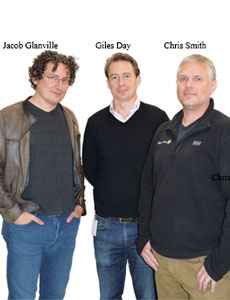
At Distributed Bio, Day worked alongside Jacob Glanville and Chris Smith. Their roles brought together scientific analysis, computing and business leadership. Smith’s background included distributed computing and responsibility for AbGenesis, the company’s cloud-based sequence analysis product. The name on the door suited the arrangement: the work depended on several kinds of expertise meeting in one business.
The company’s early software licensing revenue helped support its move into laboratory operations. Day described a business built from product revenue without outside investors. That choice made customer demand an immediate constraint. A founder could admire an idea as much as he liked; the business still needed somebody willing to buy the result.
In 2018, Day recalled the physical progression from a virtual operation to an incubator bench and then its own South San Francisco facility. The licensing approach also borrowed from software: customers received updates rather than a permanently frozen product. It is an unglamorous but revealing commercial instinct. Give people a reason to keep using what you make, and their payments can help you make the next version.
A partner before a buyer
In October 2018, Distributed Bio entered an exclusive partnership with Charles River Laboratories. The arrangement gave Charles River’s clients access to Distributed Bio’s discovery libraries and optimisation technologies. It paired the smaller company’s specialist capabilities with the larger organisation’s services and customer relationships. The work could travel farther without Distributed Bio having to build every part of the surrounding business itself.
A partnership also gives both sides something that a pitch deck cannot supply: time working together. The commercial relationship lasted more than two years before Charles River acquired Distributed Bio on December 31, 2020. The announcement followed on January 4, 2021. The buyer described the transaction as the culmination of the earlier alliance.
The published terms were $83 million in cash, subject to closing adjustments, with up to $21 million in additional performance payments. Charles River estimated Distributed Bio’s 2020 annual revenue at approximately $15 million. Those numbers describe a company transaction. They also preserve an important distinction between money paid at closing and money contingent on what happens later.
The sequence is the interesting part of the deal: collaborate, learn, then acquire. For Day, it meant that an existing commercial relationship became the setting for a change of ownership. The sale did not erase those connections. When he later returned with a new company, Charles River was among its investors. A completed transaction had become the beginning of another working relationship.
Starting again, with names attached
Ability emerged from stealth in December 2023 under the name Ability Biologics. Day was co-founder and CEO; Jean-Philippe Bürckert was co-founder and vice-president of technology. Amplitude Ventures was the founding investor and led the initial $12 million financing. The company brought together a new organisation around a team with experience in computational work and company development.
Day’s announcement of the role read like a thank-you note with an organisational chart attached. He credited Bürckert, Amplitude’s Dion Madsen and Bharat Srinivasa, and colleagues including Patricia Giblin, Matthew Clark, Aldo Rozzo and Patrick Tremblay. He praised both their experience and the pleasure of working with them. The distinction matters: a résumé tells you what someone has done; the working day tells you what it is like to do something together.
He reserved particular thanks for executive chair David de Graaf. They had met and worked together at Pfizer in the early 2000s. Two decades later, that acquaintance mattered to a new venture. The chronology offers a quieter view of career progress. Some of the value of an earlier job becomes visible long after the job itself has ended.
Amplitude’s own 2021 annual report had already recorded Day joining its advisory board. His involvement with the firm therefore preceded Ability’s public launch. In his launch-day comments, he encouraged innovators to contact Amplitude and mentioned its Pre-Amp incubator programme. He also acknowledged people who had helped translate the company’s idea into a business case investors could understand. Even an experienced founder needed collaborators for that translation.
“a genuine pleasure to work with”Giles Day, introducing Ability’s leadership in 2023
Who gets a seat at the table?
In June 2024, Ability announced the final close of its seed financing, bringing the total to US $18 million. Investissement Québec and Theodorus joined the syndicate. The total is the useful figure: it describes the completed seed round rather than a fresh $18 million stacked on top of the earlier announcement.
Day used the occasion to discuss a consideration that gets less space than the cheque. Investors, he wrote, influence a company’s culture as well as its prospects. He and Bürckert had been selective about whom they worked with. Money arrives with people attached, and those people may be involved for years. Choosing the relationship is part of choosing the financing.
His post also credited the team’s work and the data it produced. By then, there were too many colleagues to thank individually. That is a small marker of growth with a distinctly human scale: the list had outgrown the post. The enterprise that could once be introduced by naming its core leadership was acquiring the ordinary complication of a larger group.
Ability added another relationship in October 2024 through a partnership with Mila, the Quebec Artificial Intelligence Institute. The agreement brought the company into contact with an academic AI research community. It gave substance to the Montreal connection that Day would later discuss when contemplating a downtown office. Proximity and formal collaboration were becoming two ways of pursuing the same practical opportunity: work with people whose knowledge complements your own.
The next conversation
In June 2025, Angèle Maki joined Ability’s board. In December, she became chief business officer, with responsibility for business development, global partnering and new investor relationships. Her experience included licensing and corporate venture roles across established companies and younger ventures. Day’s explanation of the appointment centred on deal-making expertise and an international network.
The move from board member to executive put a dedicated business leader inside the day-to-day organisation. It also offered another example of a relationship changing form. Distributed Bio’s partner had become its buyer and later an investor in Ability. A former Pfizer colleague had become executive chair. Now a director was joining management. Day’s career is full of connections that have acquired a second job.
There is a temptation to narrate a founder’s career as a series of departures: leave the large company, start the small one, sell it, begin again. Day’s record makes that account incomplete. Each step also carries something forward. Technical experience persists. Working acquaintances return. Commercial partners reappear in a different capacity. Starting again can involve a substantial amount of continuity.
His present role at Ability Biotherapeutics brings those threads together. He is building another company, this time with institutional backing and a Montreal network. The work ahead includes partnerships, financing and the daily business of getting colleagues to accomplish something together. The rooftop lunch remains a modest ambition alongside them. It is rather pleasing when a plan for the next chapter includes somewhere to sit.