Rome turns up twice in Massimiliano Paganelli’s story. First as the city where he was born and grew up. Later as a place on his company’s expanding map. Between those appearances came Belgium, Canada, an academic career and the founding of Morphocell Technologies. A life can travel a considerable distance before an old address acquires a new purpose.
Paganelli is Morphocell’s co-founder, president and chief executive, known professionally as Max. The shorter name suits the problem of fitting several working lives onto one business card. He is a scientist, an associate professor at the Université de Montréal and an entrepreneur. He has led the company as president and CEO since 2019. The company itself dates to 2018, a distinction worth keeping: the beginning of an institution and the beginning of a particular role need not share a birthday.
By December 2025, Morphocell had completed a US$50 million Series A. In 2026, it announced a California laboratory, appointed a chief financial officer and saw Paganelli and Claudia Raggi named joint recipients of a national leadership award. Those are the public milestones. The quieter continuity running through them is a partnership that began long before the company had a financing announcement to write.
A partnership before a company
Raggi is Morphocell’s co-founder and chief scientific officer. She and Paganelli are also partners in life. When he responded to their 2026 recognition, he counted twenty years together. That makes the company a relatively recent chapter in a much longer collaboration. The executive titles arrived after the relationship, rather than supplying its original terms.
Award announcements tend to polish away the domestic scale of working together. Here, the personal dimension remains visible. Paganelli’s response put Raggi at the center and credited the wider team with carrying their original idea beyond the two of them. There is an appealing absence of solitary-founder theater in that account. Two people can share a beginning without claiming possession of everything that follows.
BIOTECanada named them joint recipients of its 2026 Gold Leaf Award for Community Leadership in Research & Innovation. The pairing is precise. Paganelli has the chief executive’s responsibilities; Raggi leads the scientific work. The award recognizes them together, allowing the public record to reflect the collaboration rather than obliging one person to stand in for it.
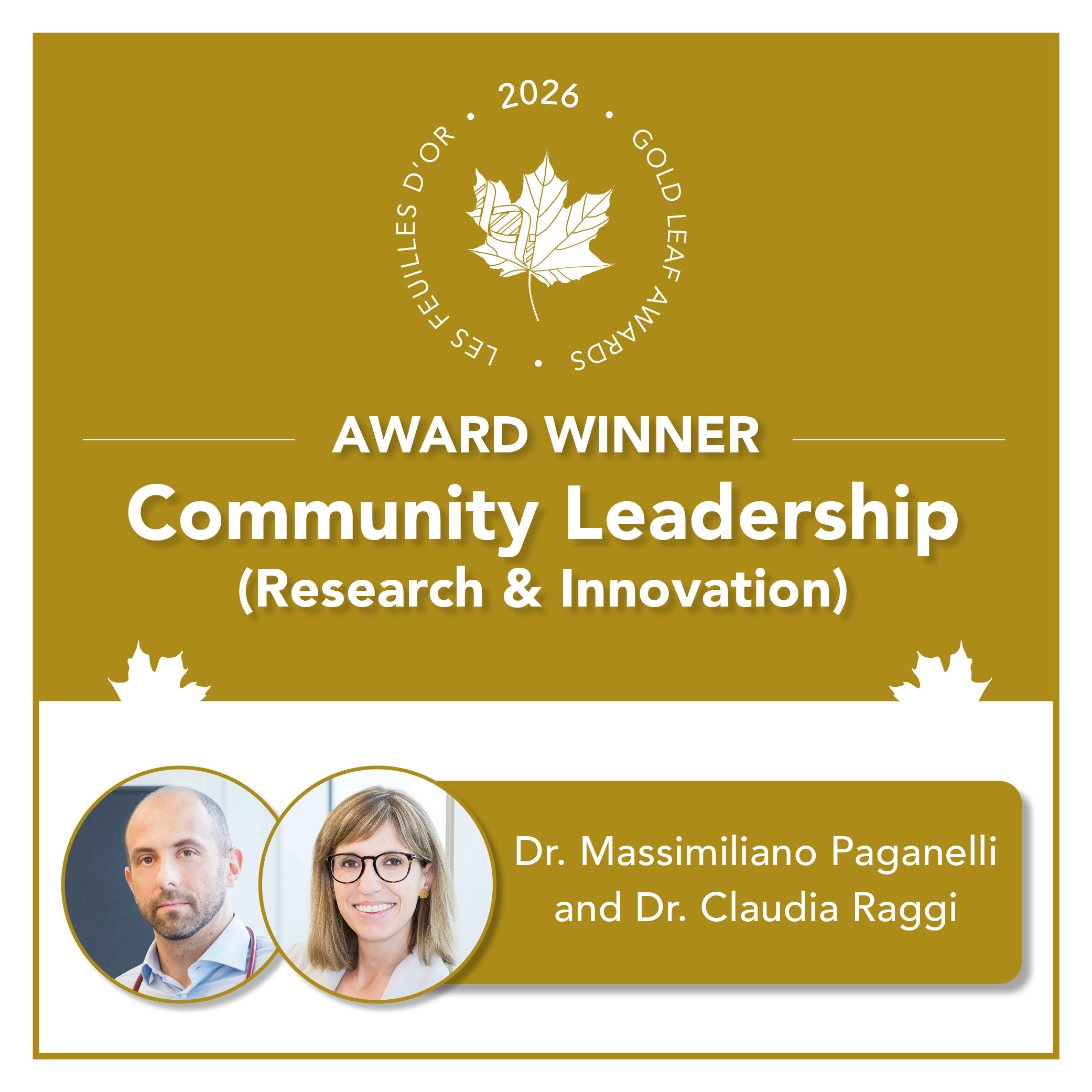
The photograph on an executive page encourages us to think in the singular. An organization asks us to think in the plural. A joint award offers a useful correction to the photograph’s grammar, and in this case the correction comes from the person whose photograph we were looking at.
The company gets its own life
Morphocell’s founding included a third person: Margaret Bywater, an experienced biotechnology entrepreneur. Paganelli and Raggi brought their scientific collaboration; Bywater brought experience in creating businesses. The founding group is a useful detail because a company needs capabilities that do not all come from the same professional education.
The work that preceded Morphocell began in 2016, supported by CIHR and Stem Cell Network. The company was created in 2018 to obtain private financing and other resources for the next stage. That sequence gives the business a concrete origin. The research came first. Creating an organization supplied another way to support its development.
For Paganelli, this added an executive role to an existing academic life. His education included a degree at Sapienza University of Rome and a doctorate at the Catholic University of Louvain. His working affiliations in Montreal include CHU Sainte-Justine and the Université de Montréal. Morphocell grew from that academic setting, carrying the founders into another kind of institution.
A laboratory and a company both require people to work together, but a company makes the arrangement more elaborate. Funding, appointments, offices and responsibilities acquire their own public record. You can follow the change in scale through those records without needing to imagine a cinematic afternoon when a scientist suddenly became a founder. The documented transition took years.
Fifty million dollars, measured in time
The initial US$40 million Series A, led by Montreal investor Genson Capital, closed in February 2024 and was announced that April. A US$10 million extension brought the total to US$50 million in December 2025. Investissement Québec and CDP Venture Capital led the addition. The two figures describe stages of the same financing round; adding the completed total to the original round would count the first money twice.
One of the more revealing details in the December announcement was the company’s description of its operational runway: more than three years. It translated a large sum into working time. Financing totals attract attention because they are easily compared. Runway brings the conversation back to what an organization can do between one decision and the next.
US$50MCompleted December 2025
Morphocell reported 44 employees at that point, with its headquarters in Greater Montreal and offices in Cambridge and Toronto. The number belongs to that announcement, rather than serving as a permanent headcount. Still, it describes a company whose daily work had grown well beyond the original founders.
For a chief executive, that growth changes the practical meaning of responsibility. More people can carry the work forward; more people also need clarity about where it is going. A successful financing announcement takes a morning to publish. The organization it supports needs attention on the mornings that follow.
A map with jobs attached
In May 2026, Morphocell announced its first laboratory outside Canada, in Irvine, California. It already had a US headquarters and business presence in Cambridge, Massachusetts. The California addition had a distinct assignment: device engineering. Expansion was becoming a division of work across places.
The Irvine laboratory sits at University Lab Partners and is led by Janahan Arulmoli. Its location puts the company near Orange County’s engineering talent and industry expertise. On a map, Cambridge and Irvine are simply two American dots. In an organization, their purposes matter more than the ink used to draw them.
Paganelli described global expansion as something that had felt distant when Morphocell started in Montreal in 2018. By the time of the California announcement, he could describe four sites across three countries. His account lets the earlier uncertainty remain in the story. Later developments need not be smuggled into the founders’ original expectations.
“There is real work ahead.”
Massimiliano Paganelli, on the California expansion
The phrase gives the map a sensible caption. Each location represents people doing particular work, rather than a flag collected for the corporate presentation. It also keeps the chief executive’s attention pointed forward. An opening is an event. Making the new place useful is an ongoing obligation.
The work of making room
In June 2026, Sandra Alves joined Morphocell as chief financial officer. She brought more than nineteen years of financial leadership experience in biotechnology, including roles at Repare Therapeutics and Clementia Pharmaceuticals. Her career included work through company acquisitions and the demands of public-company operations.
Paganelli connected her appointment to the organizational foundations needed for future growth. The language is less picturesque than an international map, but it gets closer to the everyday work of running a company. Growth needs financial functions and corporate operations as well as a larger scientific team.
There is a revealing change of emphasis here. A founder begins by helping establish the work. A growing company then requires people whose experience extends beyond the founder’s own. Recruiting Alves made that requirement visible. Her background supplied a different set of responsibilities and a different professional history to the leadership group.
The company’s expansion consequently has two dimensions. One is geographic: additional places. The other is organizational: additional kinds of expertise. Paganelli appears in both stories as the executive helping assemble the conditions under which other people can do their jobs. That is a substantial part of the role, even when it produces fewer photographs than a new laboratory.
The hours outside the company
His interests also give the biography a less formal register. Paganelli has named Mary Beard’s Roman history S.P.Q.R. among his reading, The Matrix as his favorite film and homemade pizza as his go-to meal to cook. He described skiing and cycling with his children as ways to spend his downtime. A Roman history book and a pizza recipe make a modest pair of reminders that an international career still belongs to a person with tastes, a family and hours away from work.
He has also expressed an interest in learning more about astrophysics. Even a career divided among several roles leaves room for another subject to be curious about.
Rome remains on the map
The Italian chapter carries a particular resonance. CDP Venture Capital’s participation in the Series A extension supported the establishment of Morphocell’s first European subsidiary in Italy. The investment announcement connected that move with access to Italian talent, research capabilities and industrial experience. A homecoming can have a practical agenda.
Paganelli himself described Italy as both a European entry point and a symbolic homecoming for him and Raggi. That double meaning holds the story together. The company’s needs and the founders’ origins meet in one decision. Neither has to swallow the other.
Rome is therefore more than the opening line of a biography. It reappears within a working life that has acquired colleagues, institutions and commitments elsewhere. Montreal remains the company’s base. Italy offers another chapter. The map has room for both.
The 2026 award supplies a moment to look back across that distance, with Raggi beside him and the company’s team in view. The next chapter will be written through appointments, collaboration and the work of those different locations. After all the travel, the story has arrived at a familiar city with a different set of reasons to be there.