The appointment ends. The patient leaves. The record still needs a note, a result needs checking, and somebody has to arrange the next visit. A clinic can digitize every one of those tasks and still leave its staff carrying information between them. That gap is where MEDFAR has built its business. The interesting unit of measurement is the handoff: how often must a person stop, find something, and enter it again?
- MYLE connects medical records, appointments, patient communication and reporting.
- Acquisitions added specialist records, U.S. laboratory and billing tools, and CareWay’s AI scribe.
- The buying question: how much work disappears between the tools?
Two engineers, one very terrestrial problem
In MEDFAR’s account of its beginnings, Elias Farah and Patrick Issid were aeronautical engineers who encountered a Harvard Business Review article about computerizing American clinics. They investigated Canadian healthcare and found practices burdened by paperwork. In 2010, they founded MEDFAR. Three years later came MYLE, a web-based electronic medical record. The acronym means Make Your Life Easy. Someone had finally given enterprise software a name that sounded like a request.
There is a useful clue in that engineering background. A record is a repository, but a clinic is a sequence of actions. MEDFAR’s proposition has grown around joining those actions. Its customers include primary-care teams, specialists and laboratories across Canada and the United States. The company’s current About page reports 20,000 healthcare professionals using its solutions.

Scale can conceal the actual customer. Consider Clinique médicale Saint-François in Saint-Pie: one physician, one nurse and one administrative assistant, according to MEDFAR’s 2016 case study. It adopted MYLE that June. A three-person practice makes the argument wonderfully concrete. Every extra administrative task lands on somebody whose absence would be immediately noticeable.
The fax gets a seat at the table
MYLE handles the familiar essentials: charts, schedules, clinical templates, results and billing. Around that core sit tools for the surrounding work. Patients can book online and receive messages, forms, results and care plans through a portal. Appointment reminders go by SMS or email. A kiosk lets patients register and update their details. Telemed starts virtual consultations from the record.
The less photogenic features are revealing. MYLE Direct receives and indexes electronic faxes into patient charts; outgoing faxing sends documents digitally. The fax has survived enough technological revolutions to deserve its own pension. MEDFAR accommodates it because clinics still have to exchange documents with organizations that use it.
Conceptual workflow. Features depend on the selected offering.
MYLE Connect supplies integration technology and APIs for external systems. Analytics helps managers interrogate clinic activity, including appointment volumes and cancellations. Together, these products make MEDFAR a clinical operations supplier. Its expertise includes the interfaces and reporting that make a medical record useful to the people around the physician.
Buying the missing pieces
The expansion followed a practical sequence. MEDFAR acquired Purkinje clients in 2019 and Plexia, a British Columbia EMR, in 2020. MYLE entered British Columbia in 2022. In 2023, the company acquired COMTRON in the United States. Its August 2024 integration announcement described the resulting portfolio: Medgen EHR, LABGEN laboratory software and revenue-cycle management software and services.
Each move added something geography alone cannot supply: existing customer relationships or software for another part of the care process. American billing and laboratory operations became part of the offering through COMTRON. This is one way to read MEDFAR’s acquisition strategy: buy capabilities that help the company follow the patient’s work beyond the original chart.
Series C minority investment from Investissement Québec, announced April 2023 to support expansion and acquisitions.
The financing release also named existing backers Walter Capital Partners, CIBC Innovation Banking and BDC Capital. Separately, Deloitte’s 2024 Canadian Technology Fast 50 ranked MEDFAR 47th, recording 423% revenue growth. That figure describes business growth. It does not measure minutes saved in a consultation.
The note belongs in the chart
In March 2025, MEDFAR acquired CareWay, an AI medical scribe launched the previous June. CareWay generates clinical notes from consultations and remains available as a standalone product. Within MYLE, MEDFAR’s argument is that placing the scribe inside the chart removes the copying and screen switching that can surround an external tool.
On its current product page, MEDFAR says CareWay understands more than 99 languages and generates notes in English or French. It also publishes clinician testimonials. Dr. Frédéric Picotte of CUMF Shawinigan reports saving “5 to 7 minutes per patient.” That is an individual’s experience, published by the vendor, rather than a result every practice should expect.
“With CareWay, I save 5 to 7 minutes per patient”
Dr. Frédéric Picotte / CUMF Shawinigan
Testimonial published by MEDFAR
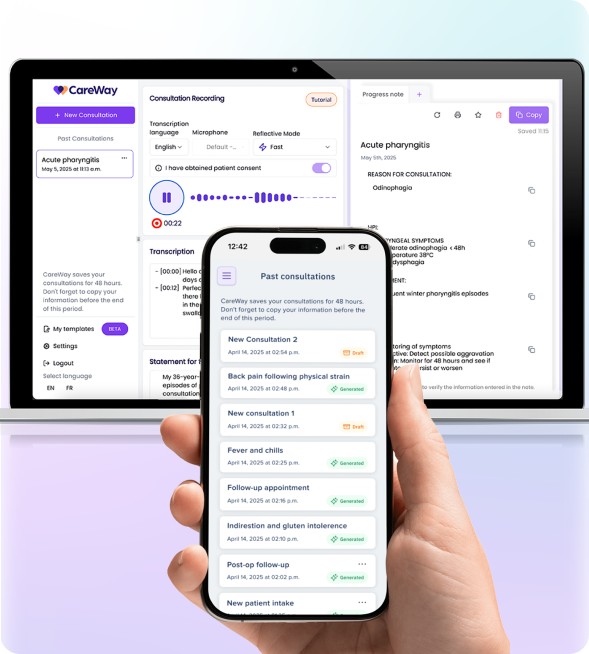
There is a distinction worth preserving here. Generating text is one task. Completing the clinical workflow is a larger one. MEDFAR is betting that owning both the record and the scribe will help with the latter. Its September 2026 article on administrative workload extends that same argument to the interruptions surrounding the consultation.
Monday morning is the real demo
MEDFAR sells MYLE through Essential, Premium and Elite license tiers. Premium adds the portal and analytics; Elite adds further connectivity tools. The public pricing page asks buyers to request a quote. A buyer therefore needs to match the package to the work. Alternatives include TELUS Health’s EMRs, QHR’s Accuro and WELLSTAR’s OSCAR Pro. OntarioMD’s August 2026 certification list includes MYLE alongside established offerings.
The company’s transition process covers customization, data migration, interface setup, training, on-site onboarding and follow-up. Those services address the difficulty of moving a functioning practice while it continues seeing patients. MEDFAR’s published workplace benefits include career-development plans and flexible schedules; its operational promise to customers depends on people doing implementation work as well as writing software.
Readers can copy a simple evaluation exercise: follow one appointment from booking through the final result. Count the handoffs. Check whether required provincial interfaces work, whether migrated records are usable and whether staff can finish their tasks. For AI notes, include consent and clinician review. A connected system earns its place when that ordinary sequence becomes easier to complete. The Tuesday after launch is an excellent place to find out.